Somewhere around 1750 BC, a man named Nanni had a scribe press a reed stylus into a slab of damp clay and tell a copper merchant exactly what he thought of him. Nearly 3,800 years later, Guinness World Records lists that letter as the oldest known written customer complaint, and the merchant who received it, Ea-nasir, has become one of the internet’s favourite villains.
The viral version, the one we shared too, pictures an ancient shopper so furious he carved his grievance into rock. It’s a great image. It just isn’t what happened. The real story is a dispute between business partners, a shipping operation hauling tonnes of copper up the Persian Gulf, and a house in Ur where the paperwork outlived everyone in it.
What the tablet actually says
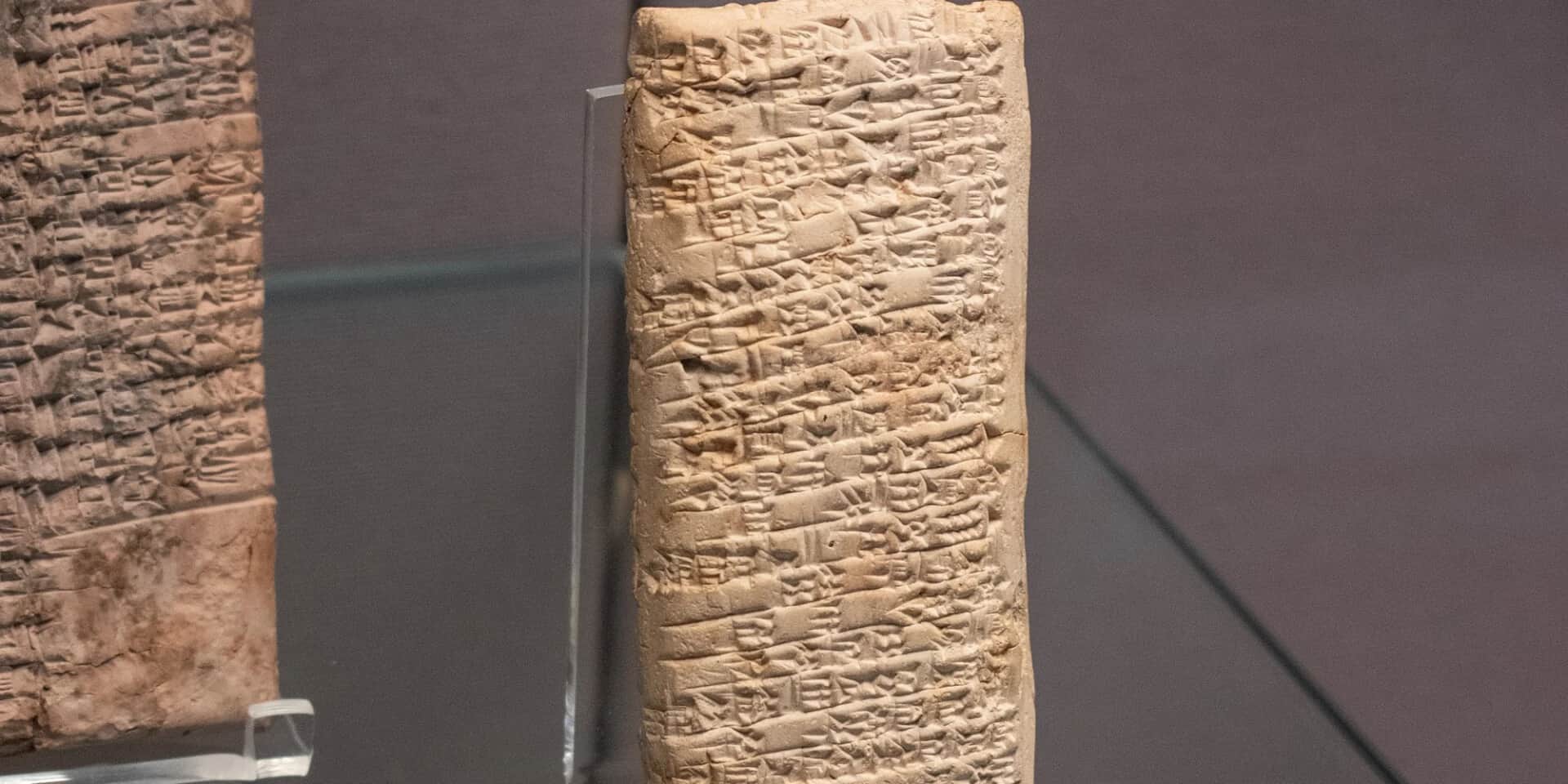
The letter is British Museum object 131236, a clay tablet about 11.6 centimetres tall, roughly the size of a phone. It was excavated at Ur, in what is now southern Iraq, and the museum dates it to about 1750 BC, in the Old Babylonian period. The Assyriologist A. Leo Oppenheim published a full English translation in 1967.
Nanni’s complaint is specific. Ea-nasir had promised that Nanni’s man would be given good-quality copper ingots. Instead, according to Nanni, he put poor ingots in front of the messenger and told him, in effect, to take them or leave. Nanni says he then sent other messengers to collect his money, and they were sent back empty-handed more than once, through hostile territory. He reminds Ea-nasir that he had handed over a large quantity of copper to the palace on his behalf. He wants his silver back, and he announces that from now on he will inspect every ingot himself, in his own yard, and reject anything that isn’t up to standard.
What do you take me for, that you treat somebody like me with such contempt?
— Nanni to Ea-nasir, c. 1750 BC (translated by A. Leo Oppenheim, 1967)
Strip away the cuneiform and it reads like an email from someone who has run out of patience: a broken promise, a rude staff member, a refund that never comes, and a vow to check everything personally next time. Personally, I think that’s why it lands so well. Nothing about it needs translating except the words.
It wasn’t a rock, and it wasn’t unusual effort
Here’s where the joke in the viral caption goes wrong. Nobody engraved anything. In Mesopotamia, clay was the ordinary writing surface. Letters, receipts, contracts and tax records were all written the same way, by pressing a stylus into soft clay, which then dried. Writing a tablet took about as much special effort as writing a letter does today. Nanni wasn’t so enraged he reached for a chisel. He was doing business.
The number is a little off too. “3,766 years” echoes the figure on the Guinness record page, but the British Museum’s “about 1750 BC” works out to roughly 3,775 years from 2026, and the Penn Museum’s W.B. Hafford thinks the letter is probably a bit older than that. Either way, it is close to four thousand years old.
The meme
An ordinary customer was so furious with a dodgy copper seller that he engraved a complaint into rock, and Ea-nasir kept a room full of complaints to gloat over.
The record
Nanni wrote a normal letter on clay, the standard medium of the day. He was an investor in Ea-nasir's trading missions, and only four of the twelve letters found in Ea-nasir's house are complaints, scattered through the house rather than stored together.
Nanni wasn’t a customer. He was an investor
The tablet was found by the archaeologist Leonard Woolley, who excavated Ur between 1922 and 1934 for the British Museum and the Penn Museum. In 1930 he uncovered a house he nicknamed No. 1 Old Street. Inside were 26 tablets dealing with a man called Ea-nasir and his copper trade, which is why the house is thought to have been his.
In August 2026, Hafford set out what the full set of tablets actually contains, and it changes the story. Most of it is ordinary business paperwork: seven lists of investments and investors, three lists of goods for export, two copper import lists, and two records of land purchases. Twelve are letters about copper imports, and just four of those are complaints. Two come from a man named Arbi-turam about the same deal, one from Ili-iddinam, and one from Nanni.
Ea-nasir's paperwork, by the numbers
Then there’s the detail that, for me, turns the meme on its head. One of the investor lists, now at the Penn Museum, names Nanni among the backers of one of Ea-nasir’s trading missions. It’s dated to the tenth year of King Rim-Sin of Larsa, around 1813 BC. All four complainers were investors in these ventures. This wasn’t a shopper ripped off at the market. It was an angry shareholder writing to the man running the business.
That doesn’t make Ea-nasir innocent. It does make the dispute more grown-up than the memes suggest: money had gone in, copper had come out, and Nanni felt he’d been handed the worst of it and then disrespected on top.
The copper came a very long way
Ea-nasir belonged to a group of merchants known as the alik Tilmun, the “Dilmun traders.” Dilmun was centred on what is now Bahrain, a Gulf trading hub. Bahrain has no copper of its own. Much of the metal that passed through it came from Magan, in today’s Oman, where Bronze Age miners worked the copper of the Hajar mountains. Ships carried it to Dilmun, and merchants like Ea-nasir bought it there and brought it up the Gulf and inland to Ur.
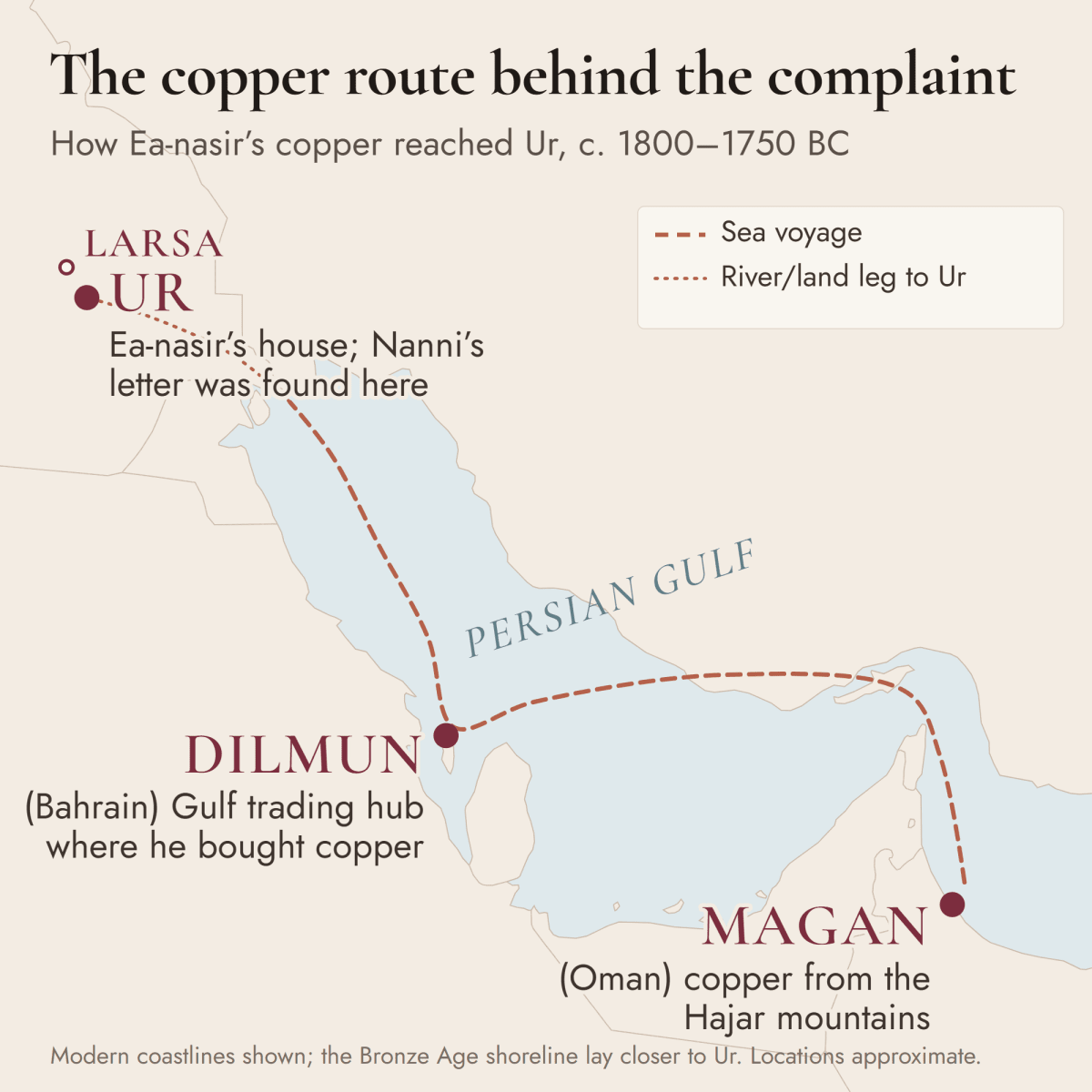
The scale matters. Hafford points to one import record that makes Ea-nasir responsible for more than 18,000 kilograms of copper on a single mission, and another showing he owed more than 5,000 kilograms in tax to the palace or temple at Larsa. When you’re loading that much metal onto ships in Bahrain, checking every ingot is close to impossible. At the end of a voyage, the copper was split among the investors, so somebody was always going to end up with the worst batch.
Does that excuse turning away Nanni’s messengers? No. But it explains why a man who dealt in tonnes of copper might generate a few furious letters without being the ancient world’s greatest con artist.
Did he keep the complaints to gloat?
The favourite internet theory is that Ea-nasir kept a room full of complaint tablets and re-read them for fun. It’s a funny idea. The evidence doesn’t support it. Hafford notes that the tablets weren’t found together in one room at all; they were scattered around the house, and some may even have ended up in the soil packed between floors when the building was remodelled, possibly after Ea-nasir’s death. A merchant also had good reason to keep correspondence alongside contracts in case of a legal dispute.
Gabriel Moshenska, a professor of public archaeology at University College London who published a study of the meme in January 2026, put it more bluntly to IFLScience: “I think it’s just business records!”
One more thing the memes get wrong: the stern, wide-eyed statue often used as Ea-nasir’s “face” is a Sumerian worshipper figure made around 2900–2600 BC, at least 800 years before he was born. Nobody knows what Ea-nasir looked like.
How a copper dealer became a legend
Moshenska’s paper, in the Journal of Contemporary Archaeology, traces how Ea-nasir became a meme that has outlasted most internet jokes by years. Part of the appeal is obvious: the gap between the ancient object and the painfully familiar complaint. Part of it, I suspect, is that he’s a villain nobody can actually hurt. He’s been dead for nearly four thousand years, and his bad reviews are in a museum.
If you’re planning to visit the tablet in London, check first. The British Museum lists it as on loan to the Zayed National Museum in Abu Dhabi from late 2025 into 2027, so the famous display case in the viral photo may be empty for a while.
Key dates
- c. 1813 BCNanni is listed as an investor in one of Ea-nasir's trading missions, on a tablet dated to the 10th year of Rim-Sin of Larsa.
- c. 1750 BCThe British Museum's date for Nanni's complaint letter; it may be somewhat earlier.
- 1922–1934Leonard Woolley excavates Ur for the British Museum and the Penn Museum.
- 1930Woolley uncovers No. 1 Old Street, the house with 26 tablets about Ea-nasir's copper trade.
- 1953The British Museum registers the tablet (1953,0411.71).
- 1967A. Leo Oppenheim publishes a full English translation in Letters from Mesopotamia.
- 2025–2027The tablet goes on loan to the Zayed National Museum in Abu Dhabi.
- 2026Gabriel Moshenska's study of the meme and the Penn Museum's breakdown of Ea-nasir's archive are published.
So, was Ea-nasir a crook?
Maybe, sometimes. Four complaints in a dozen surviving letters isn’t a great look, and Nanni’s letter describes behaviour that would get a business a one-star review today. But twelve letters can’t capture years of trade, two of the four complaints are about the same deal, and every complainer was an investor in a risky venture, not a helpless customer. As Hafford points out, the ancient world had cheats, and it also had chronic complainers.
The Bottom Line
- The tablet is real: a letter from Nanni to the copper merchant Ea-nasir, British Museum 131236, dated about 1750 BC.
- It is clay written with a stylus, the normal way to write a letter in Mesopotamia, not a complaint carved into rock.
- Nanni was an investor in Ea-nasir's Gulf trading missions, and only four of the twelve letters found in Ea-nasir's house are complaints.
- The copper came from Magan (Oman) via Dilmun (Bahrain), in shipments so large that checking every ingot was almost impossible.
Nanni didn’t carve a rock in a rage. He wrote a business letter on the everyday paper of his time, to a partner he felt had cheated him. That it still sounds like something you could send today is the whole point.
Read next: the Roman writer who described invisible disease creatures in 37 BC, whether ancient Egyptians really worshipped women as goddesses, and another viral legend we checked: Stoffel the honey badger.
Sources
- British Museum, collection record for tablet 131236 (registration 1953,0411.71)
- W.B. Hafford, “The Man Behind the Meme,” Penn Museum (August 13, 2026).
- A. Leo Oppenheim, Letters from Mesopotamia (University of Chicago Press, 1967), letter no. 12.
- A. Leo Oppenheim, “The Seafaring Merchants of Ur,” Journal of the American Oriental Society 74, no. 1 (1954)
- Gabriel Moshenska, “The Legend of Ea-Naṣir: How a Babylonian Businessman Became an Internet Meme,” Journal of Contemporary Archaeology 12, no. 1 (2026)
- Alfredo Carpineti, “Ea-nāṣir: How An Ancient Copper Merchant Became An Internet Star,” IFLScience (January 17, 2026).
- Guinness World Records, “Oldest written customer complaint”
- C. Leonard Woolley, “Excavations at Ur, 1930–31,” The Museum Journal, Penn Museum
- Pierre Lombard, Qal’at al-Bahrain, Ancient Capital and Harbour of Dilmun: The Site Museum (2018)
- UNESCO World Heritage Centre, “Qal’at al-Bahrain: Ancient Harbour and Capital of Dilmun”
- Cover photo: “Complaint tablet to Ea-Nasir, 2023” by Joel Bellviure, Wikimedia Commons (CC BY 4.0; cropped).