Ruby Bridges was six years old when she started having the same nightmare. A small box flew around her bedroom in the dark. She knew exactly what was inside it, because she had walked past it on the sidewalk outside her school: a baby's coffin with a black doll lying in it.
That memory is the core of a post that has been circulating on X this week, shared alongside a black-and-white photograph of grinning white adults crowding around an open coffin with a doll inside. The caption says the doll was meant to terrorize a six-year-old girl whose only offense was walking into a white school.
The story is true. Bridges has described it herself, more than once. The photograph is real too, and it comes from the same fight over the same schools in the same month. But it was not taken outside Ruby Bridges' school, and it was not taken in New Orleans at all.
What Ruby Bridges remembers
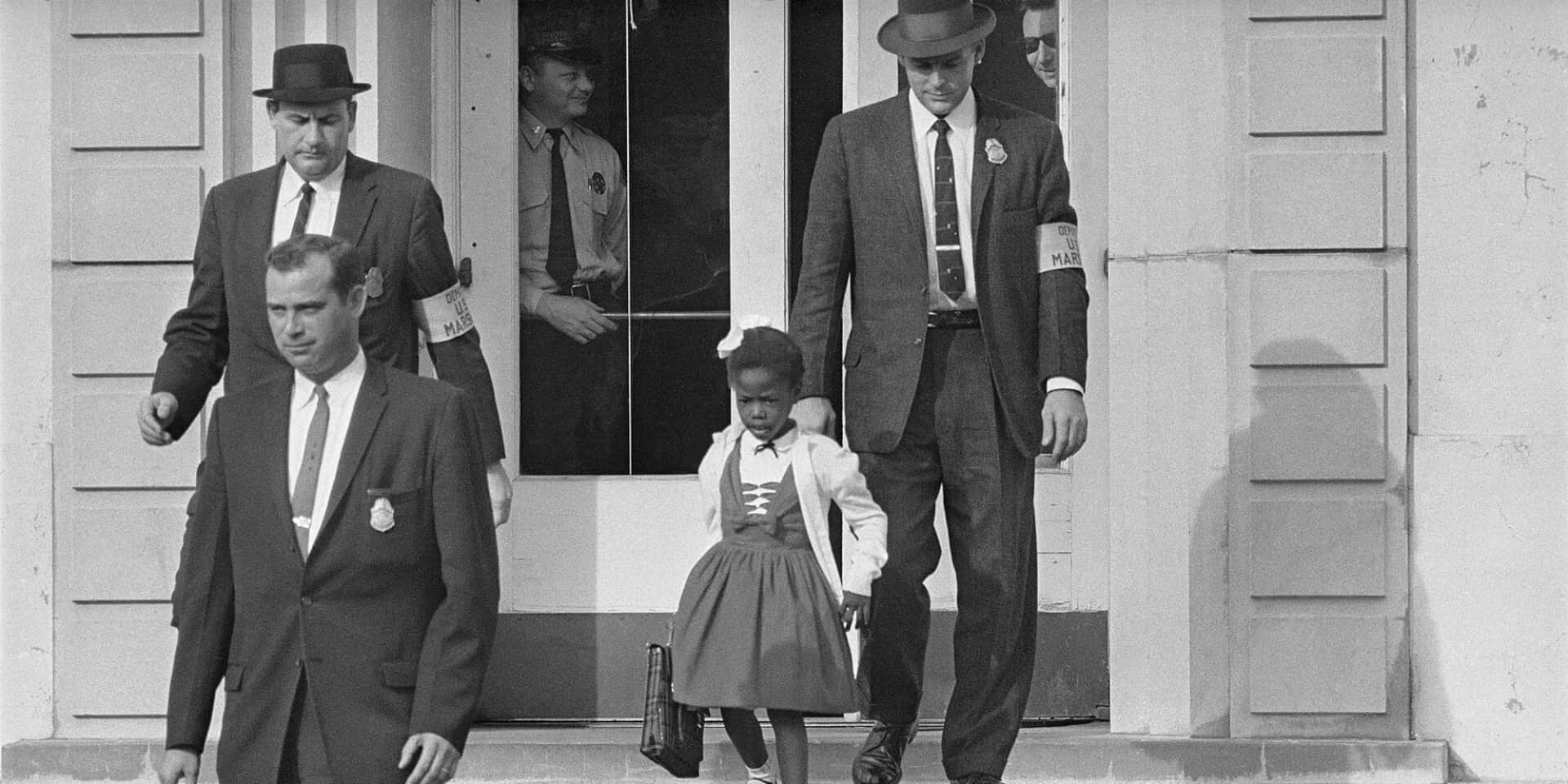
On November 14, 1960, Bridges became the first Black child to attend William J. Frantz Elementary School in New Orleans' Ninth Ward. A federal judge, J. Skelly Wright, had ordered the city's schools to begin desegregating that day. Three other six-year-old girls, Leona Tate, Gail Etienne and Tessie Prevost, entered McDonogh No. 19 Elementary a few blocks away. All four were escorted by federal marshals.
Bridges later said that when she first saw the barricades, the police and the crowds, she assumed it was Mardi Gras. It was not. White parents had gathered to scream at her, and many kept coming back. Women who called themselves the "Cheerleaders" stood outside Frantz and McDonogh No. 19 day after day, hurling insults and harassing the few white families who kept sending their children.
In a 2010 interview with NPR's Michel Martin, Bridges explained what frightened her most. On some days, she said, the crowd brought a box that "was actually a baby's coffin," with a black doll placed inside, and she had to walk past it to get to the door. She told The Guardian in 2021 that the image followed her home at night.
I would dream that the coffin was flying around my bedroom at night.
— Ruby Bridges, recalling the doll in the coffin, The Guardian (2021)
The coffin was one threat among several. One woman said she would poison her, which is why Bridges ate only food brought from home and was kept inside at recess. Her father lost his job. A grocery store refused to serve the family. White parents pulled their children out of Frantz almost entirely, and from January to May of 1961 Bridges was the only student in attendance, taught alone in a classroom by her teacher, Barbara Henry.
Where the viral photo was actually taken
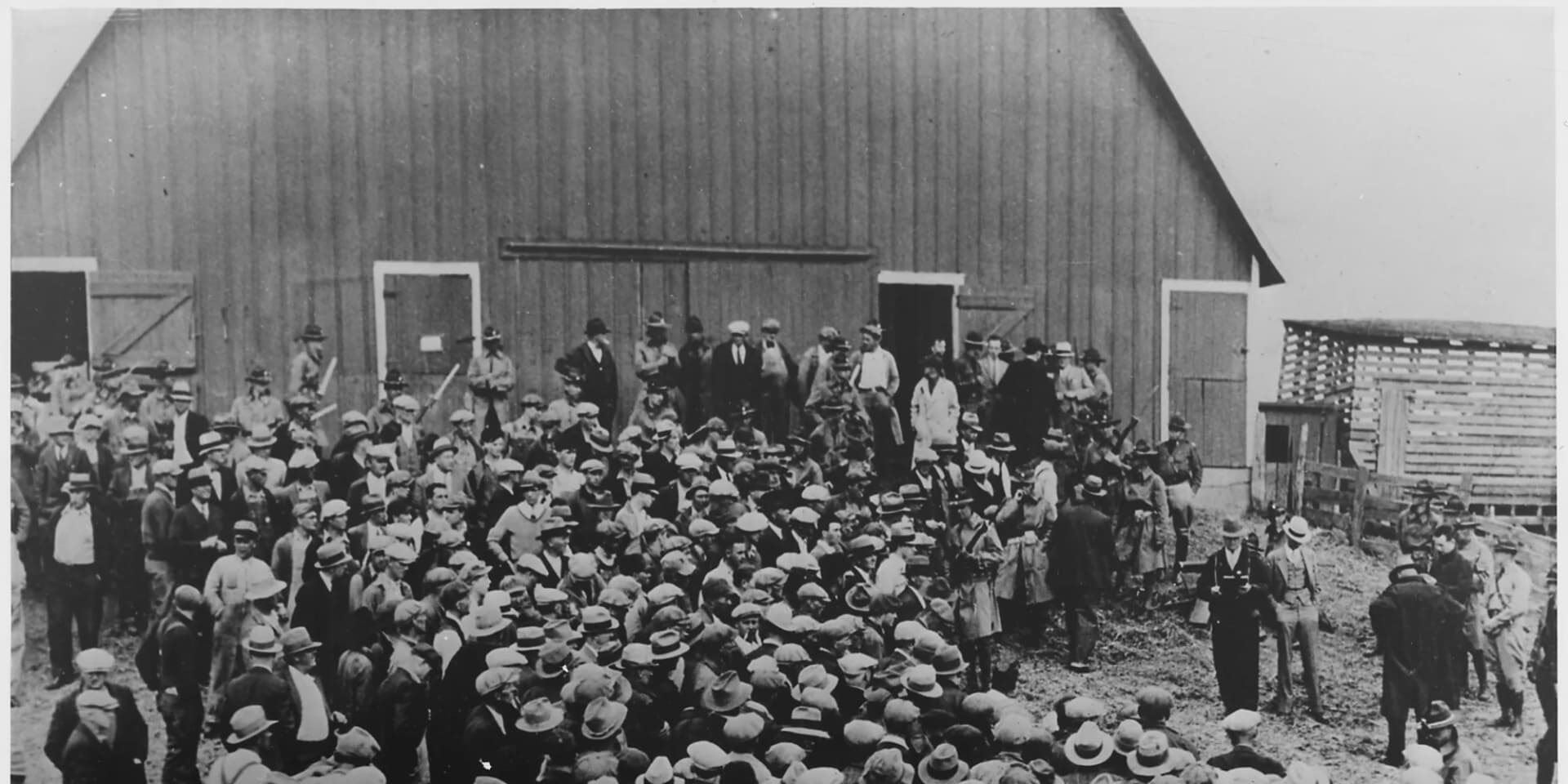
The photograph in the post belongs to the Associated Press. Its original caption, preserved in the AP archive and traced by Snopes in 2024, describes something more specific than a protest on a school sidewalk.
According to that caption, parents of children at the two newly integrated New Orleans schools staged a mock funeral procession up the steps of the Louisiana State Capitol in Baton Rouge on November 23, 1960. The "funeral" was for Judge Wright, whose order had integrated the schools. Three busloads of demonstrators had come up from New Orleans, carrying small black flags, to back the state legislature, which was meeting in special session to fight his ruling.
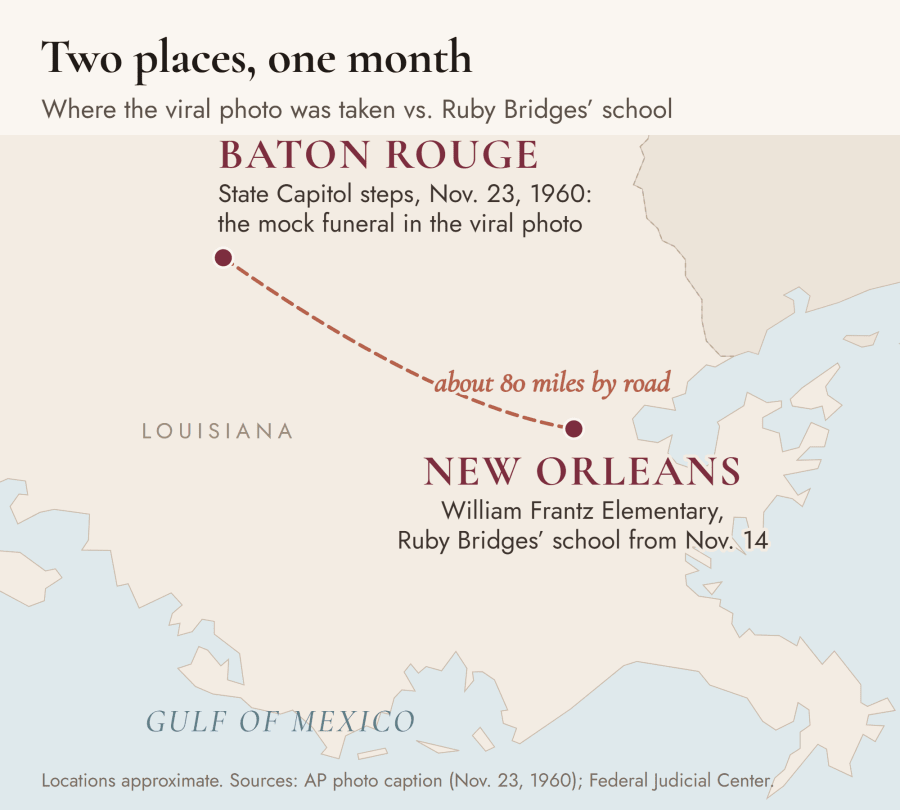
So the laughing people in the picture were not lining Ruby Bridges' route that morning. They were roughly 80 miles away, on the Capitol steps, mocking the federal judge who had opened the school door to her.
What the post implies
The photo shows segregationists taunting six-year-old Ruby Bridges with a black doll in a coffin as she walked into William Frantz Elementary in New Orleans.
What the record shows
Bridges did walk past a doll in a coffin outside her school, by her own account. This photo, though, is an AP picture of a mock funeral for Judge J. Skelly Wright on the Louisiana Capitol steps in Baton Rouge on Nov. 23, 1960.
Why the mix-up is understandable, and why it still matters
It is easy to see how the two stories merged. The photo shows the same prop Bridges described, in the same month, from the same crisis. The demonstrators were New Orleans parents whose anger was aimed squarely at the integration of her school and McDonogh No. 19. Snopes, which rated the popular caption a "mixture," noted it was possible the coffin in the Baton Rouge picture was the same one Bridges saw, but that no evidence confirms it.
Bridges' 1999 book, Through My Eyes, includes a different photograph of segregationists with a coffin and doll, in which one person holds a sign reading "Thank God for State Legislation." Where and when that picture was taken has never been firmly established, and no verified photo has surfaced of the coffin on the sidewalk outside Frantz Elementary.
None of that softens what happened to her. If anything, the real location widens the picture. The doll in the coffin was not one cruel neighbor's stunt. It was a piece of political theater carried from a school sidewalk to the steps of the state government, where elected officials were passing law after law to keep four little girls out of white classrooms.
The state that fought a first-grader
Louisiana's resistance ran far above the crowd. Governor Jimmie Davis called the legislature into special session in early November 1960, and within days it had passed a stack of measures meant to stop or stall integration, including an "interposition" resolution declaring the federal courts' desegregation rulings a usurpation of power. On the night of November 13, Judge Wright issued restraining orders against the entire 140-member legislature, the governor and other state officials, barring them from interfering with the schools the next morning.
The legislature kept going. On November 14, the day the girls walked in, it voted again to remove the elected Orleans Parish School Board. The next evening, about 5,000 people packed a Citizens' Council rally in New Orleans, where Plaquemines Parish political boss Leander Perez urged the crowd, in openly racist language, to "do something about it now." A week later, the mock funeral reached the Capitol steps.
The fight over four first-graders
- Nov. 4, 1960Gov. Jimmie Davis's special legislative session opens to block New Orleans school desegregation.
- Nov. 13, 1960Judge J. Skelly Wright issues restraining orders against the entire Louisiana legislature, the governor and other officials.
- Nov. 14, 1960Ruby Bridges enters William Frantz Elementary; Leona Tate, Gail Etienne and Tessie Prevost enter McDonogh No. 19, all with federal marshals.
- Nov. 15, 1960About 5,000 people attend a Citizens' Council rally in New Orleans against desegregation.
- Nov. 23, 1960New Orleans parents stage a mock funeral for Judge Wright on the State Capitol steps in Baton Rouge. This is the viral photo.
- Jan.–May 1961With white families boycotting, Bridges is the only student attending Frantz Elementary.
The legal challenges failed. Bridges returned to Frantz for second grade in the fall of 1961, when other Black children and returning white students joined her, and she finished elementary school there. The marshals were gone by then. So, eventually, was the crowd.
The bottom line
The claim in the post holds up: segregationists did use a black doll in a coffin to frighten six-year-old Ruby Bridges, and she remembered it as the thing that scared her most. The photograph attached to it, however, does not show that moment. It shows a mock funeral on the Louisiana State Capitol steps in Baton Rouge on November 23, 1960, staged by New Orleans parents furious at the judge who integrated her school.
Both things are history. They just happened 80 miles apart.
Read next: The acting school in segregated Atlanta that said yes to Black students · San Diego's real ant war, and the viral picture that isn't · The true story behind the Joseph Merrick skull photo
Sources
- NPR, "Wisdom From A Trailblazer: Ruby Bridges Talks Racism In Education," Tell Me More with Michel Martin, Dec. 1, 2010. npr.org
- Snopes, "1960s Pic Shows Segregationists Harassing Ruby Bridges with Doll Inside Coffin?" (Sean Eifert, July 21, 2024), including the AP caption and The Guardian (2021) quote. snopes.com
- Associated Press photo archive, mock funeral procession for Judge J. Skelly Wright, Louisiana State Capitol, Baton Rouge, Nov. 23, 1960 (AP Photo).
- Federal Judicial Center, "Bush v. Orleans Parish School Board and the Desegregation of New Orleans Schools." fjc.gov
- Nikki Brown, "Ruby Bridges," 64 Parishes (Louisiana Endowment for the Humanities). 64parishes.org
- PBS American Experience, "Ruby Bridges and Integration of New Orleans Schools." pbs.org
- PBS, "Ruby Bridges Goes to School," The African Americans: Many Rivers to Cross. pbs.org
- National Women's History Museum, "Ruby Bridges." womenshistory.org
- NPR, "60 Years Later, Ruby Bridges Tells Her Story In 'This Is Your Time'," Nov. 7, 2020. npr.org
- Images: Ruby Bridges with U.S. marshals, uncredited U.S. Department of Justice photographer, 1960, public domain (17 U.S.C. § 105), via Wikimedia Commons, restoration by Adam Cuerden. Location map: The Verified Post, base map from US Census boundaries via us-atlas.