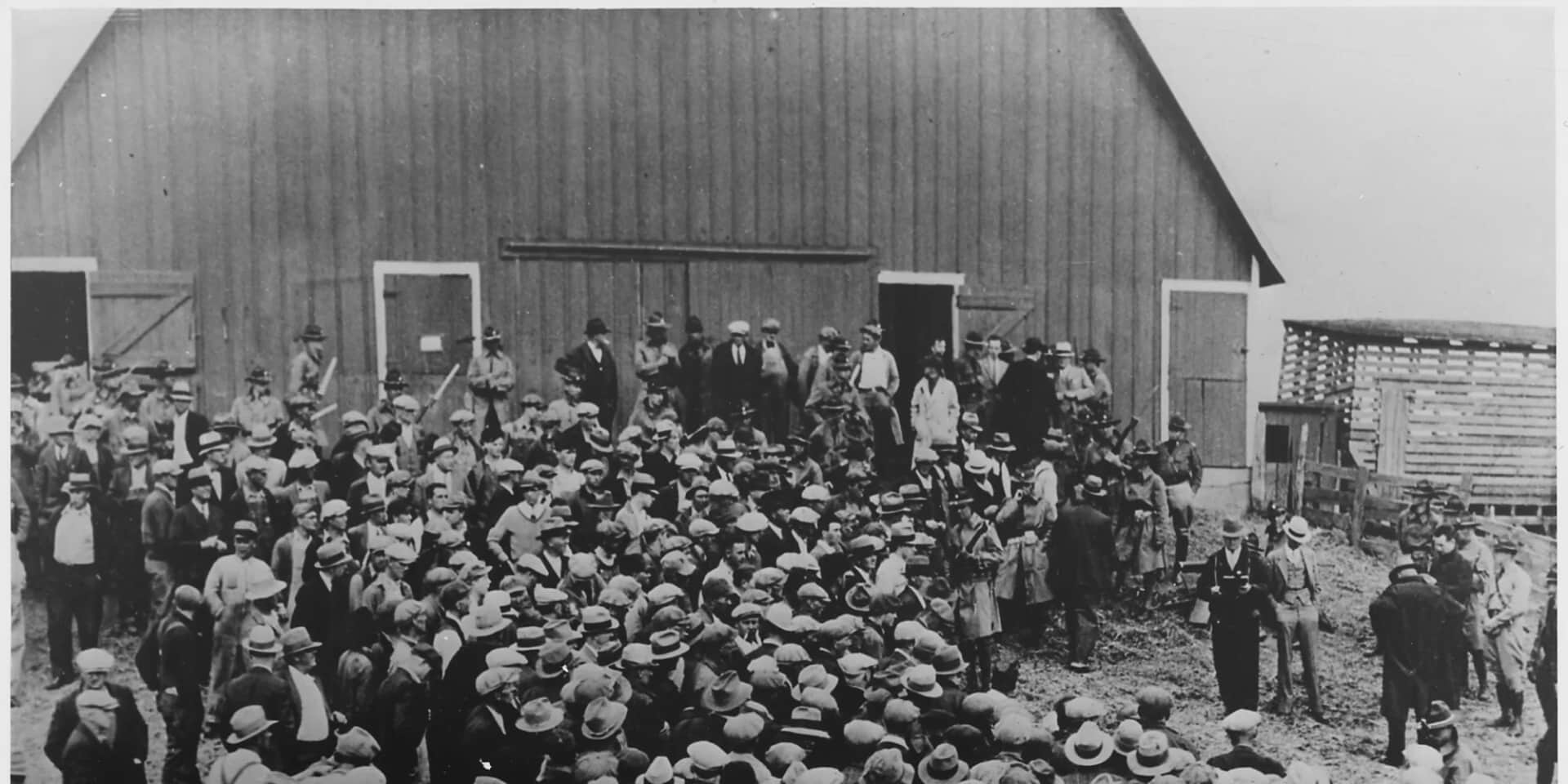
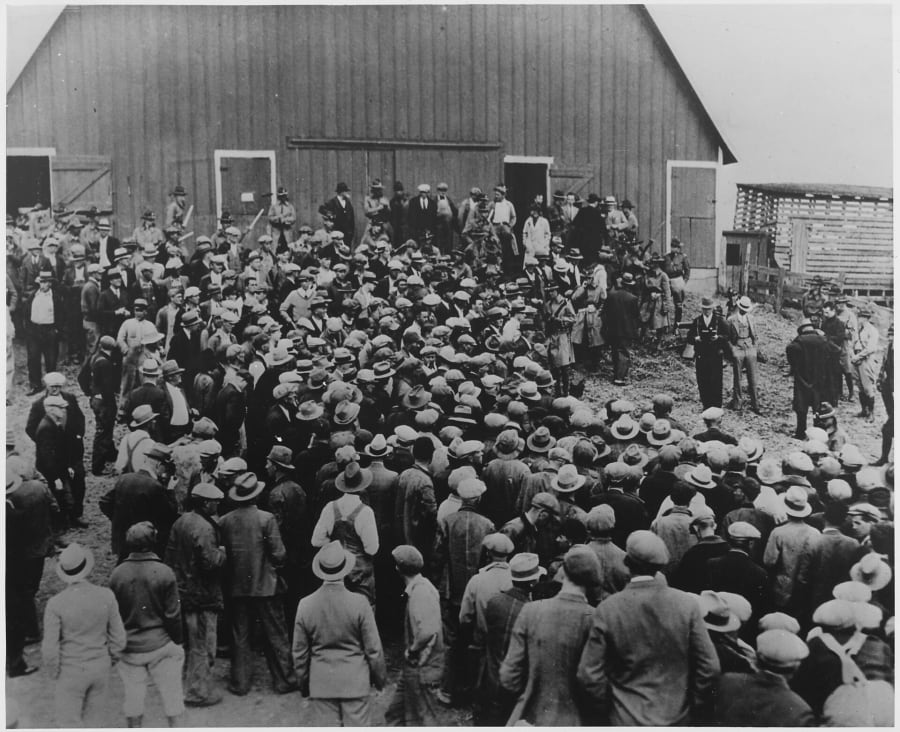
The auctioneer holds up a 16-year-old mare and asks for an opening bid. A few hundred farmers stand in the mud and say nothing. Finally someone offers two dollars. The mare goes back to her own owner for fifteen. Three more horses go for ten dollars, eight dollars and a dollar and a half; the machinery for a dollar, fifty cents, a quarter. Every item ends up back with the family it was being taken from.
That scene, witnessed by a reporter for The Nation in Iowa in early 1933, is what the viral post is describing. It says that during the Great Depression neighbors would gather at foreclosure sales, hang nooses to scare off outside bidders, buy the farm for a few cents and return it to the family. That's substantially true. But the real story is a little different from the caption, and the famous photo comes with a mystery of its own.
Why farmers were losing everything
Farm country was in trouble long before Wall Street crashed. Farmers had borrowed to expand during World War I, then crop prices collapsed in the 1920s. When the Depression hit, prices fell further and mortgages and loans that had looked manageable became impossible.
Lenders foreclosed. A sheriff would serve the papers and schedule an auction of the land, livestock and machinery pledged against the debt, and the bank would take what the sale raised. According to the American Social History Project, about 750,000 farms were lost through foreclosure and bankruptcy sales between 1930 and 1935. Iowa and the northern Plains were hit especially hard.
How a penny auction worked
The idea was simple. If a farmer's neighbors turned up in large enough numbers and refused to bid more than pennies, the sale would raise almost nothing. Whoever "won" each item would then give it back to the family. The bank got its legal sale but almost no money, and the farmer kept his means of making a living.
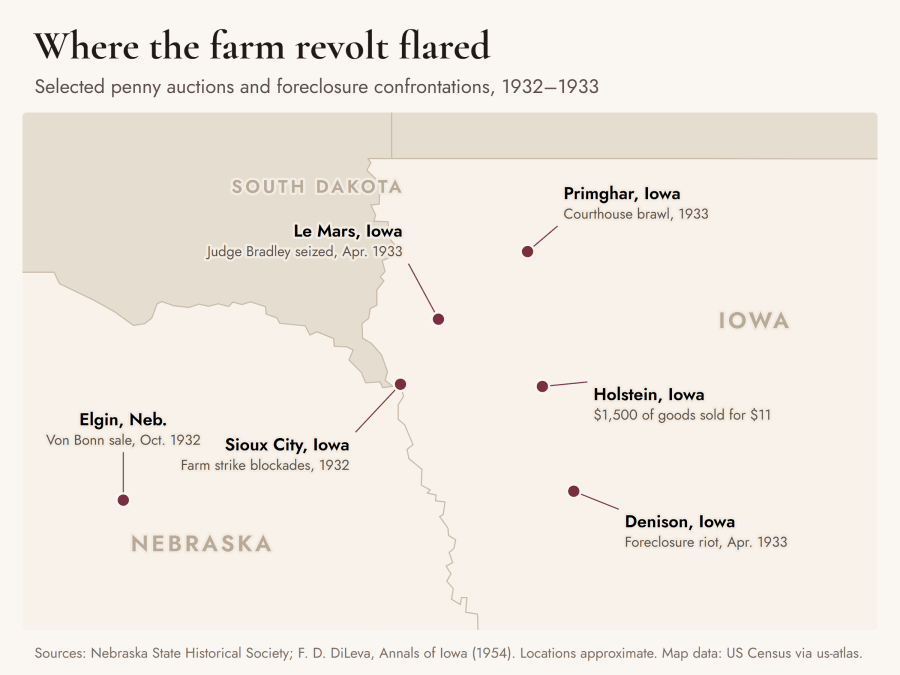
The Nebraska State Historical Society records one of the best-known early examples: on October 6, 1932, nearly 3,000 farmers gathered at the Von Bonn farm near Elgin, Nebraska, stood silently and declined to bid at a chattel mortgage sale. Members of the farm protest movement negotiated a settlement that left the property with the widow Theresia Von Bonn. Accounts of that sale put the proceeds at just $5.35.
The tactic spread fast. In northwest Iowa, according to a 1954 history in the Annals of Iowa, farmers at Holstein bought about $1,500 worth of goods for $11. Elsewhere, crowds of a thousand or more simply forced sales to be postponed.
Yes, there were nooses
The nooses aren't an internet embellishment. In February 1933 a United Press dispatch reported that wherever mortgage sales were scheduled, farmers turned up together, bought the property at "penny" prices and returned it to the owner, and that in several cases nooses had been hung from barns and trees near the auction block as warnings to outsiders thinking of raising the bids.
Most of the time, the rope was theater. The Nation's reporter wrote that farmers' main weapon was sheer numbers and that it was doubtful the ropes would be used except as a threat. Intimidation was real, though: would-be bidders were warned off, and sheriffs and lawyers were sometimes manhandled.
And at least once, the threat was nearly carried out. In late April 1933, a crowd of farmers in Le Mars, Iowa, angry about foreclosures, dragged District Judge Charles C. Bradley from his courtroom when he refused to promise to stop signing foreclosure orders. They drove him to a crossroads, put a rope around his neck and briefly hoisted him before letting him go, beaten and humiliated. The same week, a foreclosure sale near Denison turned into a riot. Iowa's governor sent in the National Guard and declared martial law in the affected counties.
The silence of the farmers is like a thick wall.
— Ferner Nuhn, describing an Iowa foreclosure sale in The Nation, 1933
The caption needs two corrections
First, it usually wasn't "the farm" being bought for pennies. Many penny auctions were chattel sales: livestock, machinery, tools and household goods pledged against a loan, rather than the land itself. Saving a family's horses and plows still mattered enormously; without them, a farmer couldn't work even rented land. Where land was at stake, crowds more often forced sales to be postponed or pressured lenders into settlements, rent deals or delays.
Second, the photo isn't documented the way it's shared. The image of two nooses hanging in a barn doorway above a crowd is real. A copy is held by the Library of Congress in its Farm Security Administration files, captioned as a warning to prospective bidders on a foreclosed farm and noting that many farms sold for only a few cents until the Farm Debt Adjustment Committee came into being. But the record lists no photographer and no location, and dates it only to June 1936. The negative is a copy of an older print, and the snow and heavy winter coats suggest it was taken in winter, so 1936 is probably when the government filed it, not when it was shot. Versions online that confidently place it in Michigan in 1936 don't cite a source.
The viral caption
Neighbors hung nooses to scare away outside bidders, bought the farm for a few cents and returned it to the family who had lost it.
What the record shows
Accurate in spirit. Crowds bid pennies and returned property, and nooses were used as warnings. But most sales involved livestock and equipment, not land, and the famous photo's date and location are unrecorded.
Did it work?
Locally, often yes. Families kept their animals and machinery, and lenders learned that foreclosing in certain counties would be slow, ugly and unprofitable. The farm protest group most associated with the movement, the Farmers' Holiday Association led by Iowa's Milo Reno, probably had its greatest success here rather than in its attempted farm strikes.
The bigger impact was political. The Encyclopedia of the Great Plains notes that the protests pushed major lenders to temporarily halt foreclosures and helped win statewide foreclosure moratoriums in Nebraska, South Dakota and Minnesota; Iowa passed one as well. Under Franklin Roosevelt, new federal farm credit and debt-adjustment programs followed, and the penny auctions faded.
Personally, I think what makes this story stick is how unglamorous the weapon was. It wasn't guns, and mostly it wasn't even the rope. It was a few hundred farmers standing in a barnyard and refusing, together, to bid more than a nickel, then giving everything back to a family down the road.
Penny auctions, by the numbers
The farm revolt, 1932–1933
- Aug 1932The Farmers' Holiday Association's farm strike begins, with blockades around Sioux City and Omaha.
- Oct 6, 1932Nearly 3,000 farmers refuse to bid at the Von Bonn sale near Elgin, Nebraska.
- Winter 1932–33Penny auctions and blocked sales spread across Iowa and neighboring states; nooses appear as warnings.
- Feb 1933Wire services report farmers in a dozen Midwestern states resisting foreclosure sales.
- Late Apr 1933Judge Charles Bradley is seized at Le Mars; a sale near Denison turns into a riot. Iowa declares martial law in three counties.
- 1933Foreclosure moratoriums and New Deal farm credit programs take the heat out of the revolt.
Read next: The long history of giving, from Carnegie to Rockefeller · The acting school in segregated Atlanta that said yes · Ea-nasir and the world's oldest customer complaint
Sources
- Nuhn F. "Like a Thick Wall": Blocking Farm Auctions in Iowa, The Nation (March 1933), via the American Social History Project's Who Built America?
- DiLeva FD. "Attempt to Hang an Iowa Judge." Annals of Iowa 32 (July 1954).
- Nebraska State Historical Society, "Penny Action at Von Bonn Farm, 1932 October 6" (archival record).
- Encyclopedia of the Great Plains, "Farmers Holiday Association" (University of Nebraska–Lincoln).
- Wessels Living History Farm, "Penny Auctions"; Nebraska Studies, "Nickel Auctions".
- United Press dispatch, "Farmers Resist Selling of Land for Back Taxes," Feb. 3, 1933, as printed in the Franklin (Pa.) News-Herald.
- Library of Congress, FSA/OWI Collection, call number LC-USF344-003357-ZB, as catalogued by Photogrammar (Yale University).
- NPR, "Fending off Foreclosures with Penny Auctions" (2007), interview with historian Hyman Berman.
- Images: Farm foreclosure sale in Iowa, c. 1933, National Archives, Wikimedia Commons, public domain. Map, The Verified Post.