In the summer of 1965, a fifteen-year-old boy named Phillip DePoy kissed a girl onstage in Atlanta, Georgia. Ten yards away, a Buick exploded.
The girl was Yolanda King — daughter of Martin Luther King Jr. and Coretta Scott King. The boy was white. The stage was the flatbed of a truck converted into a performance space, parked in the Carver Homes housing project on a warm summer afternoon. The audience was made up of children from the neighbourhood, their parents, a few dogs, and one man who had returned with something in a box — the kind of box, DePoy would later write, that his ideological brothers had used two years earlier to kill four children in a church in Birmingham.
The Buick caught fire. The explosion was not large. The smoke drifted away from the project toward the highway. Yolanda blinked, said something that DePoy recalled as sounding like "gosh," and did her funny little dance again. The children in the audience laughed.
Walter Roberts stepped to the side of the stage, said something to the crowd that DePoy could not hear from where he stood, and got a laugh and some applause. Then Walter turned back to his young actors.
"And the next line is?" he said.
The show continued.
The Only Integrated Theater in the South
Walter Grady Roberts and Betty Lou Bredemus were not famous people. They were not wealthy people. Walter had received a Guggenheim grant for children's theater — a signal of serious artistic credentials in mid-century America — and the two of them had built something unusual and fragile in the middle of one of the most racially divided cities in the American South: the Actors and Writers Workshop.
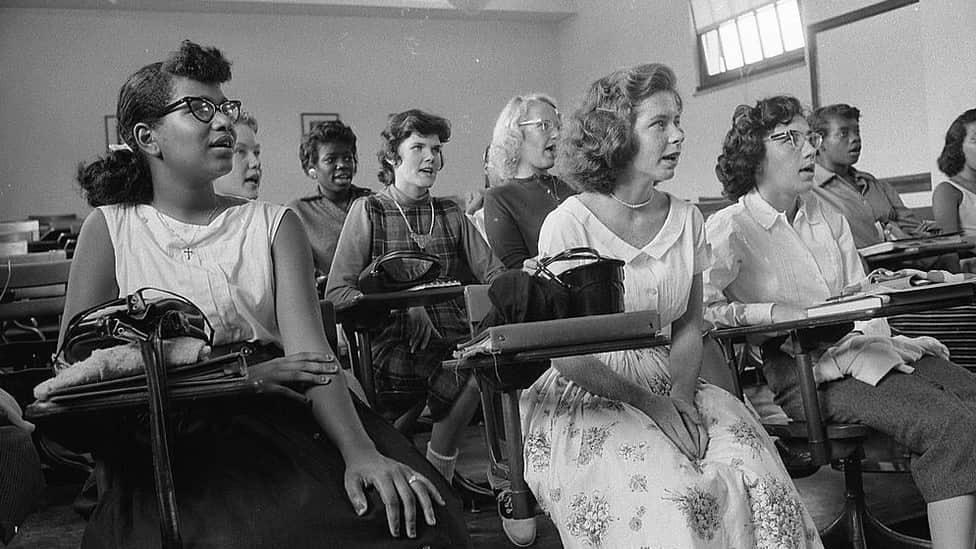
Atlanta in the early 1960s was a city of formal segregation and informal violence. Black children and white children did not share classrooms. They did not share water fountains. They did not share stages. The rules about who could sit where, learn where, perform where, were enforced not only by law but by the threat of consequences that everyone in the city understood and most people were careful not to test.
Walter and Betty Roberts ran the only integrated children's theater company in Atlanta. Possibly the only one in the South. It was not a political organization and it was not a civil rights organization. It was a theater school — teaching children to write, perform, and inhabit other lives for the duration of a play. They accepted whoever showed up and showed promise, regardless of what the city's social architecture said about who was supposed to sit next to whom.
This was not a small thing. It was, in the context of Atlanta in 1963, an act that required either extraordinary courage or extraordinary indifference to the consequences — and possibly both.
Mr. Roberts was so imposing. I loved him, but I was also a little intimidated by him too. He taught me so much — about the work, and just about living and being really open, grabbing life and making the best of it.
— Yolanda King, daughter of Martin Luther King Jr. and Coretta Scott King, speaking about Walter Roberts in a 2001 CNN interview
The Phone Call That Started Everything
At some point in the early 1960s, Coretta Scott King picked up the telephone and called Betty Lou Roberts.
The Kings were not struggling to find opportunities for their children in the way that most Black families in Atlanta struggled. Martin Luther King Jr. was already one of the most prominent figures in America. They had resources, connections, and a level of public visibility that offered a degree of protection unavailable to ordinary Black families in the South. And yet even the children of Martin Luther King Jr. could not find an acting school in Atlanta that would accept them.
Coretta Scott King had heard about the Actors and Writers Workshop. She asked Betty Lou Roberts if her children could be part of it.
Betty Lou said yes. Come on over.
The King children — Yolanda, Martin III, Dexter, and Bernice — joined the workshop. Yolanda, the eldest, became deeply embedded in its life. She was cast in plays. She performed alongside white children. Walter Roberts gave her the same demanding instruction he gave everyone, and she loved and feared him for it in equal measure, as students tend to love and fear the teachers who take them seriously.
The two families became friends. In a city where the social architecture was designed specifically to prevent this kind of relationship from forming, Betty Lou Roberts and Coretta Scott King became close. Their children performed together. Their households were connected by the ordinary intimacies of friendship — shared meals, shared concerns, shared time.
What that friendship cost the Roberts family in social terms — in the eyes of white Atlanta neighbours, in the hostility it attracted, in the danger it placed the school and its students in — is something the historical record does not fully document. The Buick in the Carver Homes parking lot gives some indication.
The Box in the Parking Lot
Phillip DePoy's 2013 essay for Arts ATL — written nearly fifty years after the events it describes — is one of the most vivid primary documents about what the Actors and Writers Workshop actually meant to the people inside it, and what it cost to exist.
DePoy describes the man who returned to the Carver Homes parking lot the day after witnessing him kiss Yolanda King onstage. He came back, DePoy wrote, with a box — the kind his ideological brothers had used two years earlier to kill four children in the 16th Street Baptist Church bombing in Birmingham in September 1963. Whether the man intended to place it under the flatbed truck, DePoy could not say. There were too many people in the parking lot — too many children and parents and dogs and police — and so he planted it in the nearest available target, which happened to be a Buick.
The explosion was not large. The car caught fire. The smoke blew away. Most of the crowd, DePoy recalled, responded with remarkable mildness — the practiced calm of people who had learned not to give violence the satisfaction of panic.
Yolanda King blinked. Said something quiet. Did her funny little dance. The children laughed.
Walter Roberts got a laugh from the crowd, turned back to his actors, and asked for the next line.
In 2001, Yolanda King spoke about the workshop in an interview with CNN. She described what Walter Roberts had given her — not just technique, not just craft, but something harder to name: a way of being open in the world, of grabbing life and making the best of it. She said she loved him. She said she was also a little intimidated by him. She said the Black kids and the white kids had no racial problems with each other whatsoever.
Yolanda King died in 2007, at the age of 51, from complications related to a heart condition. She had spent her life, as DePoy predicted she would, involved in theater.
Walter Roberts stepped to the side of the stage, said something to the crowd that got a laugh and some applause, then turned back to his young actors. "And the next line is?" A car was burning in the parking lot. The show continued.
The Hospital Bill
On October 28, 1967, Betty Lou Roberts gave birth at Crawford Long Hospital in Atlanta. The baby was the couple's third child — they already had a son, Walter Jr., and another son named Eric who would go on to study at the Royal Academy of Dramatic Art in London. This new daughter they named Julia Fiona.
Walter and Betty Lou Roberts could not pay the hospital bill.
The Actors and Writers Workshop had never been financially stable. Running the only integrated children's theater in the South was not, as it turned out, a commercially lucrative undertaking. The school operated on grants, goodwill, and the commitment of people who believed that what they were doing mattered more than whether it paid.
Martin Luther King Jr. and Coretta Scott King paid the bill.
They did it because they were friends. Because the Roberts family had opened a door in segregated Atlanta that almost no one else would open, and the Kings had walked through it, and something real and durable had grown from that. They did it the way friends help friends — quietly, without ceremony, without any apparent expectation that it would be remembered or repeated or turned into a story that would circulate for decades.
Less than six months later, on April 4, 1968, Martin Luther King Jr. was assassinated on the balcony of the Lorraine Motel in Memphis, Tennessee. He was thirty-nine years old. The baby whose first days he had helped pay for was not yet six months old.
What Happened to the People in the Story
The Actors and Writers Workshop eventually closed — financial pressures that had always been present became insurmountable. Walter and Betty Lou Roberts divorced. Walter Roberts died in 1977.
Phillip DePoy became an award-winning playwright and novelist. His brother Scott continued working in theater across the American Southeast. Eric Roberts went to London, studied at the Royal Academy of Dramatic Art, and built a long career as an actor.
The story of the hospital bill was not a secret, exactly — it had surfaced periodically over the years — but it did not become widely known until September 2022, when Julia Roberts mentioned it at a History Channel event in Washington, D.C., in conversation with journalist Gayle King. A clip circulated on social media. Bernice King — the youngest daughter of Martin Luther King Jr. and Coretta Scott King — confirmed it publicly, writing that she knew the story well and that it was moving to be reminded of her parents' generosity and influence.
Snopes rated the story as true. NPR covered it. The Smithsonian covered it. CBS News covered it. For a few days in the autumn of 2022, millions of people learned something that the people closest to it had known for fifty-five years: that two families in Atlanta had decided, quietly and without any particular fanfare, that what connected them was stronger than what the city around them had been built to keep apart.
The Actors and Writers Workshop is long gone. But the story of what happened there — the King children learning their craft alongside white children in a city that forbade it, the Buick in the Carver Homes parking lot, the show that continued anyway, the hospital bill paid by friends — that story has not gone anywhere.
Kindness operates on a long timeline. It rarely knows in advance what it is setting in motion.
The Point
Walter and Betty Lou Roberts did not open their theater school to Black children because they were calculating a return on that investment. They opened it because Coretta Scott King called and asked, and the answer was yes. What followed — the friendship, the Buick in the parking lot, the hospital bill, the children who grew up in that room together — none of it was planned. It was just what happens when ordinary people make a decision to treat other people as fully human in a system specifically designed to prevent that. The school is gone. The people who ran it are gone. But on a warm summer afternoon in 1965, a car exploded in a parking lot in Atlanta, a girl blinked and said "gosh," and the show continued. That is the part that does not go away.
Read next: The forgotten history of the idea that dying rich is a disgrace, and why Rachel McAdams stepped away from Hollywood.
Sources
- NPR — Martin Luther King Jr. paid the bill for Julia Roberts' birth. Here's the backstory — npr.org (November 2022)
- Smithsonian Magazine — Actress Julia Roberts Reveals an Unlikely Connection to Martin Luther King Jr. — smithsonianmag.com (November 2022)
- CBS News — Julia Roberts reveals Martin Luther King Jr. and Coretta Scott King paid for her parents' hospital bill — cbsnews.com (October 2022)
- Snopes — Did Martin Luther King Jr. Pay the Hospital Bill for Julia Roberts' Birth? — snopes.com (rated True)
- TODAY — Julia Roberts says Martin Luther King Jr. and Coretta Scott King paid the hospital bill for her birth — today.com (October 2022)
- Phillip DePoy — Essay: Academy Theatre, Julia Roberts' parents laid foundation for blossoming of theater in Atlanta — Arts ATL (2013)
- Arts ATL — Preview: Atlanta writer Phillip DePoy brews up "Edward Foote" — artsatl.org
- CNN — 2001 profile of Julia Roberts including interview with Yolanda King — transcript referenced via Snopes and Yahoo News
- Bernice King — public statement confirming the story — Twitter/X, October 2022