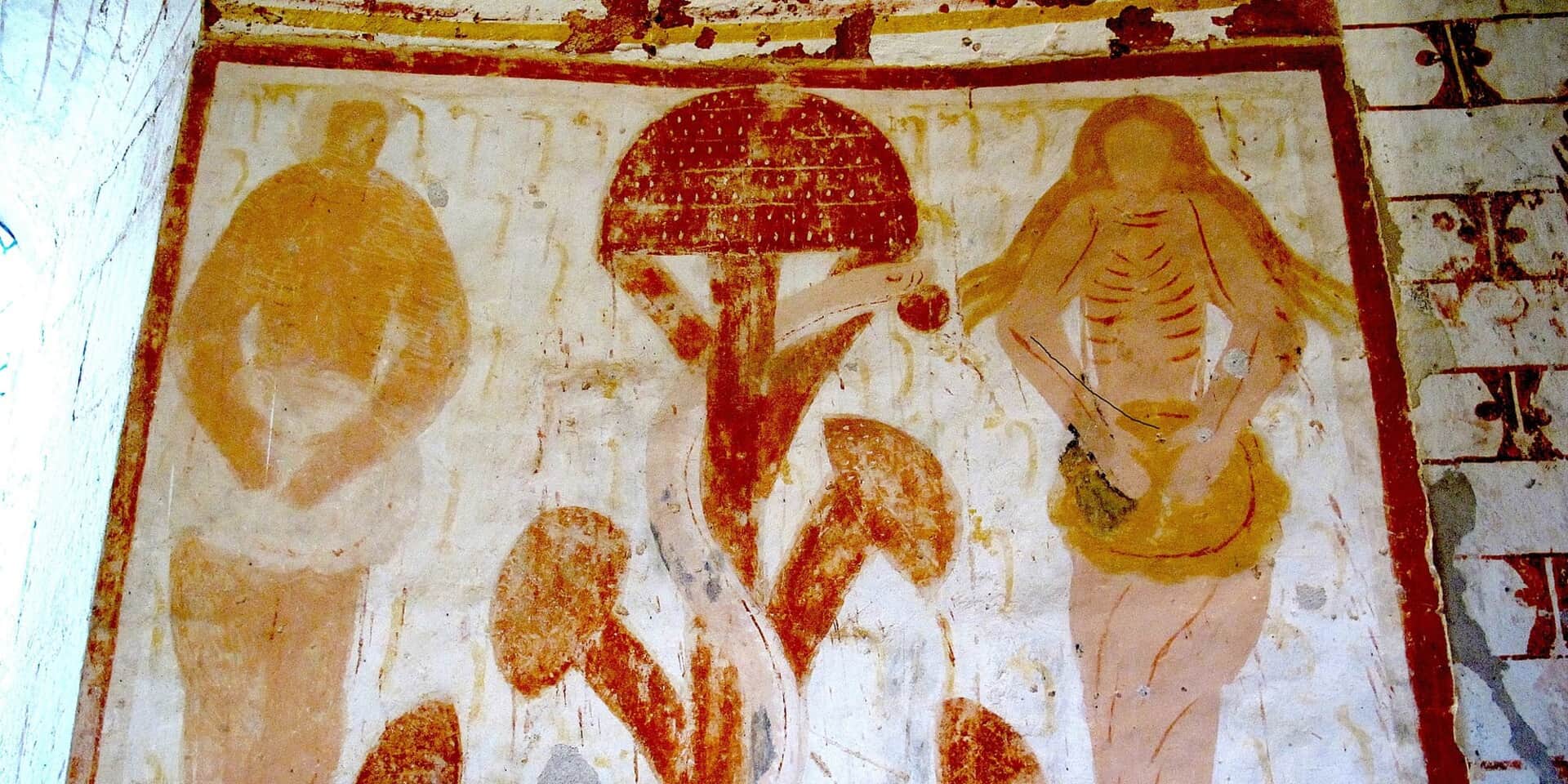
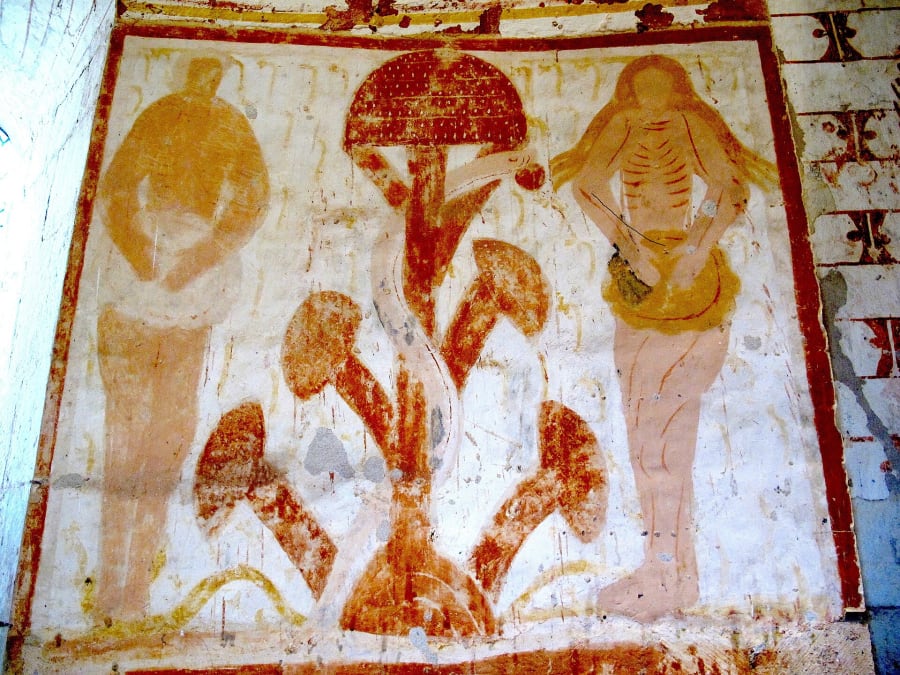
Adam stands on the left. Eve stands on the right, her ribs painted as bold red slashes. Between them rises the Tree of the Knowledge of Good and Evil, and it looks unmistakably like a mushroom: a red, dome-shaped cap covered in white dots, sitting on a thick stalk, with four smaller caps sprouting from below.
The image going viral right now claims this is 900-year-old church art showing the forbidden fruit as a giant mushroom instead of an apple. The painting is real. It's in a small Romanesque chapel at Plaincourault, in the village of Mérigny in central France, and it really does look like that.
But almost every other part of the claim needs correcting. The fresco is about 735 years old, it's the tree that's mushroom-shaped rather than the fruit, and the people who study medieval art for a living say it isn't a mushroom at all. The full story is a century-long argument involving a French mycologist, a Princeton art historian, a Dead Sea Scrolls scholar whose career it helped end, and, more recently, Joe Rogan.
Where the painting actually is
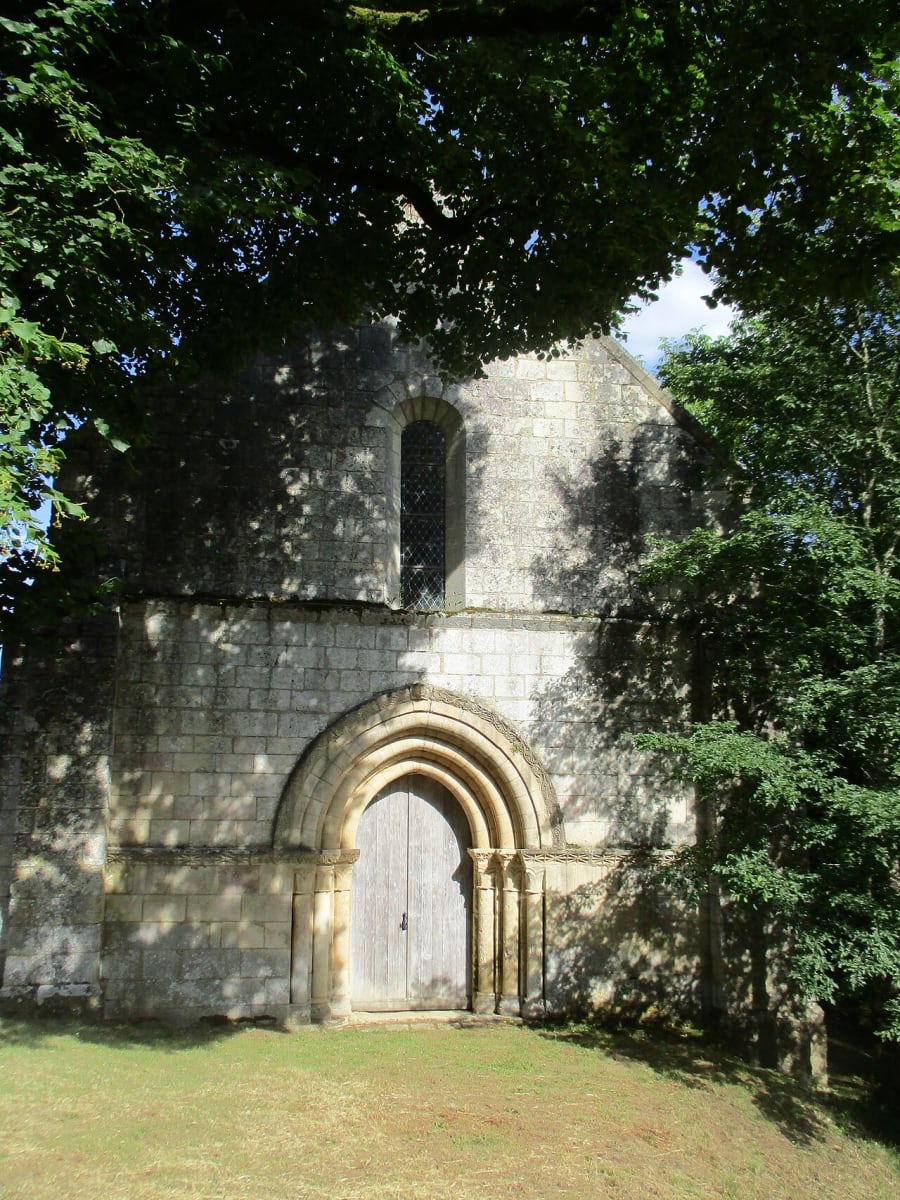
The Chapel of Plaincourault was built by the Knights Hospitaller, the military religious order of St John of Jerusalem, who founded a commandery on the site in the early 12th century. Historical accounts date the chapel itself to the 12th century. That's probably where the "900 years" figure comes from.
The fresco is younger than the building. Scholars, including those who argue it is a mushroom, date the Temptation scene to the late 13th century, around 1291. That makes it roughly 735 years old. Still impressively old, just not as old as the wall it's painted on.
The chapel has had a rough life since. The Hospitallers left in 1632 and it was turned into a barn. It was damaged during the French Revolution, listed as a historic monument in 1944, and restored only after the Brenne Regional Natural Park bought it in 1994. Today it opens to the public mainly during France's annual heritage days.
Look again: the fruit isn't the mushroom
The viral caption says the forbidden fruit is shown as a mushroom. Look closely at the real painting and you'll see that's not quite what's happening. The serpent is coiled around the trunk, and in its mouth it holds out a small, round, red fruit toward Eve. The mushroom-like shape is the tree, not the fruit.
And the "not an apple" part is less of a twist than it sounds. Genesis never says what the fruit was. The apple is a later Western convention, and medieval artists painted the fruit in all sorts of ways. A Romanesque painter not drawing an apple wouldn't have struck anyone at the time as strange.
So why does the tree look like a mushroom?
People have been asking that for more than a century. In 1910, the fresco was shown to the Mycological Society of France, and the eminent mycologist Émile Boudier wrote it up the following year. He identified the tree as an Amanita, most likely the red, white-spotted fly agaric, Amanita muscaria. He even suggested that Eve looks less ashamed than as if she's suffering stomach cramps, clutching her belly with both hands.
In 1952 the banker and amateur mushroom scholar R. Gordon Wasson, who later helped introduce psilocybin mushrooms to Western readers, became interested in the fresco and asked the art historian Erwin Panofsky of Princeton for his view. Panofsky's reply was blunt.
The plant in this fresco has nothing whatever to do with mushrooms.
— Erwin Panofsky, art historian, in a 1952 letter to R. Gordon Wasson
His explanation is the one most art historians still give. Medieval artists didn't paint trees from life. Over centuries, the soft, umbrella-shaped Italian pine of Roman and early Christian painting was simplified and stylized again and again, until it hardened into a standard shape: a stalk with a rounded crown. Art historians even have a name for it, the "mushroom tree" (Pilzbaum in German). Panofsky said there were hundreds of examples, and he sent Wasson specimens from roughly 990 and the 13th century to show the progression. Plaincourault, he argued, was just a provincial and particularly misleading example.
Wasson, who believed passionately that mushrooms had shaped religion elsewhere, accepted that verdict, dismissed the fresco in print and reproduced Panofsky’s letter in his 1968 book Soma. The art historians interviewed by Atlas Obscura in 2021 said much the same: Marcia Kupfer, who wrote the standard study of Romanesque wall painting in central France, said the form doesn't refer to any particular mushroom species, and Case Western Reserve's Elina Gertsman said she doubted any medieval art specialist would back the psychedelic reading.
The viral claim
A 900-year-old church painting shows the forbidden fruit of Eden as a giant mushroom, not an apple.
What the evidence shows
The fresco dates to around 1291 (about 735 years). The mushroom-like shape is the tree, while the serpent offers a small round fruit. Most art historians see a stylized 'mushroom tree,' a common medieval way of drawing trees.
The theory that wouldn't die
The mushroom reading didn't go away. In 1970, John Allegro, a philologist at the University of Manchester and a member of the original Dead Sea Scrolls team, published The Sacred Mushroom and the Cross. He argued that Christianity grew out of a fertility cult centered on hallucinogenic mushrooms, and he held up Plaincourault as visual proof.
The book was savaged. The Times called it a sensational lunatic theory, and it badly damaged Allegro's academic reputation. Even Wasson attacked it publicly, pointing to Panofsky's letter.
The debate got a second wind in 2019, when anthropologist Jerry Brown and psychotherapist Julie Brown published a paper in the Journal of Psychedelic Studies. They printed a second, less-quoted letter from Panofsky in which he allowed one narrow possibility: that a particularly ignorant craftsman might have mistaken the stylized tree for a real mushroom. Panofsky still thought that unlikely. The Browns argue the clustered smaller caps look like young mushrooms emerging around an older one.
Then the internet took over. Joe Rogan described the fresco on his podcast as a 13th-century painting of Amanita muscaria, and the image has circulated ever since, often, as one art historian noted, with the colors boosted to make it look more like a fly agaric.
What about the viral picture itself?
Compare the image being shared with photographs of the real wall and something is off. The layout matches the fresco, but the viral version adds a glowing arched window with sunbeams pouring across the painting and noticeably richer, warmer color. It appears to be a digitally embellished or AI-reworked version of the original, which is exactly the kind of "enhancement" that makes the mushroom reading look more convincing than the faded original does.
Personally, I think the real fresco is more interesting than the myth. A provincial painter, working from a centuries-old shorthand for "tree," produced something that looks so much like a famous mushroom that it has fooled a mycologist, launched a culture-war theory about the origins of Christianity, and still stops people scrolling 735 years later. That's a remarkable afterlife for a painting most people in 1291 would have walked past without a second look.
The fresco and the fight over it
- Early 1100sThe Knights Hospitaller found a commandery at Plaincourault; the chapel is built in the 12th century.
- c. 1291The Temptation fresco with its mushroom-shaped tree is painted.
- 1632The Hospitallers leave; the chapel is later used as a barn.
- 1910–1911The fresco is presented to the Mycological Society of France; Émile Boudier identifies an Amanita.
- 1944The chapel is listed as a French historic monument.
- 1952Erwin Panofsky tells R. Gordon Wasson the tree is a stylized 'mushroom tree,' not a mushroom.
- 1970John Allegro's The Sacred Mushroom and the Cross revives the mushroom reading.
- 1994The Brenne Regional Natural Park buys and restores the chapel.
- 2019Jerry and Julie Brown publish Panofsky's letters and argue for the mushroom reading.
The bottom line
- The fresco is real and is in the Chapel of Plaincourault in Mérigny, central France.
- It dates to around 1291, about 735 years ago. The chapel itself is 12th-century.
- The mushroom-like shape is the Tree of Knowledge; the serpent offers Eve a separate round fruit.
- Most art historians read the tree as a stylized 'mushroom tree,' a common medieval convention, not a fly agaric.
- The viral image appears to be a digitally embellished version of the real painting.
Suggested video: another viral image we fact-checked, the San Diego ant war. Watch on YouTube
Read next: Another viral image that got the real story wrong: San Diego's ant war · Ea-nasir and the world's oldest customer complaint · The Roman writer who described germs in 37 BC
Sources
- Brown JB, Brown JM. "Entheogens in Christian art: Wasson, Allegro, and the Psychedelic Gospels." Journal of Psychedelic Studies 3(2) (2019): 142–163. doi:10.1556/2054.2019.019 (includes Panofsky's 1952 letters).
- Betuel E. "Does This Medieval Fresco Show A Hallucinogenic Mushroom in the Garden of Eden?" Atlas Obscura, Aug. 5, 2021 (interviews with Marcia Kupfer and Elina Gertsman).
- Dlabacová A. "Medieval Mushrooms." Leiden Medievalists Blog, Leiden University.
- Boudier É. "La fresque de Plaincourault (Indre)." Bulletin de la Société Mycologique de France 27 (1911): 31–33.
- Wasson RG. Soma: Divine Mushroom of Immortality (Harcourt Brace Jovanovich, 1968).
- Allegro JM. The Sacred Mushroom and the Cross (1970).
- Ministère de la Culture, Base Mérimée PA00097393 (Château et chapelle de Plaincourault); chapel history via French Wikipedia.
- Images: fresco, Aranthama, Wikimedia Commons, CC BY-SA 4.0. Chapel exterior, Ritadesbois, Wikimedia Commons, CC BY-SA 4.0.