The picture is spectacular: a river of giant red ants charging a river of giant black ants across a dusty trench, each soldier the size of a dog. The caption says two ant colonies have been at war outside San Diego for decades, that 30 million die every year, that the front line runs for miles, and that scientists compared it to World War I trench warfare.
Here's the strange part. Almost everything in that caption traces back to real science. The one thing that's completely made up is the picture.
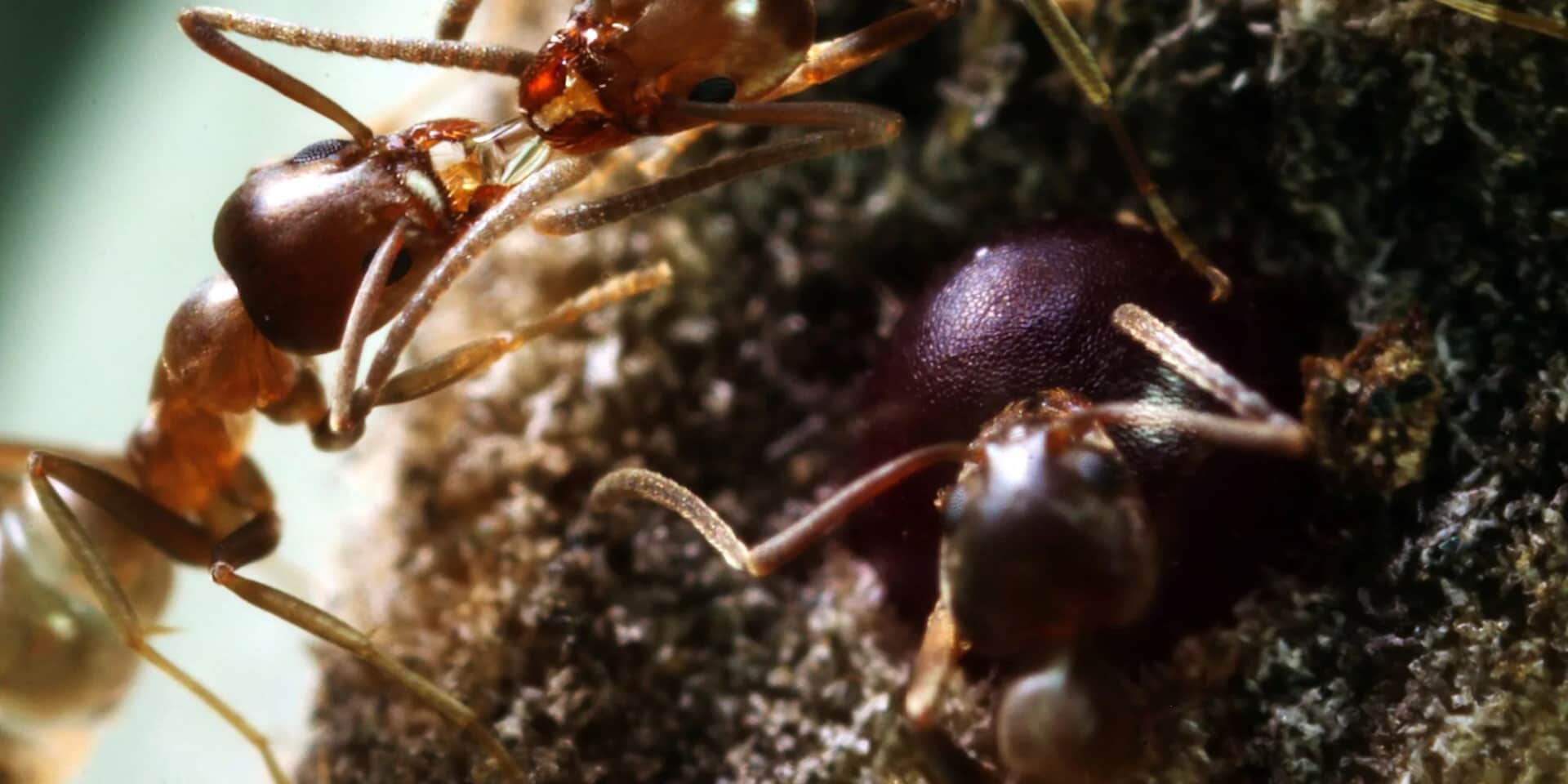
The real war is smaller, browner and, honestly, more interesting. It's fought by an ant about 2 to 3 millimeters long, and both armies belong to the same species.
The armies: one tiny invader, split into rival empires
The combatants are Argentine ants, Linepithema humile. They're native to the river floodplains of northern Argentina and hitched rides around the world on ships and cargo. They were recorded in New Orleans in 1891 and reached California in the early 1900s, where they spread up and down the coast.
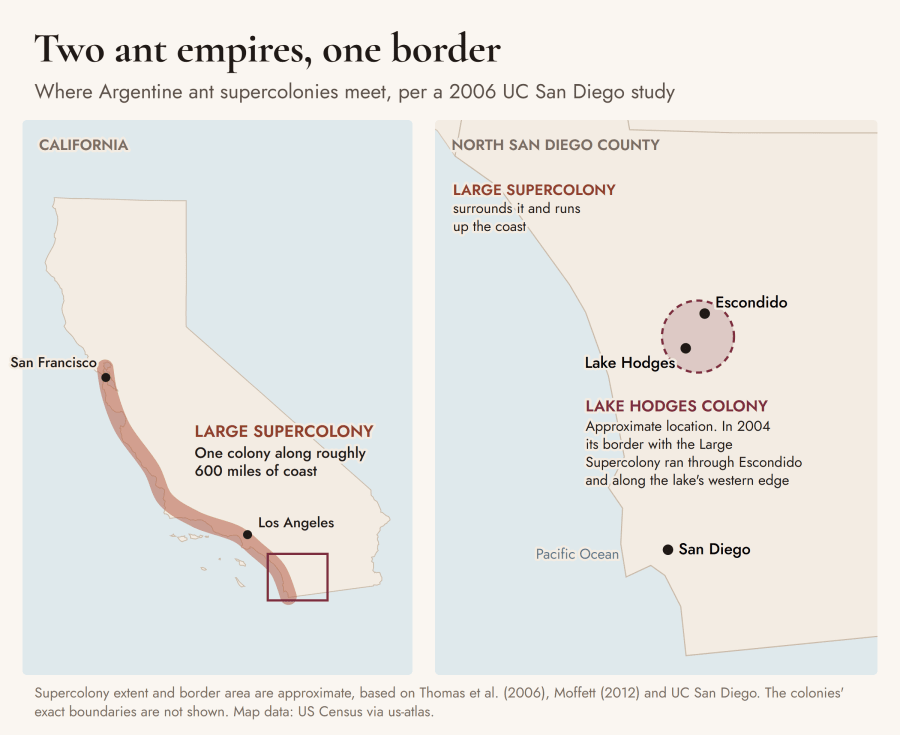
In their homeland, Argentine ant colonies are modest and fight their neighbors constantly. In California something odd happened. Ants from nests hundreds of miles apart treat each other as family. In 2000, researchers from UC San Diego showed that one enormous supercolony stretched across most of coastal California, and later work traced it from the San Francisco Bay Area to the Mexican border. Ants from one end of that range won't fight ants from the other.
But it isn't the only one. A 2006 UC San Diego announcement counted five Argentine ant supercolonies in southern California. The giant coastal one borders three of the four smaller ones, including a colony centered on Lake Hodges, north of San Diego near Escondido. Those colonies are genetically distinct and, crucially, they don't recognize each other as kin.
Ants tell friend from foe mostly by smell, sniffing chemical cues on each other's bodies with their antennae. Within a supercolony those cues are so uniform that a stranger from 500 miles away smells like home. At the boundary between two supercolonies, the cues don't match, and the result is a fight to the death.
The battlefield the scientists actually found
The key study came from ecologist Melissa Thomas, then a postdoc in David Holway's lab at UC San Diego, with colleagues at the University of Illinois and UC Irvine. Published in Molecular Ecology in December 2006, it was the first field study of what happens where these supercolonies meet.
The team found sharp, well-defined borders at 16 contact zones between three pairs of supercolonies. They visited nine of those zones every week for six months in 2004 and saw consistent, intense fighting. Thomas collected the dead along small stretches of the border and scaled up. Her estimate: border clashes around the Lake Hodges colony killed at least 15 million workers in six months.
The front wasn't hard to find. Holway told the San Diego Union-Tribune that you could spot the piles of dead ants from the car. The paper described the battle line winding through Escondido neighborhoods west of Interstate 15 and along the western edge of Lake Hodges. Despite the carnage, the boundary barely moved.
That's where the comparison in the viral post comes from. Holway reached for exactly the image the caption uses, a front line soaked in casualties that hardly shifts.
It was sort of akin to a World War I battlefield.
— David Holway, UC San Diego, speaking to the San Diego Union-Tribune in 2006
A related experiment by Thomas, Holway and UC Irvine’s Neil Tsutsui found something chilling: ants that lived right at the border were more aggressive than ants of the same colonies taken from 500 meters back. Border ants started fighting in under three minutes on average, compared with over six minutes for the "naive" ones. Contact with the enemy doesn't calm these colonies down. It makes them meaner.
Checking the viral claims, one by one
"Two ant colonies." Fair, with a footnote. They're supercolonies, each made of countless interconnected nests, and the giant coastal one was fighting more than one neighbor. The best-documented front was against the Lake Hodges colony.
"30 million die per year." This number comes from the Smithsonian-affiliated entomologist Mark Moffett, whose 2010 book Adventures Among Ants described the Lake Hodges border war as killing 30 million ants a year. It's essentially the 2004 study scaled to a full year. That's a reasonable back-of-the-envelope figure, but it's worth knowing what it rests on: one six-month field season, a minimum estimate, and an assumption that fighting stays steady year-round. In a 2012 paper Moffett put it more conservatively, at more than a million deaths a month between two colonies.
"The front line is miles long." Supported. Moffett described the borders as only centimeters wide but stretching for kilometres, and the 2004 front wound through Escondido neighborhoods and along the Lake Hodges shoreline.
"For decades." Plausible but not directly measured. Holway said the colonies had kept their separate genetic identities despite continuous fighting along their borders for decades, and Moffett has suggested these wars may go back close to a century. Nobody, however, was counting bodies at the border before the 2000s.
"Scientists compared it to World War I trench warfare." True, as quoted above.
The bigger caveat is time. The headline figures are now around 20 years old. Argentine ants are still everywhere in coastal San Diego; resurveys published in 2020 and 2025 found them persisting across the region. But we couldn't find a newer study that went back to the Lake Hodges border to count the dead. So "have been fighting for decades" is a fair reading of the evidence, while "30 million die per year" describes conditions in the mid-2000s, not a fresh 2026 tally.
The ant war, by the evidence
And that picture?
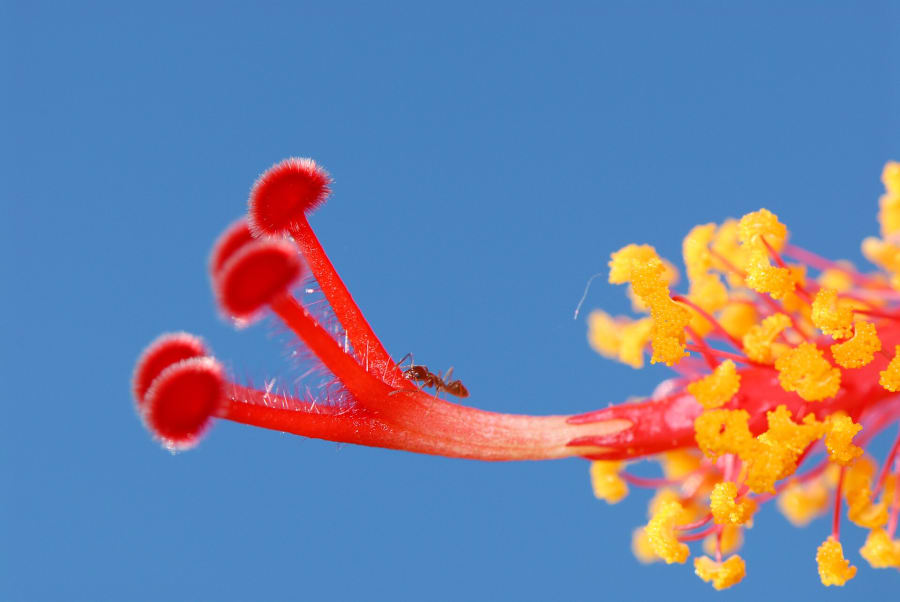
It's AI-generated, and it gets almost everything about the real war wrong. There are no red and black armies. Both sides are the same small, dull-brown species, and you couldn't tell the colonies apart by looking. The ants in the image are also many times the size of real Argentine ants, rendered like beetles marching across open desert, when the actual fighting happens along curbs, lawns and garden soil in suburban Escondido.
The viral image
Giant red ants and giant black ants, visibly different species, facing off in two massed armies across a desert trench.
The real war
Identical brown Argentine ants about 2 to 3 mm long, sorted into colonies only by smell, dying in piles along suburban sidewalks and garden borders.
Personally, I think this is the frustrating thing about posts like this one. The real story didn't need help. Billions of tiny clones, a family feud imported from South America, a front line running through someone's front yard. Swapping that for a movie poster makes the claim easier to dismiss, when it's one of the more remarkable things ever documented in a California suburb.
How the ant war came to light
- 1891Argentine ants are first recorded in the United States, in New Orleans.
- Early 1900sThe species reaches California and spreads along the coast.
- 2000UC San Diego researchers describe a single vast supercolony across coastal California.
- 2004Weekly fieldwork at supercolony borders near San Diego; at least 15 million deaths estimated in six months.
- Dec 2006Thomas and colleagues publish the border study in Molecular Ecology; Holway makes the World War I comparison.
- 2010Mark Moffett's book Adventures Among Ants puts the toll at 30 million ants a year.
Why these ants matter beyond the war
- Argentine ants are among the world's most damaging invasive species and have pushed many native ants out of urban coastal California.
- The colonies' lack of internal fighting lets them pour resources into growth, which is part of why they spread so widely.
- They depend heavily on moisture. Researchers have found them retreating where irrigation is cut back, so drier gardens are one of the best ways to discourage them.
So the next time you see a line of ants heading for your kitchen in southern California, look closely. They may be foot soldiers of the largest colony on the coast, and somewhere a few miles away, their sisters are probably still holding a line they've been holding for longer than anyone has been watching.
Read next: How whooping cranes learned to migrate by following costumed pilots · The true story behind Stoffel the honey badger's viral escapes · The real story behind the viral 1922 insulin photos
Sources
- Thomas ML, Payne CM, Suarez AV, Tsutsui ND, Holway DA. "When supercolonies collide: territorial aggression in an invasive and unicolonial social insect." Molecular Ecology 15 (2006): 4303–4315. doi:10.1111/j.1365-294x.2006.03038.x.
- UC San Diego Biological Sciences, "Invasive Ants Territorial When Neighbors Are Not Kin" (Nov. 30, 2006).
- San Diego Union-Tribune, "UCSD study says Argentine ants very territorial" (Dec. 10, 2006).
- Thomas ML, Tsutsui ND, Holway DA. "Intraspecific competition influences the symmetry and intensity of aggression in the Argentine ant." Behavioral Ecology 16 (2005). doi:10.1093/beheco/ari014.
- Tsutsui ND, Suarez AV, Holway DA, Case TJ. "Reduced genetic variation and the success of an invasive species." PNAS 97 (2000): 5948–5953. PubMed.
- Moffett MW. Adventures Among Ants (University of California Press, 2010), as summarised by The Washington Post (June 1, 2010).
- Moffett MW. "Supercolonies of billions in an invasive ant: What is a society?" Behavioral Ecology 23 (2012): 925. doi:10.1093/beheco/ars043.
- Menke SB, Holway DA. "Historical resurvey indicates no decline in Argentine ant site occupancy in coastal southern California." Biological Invasions 22 (2020): 1669–1679; and Hathaway S, Menke SB, Holway DA, Biological Invasions (2025).
- Images: cover, Davefoc, Wikimedia Commons, CC BY-SA 4.0. Ant on hibiscus, Sam Fraser-Smith, Wikimedia Commons, CC BY 2.0. Map, The Verified Post.