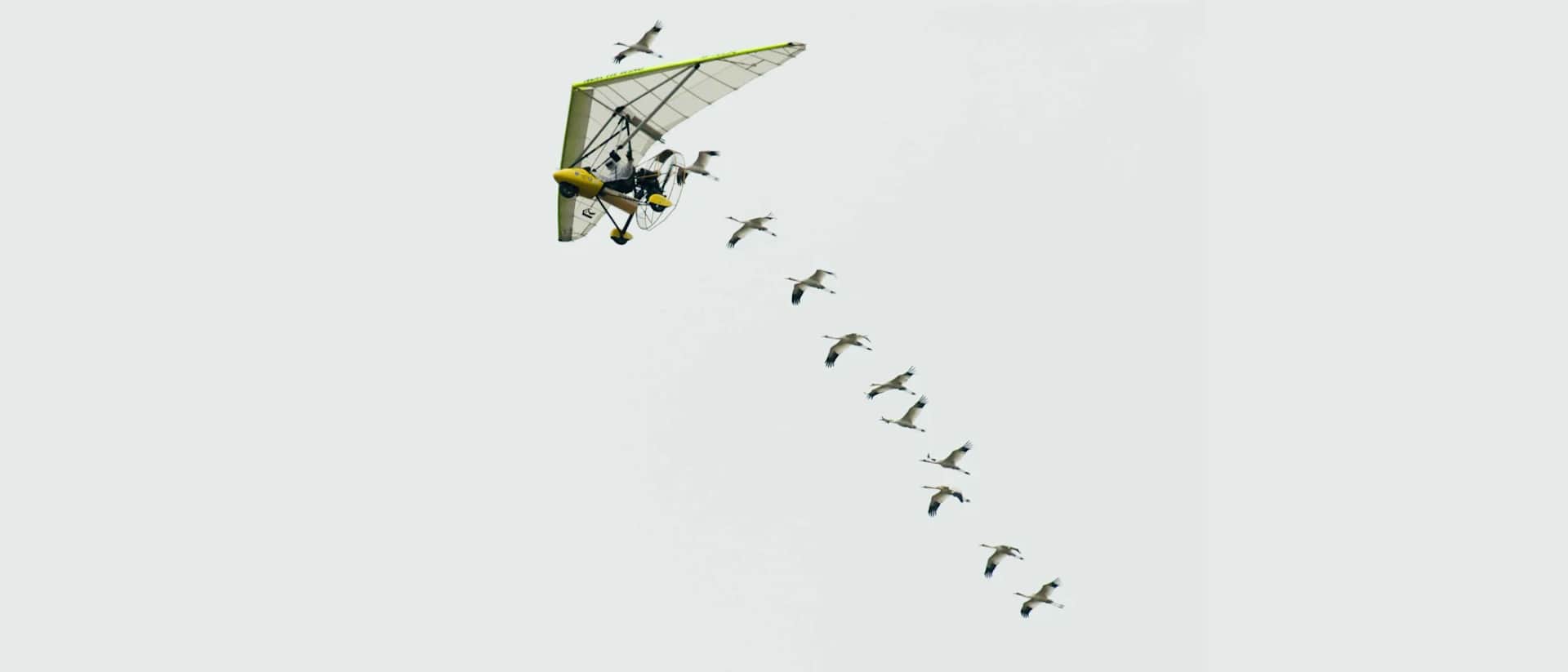
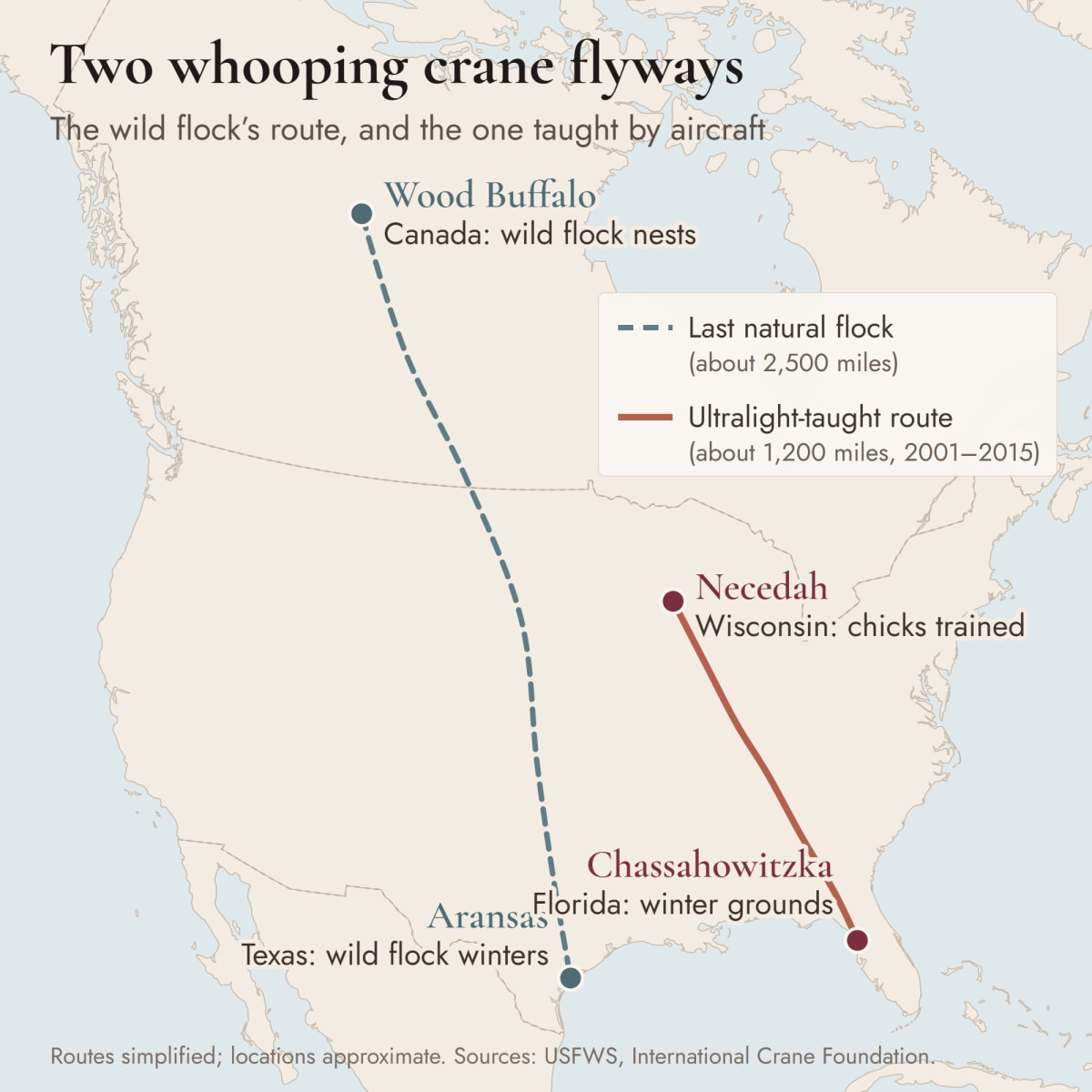
For 15 autumns, one of the strangest formations in American skies took off from the marshes of central Wisconsin: a tiny open-cockpit aircraft, a pilot covered head to toe in a white hooded suit, and a line of young whooping cranes tucked in behind the wing. Their destination was Florida, about 1,200 miles away. The birds had never made the trip, and no crane alive could show them how.
The viral post about this is, for once, accurate. Between 2001 and 2015, pilots really did dress up as cranes and fly ultralights to teach captive-raised chicks a migration route their species had lost in the East. What the post leaves out is the part I find most interesting: the flying worked, and the program was still shut down.
Why the cranes needed a teacher
The whooping crane is North America’s tallest bird, standing about five feet, and one of its rarest. Hunting and the draining of wetlands crashed its numbers, and by 1941 the species was down to about 21 birds. Only 15 or 16 of them belonged to the last migratory flock, which nested in Canada and wintered on the Texas coast. Every whooping crane alive today descends from that remnant.
Cranes in the eastern half of the continent had been gone for more than a century. That created a problem conservation money couldn’t simply buy its way out of. Young cranes learn their migration route by following their parents. Chicks hatched in captivity, which the U.S. Fish and Wildlife Service had been breeding since 1967, had no parents to follow. Release them in Wisconsin and they would have no idea where to go when winter came.
There was also a safety argument. With the entire wild population packed into one flock wintering at Aransas, Texas, a single hurricane, disease outbreak or oil spill could wipe out most of the species. A second migratory flock in the East would be insurance.
The costume rules
Crane chicks bond with whoever raises them. A chick raised by people grows up thinking it’s a person, which is a disaster for a bird that needs to find a crane mate. In 1985, biologists at the International Crane Foundation developed the fix: a shapeless white costume worn with a crane-head puppet on one hand.
The rules around it were strict. According to the Smithsonian’s National Air and Space Museum, which now holds one of the costumes, Operation Migration staff wore a hood, goggles and a white smock, and talking near the birds was forbidden. Chicks got numbers instead of names, to remind everyone they weren’t pets. Even before hatching, the eggs were played recordings of an ultralight engine, so the sound would feel familiar. About eight weeks after hatching, the chicks were following the aircraft as it taxied, and at 80 to 90 days old they were flying with it.
The wildlife equivalent of putting a man on the moon.
— John Christian, U.S. Fish and Wildlife Service, on Operation Migration
Fifteen years of flights
The method came from two Canadians, Bill Lishman and Joe Duff, who founded Operation Migration in 1994 after experiments leading birds with ultralights, work that inspired the 1996 film Fly Away Home. After a trial with sandhill cranes in 2000, the first whooping crane flight lifted off from Necedah National Wildlife Refuge in Wisconsin on October 17, 2001, with three ultralights leading the young birds toward Chassahowitzka National Wildlife Refuge on Florida’s Gulf Coast. Private landowners along the way offered their land as overnight stops.
The aircraft were built for it. An ultralight can fly slowly and quietly enough to match a crane’s cruising speed of about 38 mph, and the birds learned to ride the air coming off the wingtip, which let them fly with less effort. A recording of a crane brood call played from a speaker on the landing gear to keep the flock in formation.
Then came the real test. In April 2002, the surviving members of that first class flew back to Wisconsin on their own, with no aircraft and no costumes. The route had stuck. In 2006, a pair of these birds hatched chicks at Necedah, the first wild whooping cranes to hatch in the eastern United States in more than 100 years.
By the time the last flock was led south, Operation Migration’s pilots had guided 186 whooping cranes along the route over 15 years, covering 17,457 miles. From 2005, biologists also tried a second method, releasing young cranes in autumn alongside older birds so they could learn the route from them instead.
Operation Migration, by the numbers
Why the flights stopped
Here’s the twist the viral posts skip. In January 2016, the U.S. Fish and Wildlife Service announced it would no longer support ultralight-led migration. The cranes were migrating fine. They just weren’t raising chicks. Of roughly 250 whooping cranes released into the eastern flock since 2001 by all methods, 93 were alive at the time, and only 10 chicks had fledged and survived. Since 2005, wild chicks had come from just five breeding pairs.
Crane biologists concluded that heavy human involvement, the aircraft and the costumed caregivers, was hurting the birds’ ability to become good parents. A 2018 summary of the decision described the method as judged “too artificial,” with costume-raised cranes thought to make inattentive parents. Biting black flies at Necedah, which drove adults off their nests, made things worse, and biologists still actively manage nests today to limit the disturbance.
Operation Migration disagreed, arguing the aircraft had helped the cranes survive. It kept working for three more years, then withdrew from the partnership in 2018 and dissolved, saying it no longer believed a self-sustaining eastern flock was achievable.
Personally, I don’t think “failure” is the right word. The part that sounds absurd, a person in a crane suit flying a hang glider with an engine, did exactly what it was meant to do: every bird that survived its first trip went on migrating by itself. What nobody could teach from an aircraft was how to be a crane parent.
2001–2015
Chicks were raised by costumed handlers, trained to follow an ultralight, and led on their first migration from Wisconsin to Florida by costumed pilots.
Today
There are no aircraft. Chicks are costume-reared or raised by crane parents at the International Crane Foundation, then released in Wisconsin in autumn to learn the route from older cranes. Some chicks now hatch in the wild.
Where the cranes are now
The eastern flock still exists. The International Crane Foundation’s August 2026 update puts it at about 63 birds, 17 of them hatched in the wild. This year, 14 pairs built 20 nests and hatched 11 chicks, four of which were still alive in August. It’s a small, fragile population, and it still depends on new releases to keep going. The costumes haven’t disappeared either: in 2025, seven of the eight young cranes released into the flock had been costume-reared.
The species as a whole is doing better. The natural flock that migrates between Wood Buffalo National Park and Aransas was estimated at about 540 birds in the 2025–26 winter, and has stayed above 500 for nine straight years. Counting captive birds and the reintroduced flocks, there are roughly 830 whooping cranes in total, up from about 21 in 1941.
Key dates
- 1941The species falls to about 21 birds, with only 15 or 16 in the last migratory flock.
- 1967Captive breeding of whooping cranes begins at Patuxent Wildlife Research Center in Maryland.
- 1985The International Crane Foundation develops costume rearing to stop chicks imprinting on people.
- 1994Bill Lishman and Joe Duff found Operation Migration.
- Oct 2001The first ultralight-led whooping crane migration leaves Necedah, Wisconsin, for Florida.
- Apr 2002The first class flies back to Wisconsin on its own.
- 2006The first wild whooping crane chicks in the eastern US in more than a century hatch at Necedah.
- Jan 2016The Fish and Wildlife Service ends support for ultralight-led migration after poor breeding results.
- 2018Operation Migration withdraws from the partnership and dissolves.
- Aug 2026The eastern flock numbers about 63 birds, 17 of them wild-hatched.
The pilots in crane suits didn’t save the whooping crane by themselves, and the eastern flock they built is still a long way from standing on its own. But for 15 years, a handful of people agreed to stop talking, dress like birds and fly 1,200 miles at 38 mph, so that a species could relearn a road it had forgotten. Some of their birds are still flying it.
Read next: why humans could never fly like birds, and the true story of Stoffel, the honey badger escape artist.
Sources
- U.S. Fish and Wildlife Service, “Ultralight-led whooping cranes start historic migration” (October 17, 2001).
- National Air and Space Museum, “Operation Migration” (July 26, 2022).
- International Crane Foundation, “Connect with Whooping Cranes” (history of costume rearing)
- International Crane Foundation, “Class of 2001”
- Phil McKenna, “How to Raise a Wild Bird: The Tricks and Costumes Behind the Whooping Crane’s Return,” Audubon
- Associated Press, “Feds to end ultralight aircraft-led whooping crane migration,” via Chicago Tribune (January 24, 2016).
- Wisconsin Society for Ornithology, “Operation Migration Calls It Quits” (September 5, 2018).
- U.S. Fish and Wildlife Service, Whooping Crane Recovery Activities Report 2024–2025
- International Crane Foundation, “Whooping Crane Eastern Population Update – August 2026”
- International Crane Foundation, “Whooping Crane Population Holds Steady at 540”
- Birds of the World, “Whooping Crane: Demography and Populations,” Cornell Lab of Ornithology
- Cover photo: “Operation migration flyover” by Keith Ramos, U.S. Fish and Wildlife Service, via Wikimedia Commons (public domain)