The line going around on X says brain scans show children from unstable families have brain changes like combat soldiers after active duty. There is a real study behind it, and the finding is a serious one. But the children in that study didn't come from homes that were merely "unstable." They had documented exposure to violence at home, which is a far narrower and far graver thing.
In 2011, researchers at University College London scanned 43 children and found that those who had lived with family violence showed heightened activity in two threat-related brain regions when they looked at angry faces. An earlier study had found the same two regions responding more strongly in soldiers back from a combat zone. The researchers read this as a brain adapting to danger, with a possible cost later on. The children were healthy when they were scanned.
What the scanner actually measured
The paper, by Eamon McCrory and colleagues at UCL and the Anna Freud Centre, ran in Current Biology in December 2011. It compared 20 children who had been exposed to documented violence at home with 23 closely matched children who hadn't. The first group had all been referred to social services in London, and their average age was 12.
Inside the scanner, each child saw a run of faces that looked angry, sad or neutral. Their only job was to say whether each face was male or female, so nobody was asked to think about emotion at all. That design is the clever part. Whatever the scanner picked up was the brain registering anger while the child's attention was on something else.
The violence-exposed group showed more activity in the right amygdala and in the anterior insula on both sides of the brain. That happened with angry faces and didn't happen with sad ones. Within the group, children with more severe exposure showed stronger activity in the left anterior insula, although the authors labelled that analysis exploratory, and it rests on only 20 children.
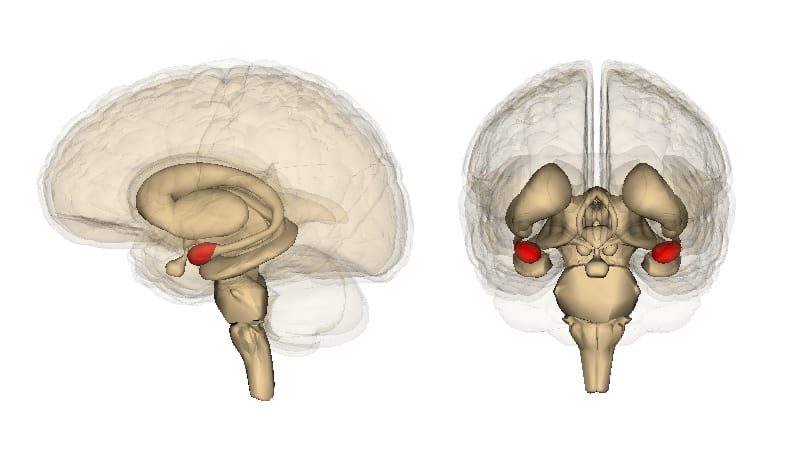
The two regions do related jobs. The amygdala is widely recognized for its role in detecting threat. The anterior insula, folded deep inside the side of the brain, helps combine emotional and bodily signals and has been linked to anticipating pain. Together they belong to a wider network that flags what deserves attention right now.
Where the soldiers come in
The children and the soldiers never shared a scanner. The military half of this comparison comes from a separate Dutch study, published the same year in Molecular Psychiatry. Guido van Wingen's team scanned 33 healthy soldiers before their first deployment and again about six weeks after they returned from four months in Afghanistan, where they faced enemy fire, armed combat and the sight of seriously injured people. A further 26 soldiers who were never deployed served as the comparison group.
Amygdala reactivity rose in the combat group with no significant change in the soldiers who stayed home, and the anterior insula showed a similar difference between the groups. Self-reported PTSD symptoms, meanwhile, didn't change in any way that set the two groups apart. McCrory's paper cited that work as a parallel, and UCL's press release put the soldier comparison in its headline. That's the sentence the viral claim is built on.
The children (McCrory, 2011)
20 children, average age 12, with documented family violence, scanned once and compared with 23 matched peers. They judged the gender of angry, sad and neutral faces. Result: a stronger right amygdala and anterior insula response to angry faces, with normal levels of anxiety and depression.
The soldiers (van Wingen, 2011)
33 Dutch soldiers scanned before and about six weeks after four months in Afghanistan, plus 26 never deployed. They did a different task using angry and fearful faces. Result: a rising amygdala and anterior insula response, with no matching rise in PTSD symptoms.
So "similar" is fair, in a limited sense: the same two regions moved in the same direction. It doesn't mean a 12-year-old's brain looks like a soldier's. The groups differed in age and took different tests. The soldiers were also scanned twice, so that study could watch a change happen, while the children were scanned once, so researchers could only see a difference between groups. McCrory's own 2017 review says the cross-sectional design of this kind of imaging work rules out any strong conclusion about cause.
"Unstable" is the wrong word
This is the part of the viral version I'd most want fixed. Children whose parents split up, or who move around a lot, or whose households are chaotic in ordinary ways were not the subject of this study. The children in it had experienced physical abuse or violence at home, serious enough to be documented. If you've ever read about why leaving an abusive home can be the most dangerous moment, you'll have a better picture of what that environment can mean than the word "unstable" gives you.
Household instability does have its own research, and it says something different. A 2023 University of Michigan-led study followed 237 young people and looked at moves, changes in who lived in the home and caregiver transitions in their first five years. More instability was linked to differences in white-matter network organization in adolescence, and through that to more depressive symptoms in young adulthood. It's a real finding about real risk. It measured brain wiring, though, and it says nothing about soldiers.
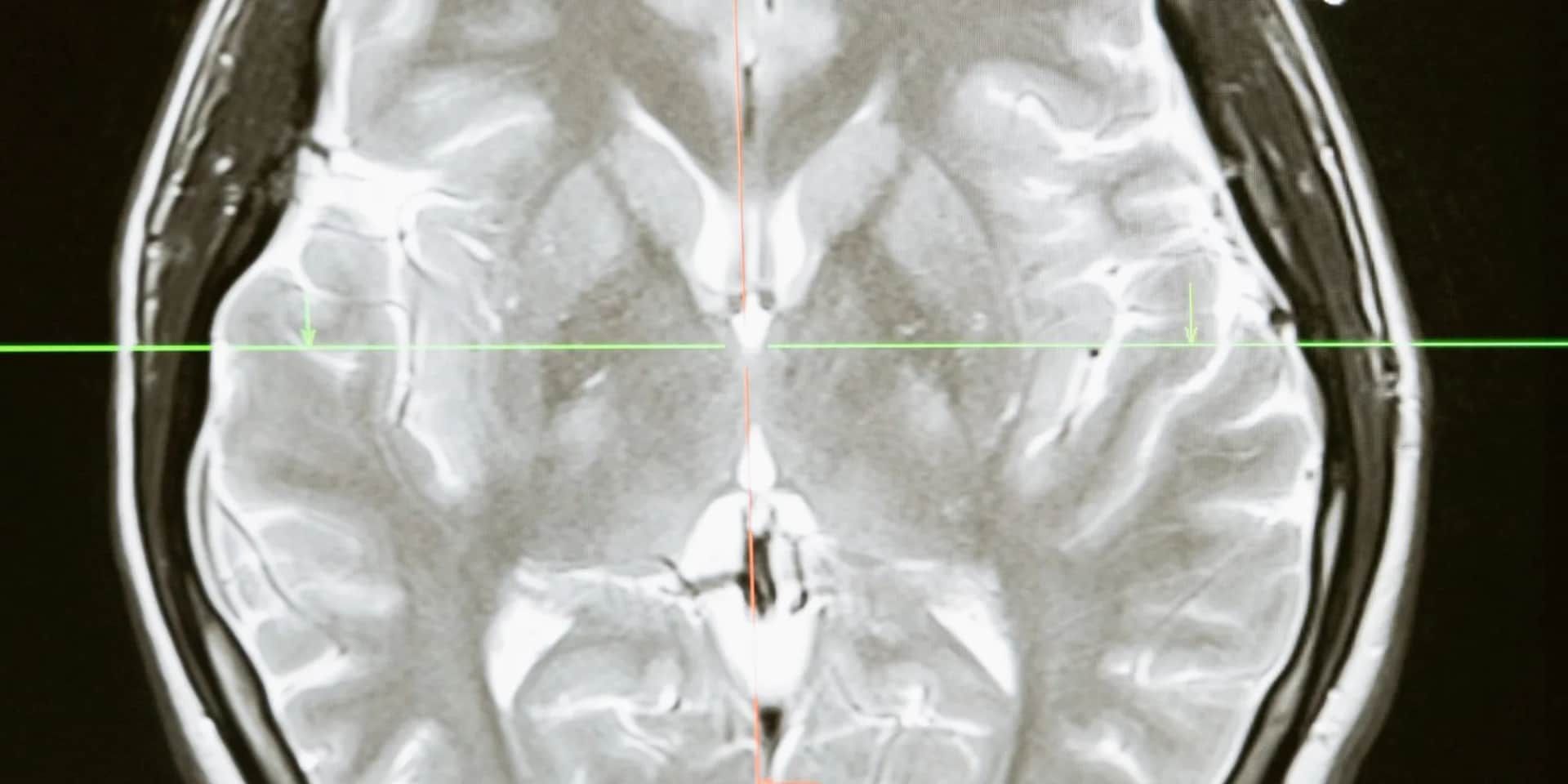
"Brain changes" also needs a caveat. Functional MRI tracks blood-oxygen signals as a stand-in for activity during a task, so these studies are reporting how a region responded in the moment. They aren't showing a brain that looks physically different, and the dramatic scan image that usually travels with this claim is a structural picture that couldn't show the result at all.
How well the finding has held up
Broadly well, at least for the amygdala. A 2017 meta-analysis pooling 20 child and adult studies tied maltreatment to stronger amygdala activity on both sides when people viewed emotional faces. A 2025 analysis of 30 studies and 2,474 participants reported its robust result in the right amygdala, and its abstract names no comparable insula finding, so the insula half of the soldier comparison has thinner backing at that level.
The picture isn't uniform either. McCrory's 2017 review notes that some maltreated samples show blunted responses to threat as well as heightened ones. And "maltreatment" in these pooled studies covers more than family violence, so they support the general direction without proving the specific soldier parallel.
A useful adaptation with a possible price
What most people overlook in this story is that the researchers don't describe a broken brain. In a home where anger can come before violence, picking up on an angry face quickly might help a child. The soldiers' paper makes the same argument about a war zone. The trouble is that a system tuned for danger may fit poorly once the danger has gone, whether that's a classroom, a friendship or a calm house. People who feel constantly on guard around others might recognize something similar in research on why some people feel disliked despite the evidence, although that's a different body of work.
McCrory's term for this is latent vulnerability. His 2017 review explicitly frames these neural differences as something other than damage: a recalibration that raises risk but may never turn into symptoms, particularly with social support and without further major stress.
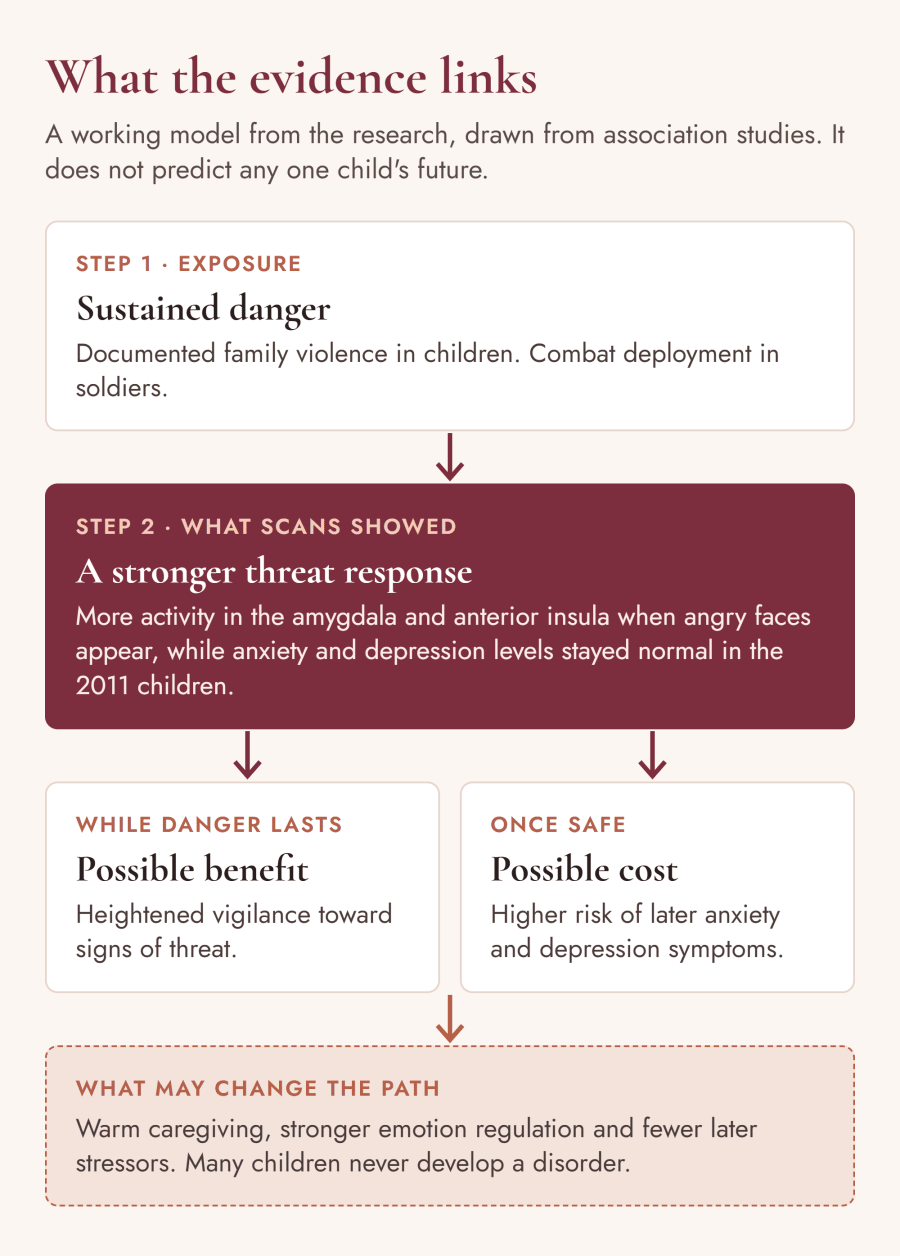
There's some evidence for the cost side. A 2019 study led by UCL and Duke researchers drew on a sample of 1,144 young adults, comparing 100 with a history of maltreatment against 96 carefully matched peers. Maltreatment predicted stronger amygdala reactivity at the start, and that reactivity helped account for more anxiety and depression symptoms about a year later. Greater exposure to stressful life events played a part too.
Many bounce back and lead successful lives.
— Eamon McCrory, lead author, on children exposed to family violence, UCL, 2011
What seems to protect children
This is where the viral framing does its real harm, because it sounds like a life sentence for a child. The research points somewhere else. A study of 53 mother-child pairs led from Emory University, with children aged 8 to 14, found that children who had experienced more violence at home showed an amygdala response that grew over repeated faces. Among children whose mothers were warm, that link disappeared, and warmth also predicted fewer behavior problems up to a year later.
A Harvard-led study of 151 young people aged 8 to 17, 79 of them maltreated, found a similar kind of opening. Maltreated children who were better at engaging prefrontal control regions and calming the amygdala while reappraising an emotional situation had a lower risk of depression over time. Both studies are small and describe associations, and the authors of the second call their results preliminary. Neither proves that any treatment reverses a scan result.
In 2011, McCrory said the next question was how stable these differences are. The imaging studies in his 2017 review still couldn't settle that, because they captured people at a single moment.
The Bottom Line
- The 2011 study looked at 20 children with documented family violence, not children from unstable families in general.
- Their brains responded more strongly to angry faces in two regions that also became more reactive in soldiers after combat deployment.
- The scans measured activity during a task. They didn't show physical damage, and the children and soldiers were studied separately using different tests.
- Researchers see this as a possible risk factor. Many exposed children never develop a mental health disorder.
If you're worried about a child
- US: the Childhelp National Child Abuse Hotline is 1-800-422-4453, open 24 hours a day.
- UK: the NSPCC Helpline for adults is 0808 800 5000. Children can call Childline on 0800 1111.
- If a child is in immediate danger, call your local emergency number.
The 2011 paper cited estimates that 4 to 16 percent of children experience physical abuse and 8 to 25 percent are affected by violence between adult partners. That's a lot of children, most of them without any scan or diagnosis to point to. The accurate version of this story is less catchy than the viral one and more useful: a child's brain can register violence at home well before anyone sees symptoms, and that's the reason to act on the violence itself instead of waiting for symptoms to appear.
Read next: Why Leaving Is the Most Dangerous Moment in Abuse · If You Always Feel People Don't Like You, Your Brain Might Be Filtering Out the Proof They Do
Sources
- McCrory EJ, De Brito SA, Sebastian CL, et al. Heightened neural reactivity to threat in child victims of family violence. Current Biology, 2011
- University College London press release: Maltreated children show same pattern of brain activity as combat soldiers, via ScienceDaily, 2011
- van Wingen GA, Geuze E, Vermetten E, Fernández G. Perceived threat predicts the neural sequelae of combat stress. Molecular Psychiatry, 2011
- McCrory EJ, Gerin MI, Viding E. Annual Research Review: Childhood maltreatment, latent vulnerability and the shift to preventative psychiatry. Journal of Child Psychology and Psychiatry, 2017
- Hein TC, Monk CS. Neural response to threat in children, adolescents, and adults after child maltreatment: a quantitative meta-analysis. Journal of Child Psychology and Psychiatry, 2017
- Kuo PC, Yao ZF. Amygdala hyperactivation in childhood maltreatment: an ALE-based meta-analysis on emotion-related processing. Neuroscience & Biobehavioral Reviews, 2025
- Hardi FA, Goetschius LG, Tillem S, et al. Early childhood household instability, adolescent structural neural network architecture, and young adulthood depression. Developmental Cognitive Neuroscience, 2023
- Gerin MI, Viding E, Pingault JB, et al. Heightened amygdala reactivity and increased stress generation predict internalizing symptoms in adults following childhood maltreatment. Journal of Child Psychology and Psychiatry, 2019
- Stevens JS, van Rooij SJH, Stenson AF, et al. Amygdala responses to threat in violence-exposed children depend on trauma context and maternal caregiving. Development and Psychopathology, 2023
- Rodman AM, Jenness JL, Weissman DG, Pine DS, McLaughlin KA. Neurobiological markers of resilience to depression and anxiety following childhood maltreatment. Biological Psychiatry, 2019
- NSPCC: Reporting abuse
- Image credits: cover photo by MART PRODUCTION on Pexels (Pexels License). Amygdala.png by Life Science Databases (LSDB), CC BY-SA 2.1 JP, via Wikimedia Commons. Diagram by The Verified Post.