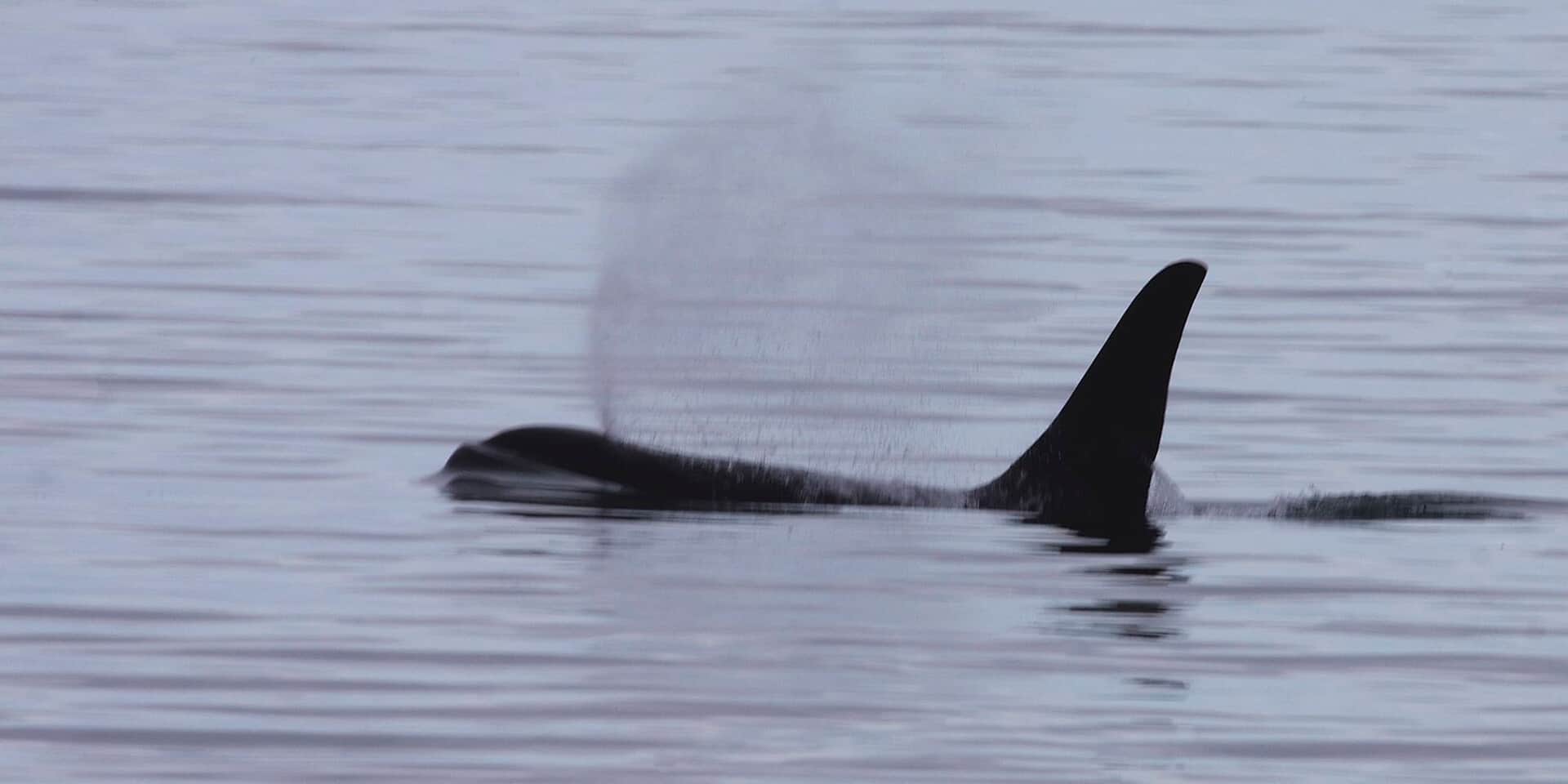
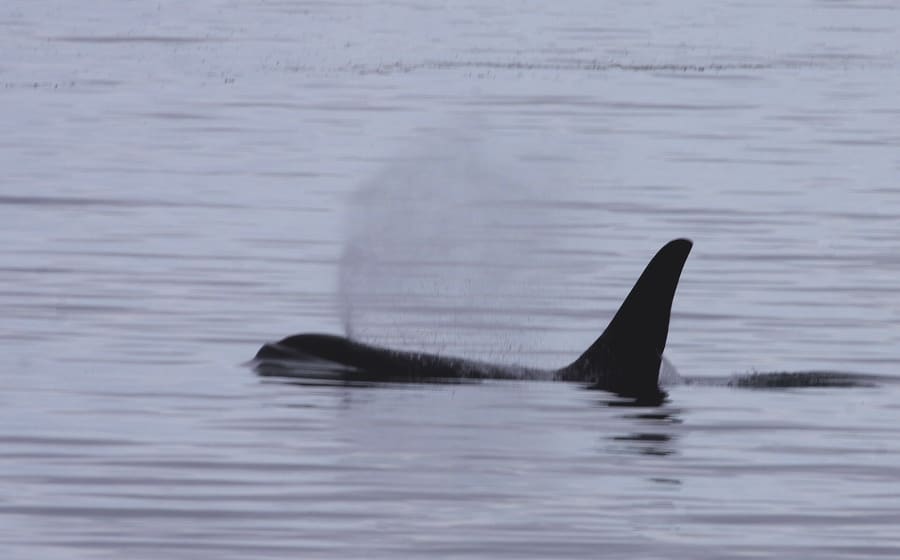
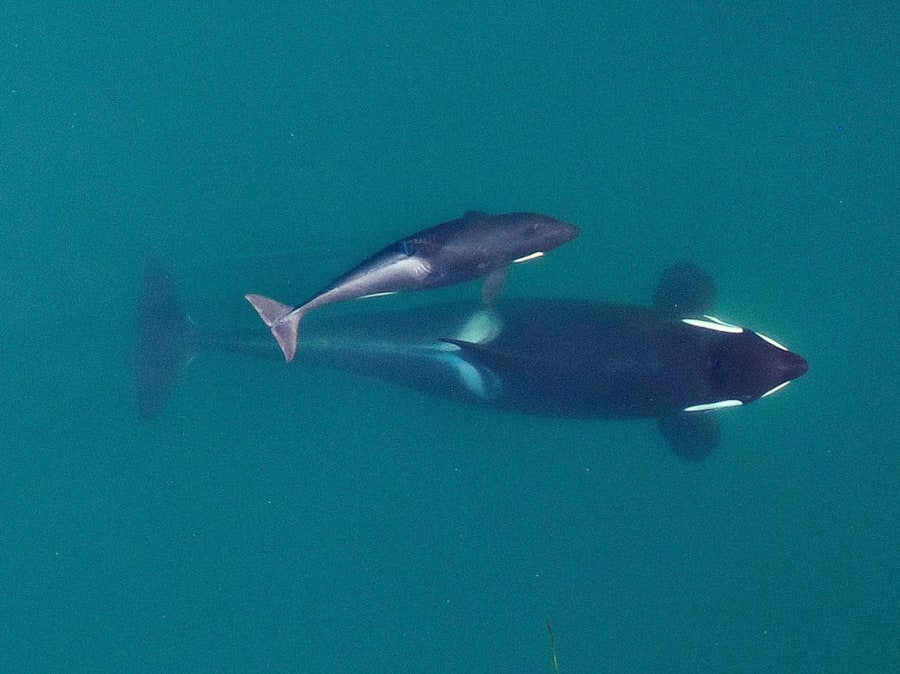
The photo is one of those images that stops you mid-scroll: a towering black dorsal fin, nearly twice the height of the fin beside it, and a tiny one tucked in at the front. The caption calls it a huge male orca with his mother and baby sister, and adds that male orcas never really leave home and stay loyal to their mothers for life.
It sounds like the kind of sweet animal fact the internet invents. This one is largely real. In some orca populations, sons do stay with their mothers until one of them dies, and decades of research suggest that the bond is a matter of life and death for the son, and an expensive one for the mother.
But the claim needs two important caveats, and the photo needs one more.
The orcas that never leave home
Most of what we know about orca family life comes from one extraordinary dataset. Since the 1970s, researchers in the Pacific Northwest, including the Center for Whale Research and Fisheries and Oceans Canada, have photographed and identified every individual in the fish-eating "resident" killer whale populations off Washington state and British Columbia. Each whale can be recognized by the shape of its fin and the gray "saddle patch" behind it, so scientists have been able to follow whole families across generations.
What they found was unusual for a mammal. In resident killer whales, neither sons nor daughters leave their mother's group. They travel, hunt and rest with her for life. Males do mate with females from other groups, but they come back. New groups form only slowly, when a family grows large and a daughter gradually splits off with her own offspring.
So the caption's core claim, that males stay loyal to their moms for life, is an accurate description of these orcas. It's also why the photo's arrangement is so familiar to whale watchers: a big male traveling beside an older female and a youngster is exactly what a resident family looks like.
Why mom matters so much
Here's where the story gets more striking than the caption. Staying with mom isn't just sentimental. It appears to keep sons alive.
In a 2012 study in Science, researchers led by Emma Foster and Darren Croft at the University of Exeter used those decades of census records to see what happened to adult orcas after their mothers died. Sons were hit far harder than daughters. As reported at the time, a son over 30 was about 14 times more likely to die in the year after losing a mother who had stopped breeding.
Later work has filled in why. Older, post-menopausal mothers tend to lead their families to salmon, especially when fish are scarce, and they share the fish they catch, often with their sons. A 2023 study found that adult males with living, post-menopausal mothers carried fewer tooth-rake injuries from other whales, suggesting their mothers helped keep them out of fights.
And that support comes at a price. In a 2023 study in Current Biology, Michael Weiss and colleagues looked at 40 Southern Resident females over almost four decades. Each surviving son roughly halved his mother's chance of successfully raising another calf in a given year. Daughters had no clear effect. And sons didn't get cheaper as they aged; a 30-year-old son cost his mother about as much as a young one.
Killer whale mothers pay a high cost in terms of their future reproduction to keep their sons alive.
— Michael Weiss, University of Exeter and Center for Whale Research, to the BBC (2023)
Why would evolution favor mothers who pour so much into adult sons? The researchers' explanation is genetic bookkeeping. A daughter's calves are born into the family and compete with it for food. A son's calves are born into other groups, which raise them. Keeping a big, healthy son alive lets a mother spread her genes without adding mouths to her own group. It may also help explain why female orcas, like humans, go through menopause and can live for decades afterward.
Personally, I find this more moving than the viral version. "Loyal to mom" makes it sound like the son is the devoted one. The research suggests it's mostly the other way around.
Orca mothers and sons, by the research
Caveat one: not all orcas live this way
"Male orcas never leave home" is true of resident killer whales, but orcas aren't one uniform species socially. In the same waters live Bigg's killer whales (formerly called "transients"), which hunt seals, sea lions and other marine mammals in small, stealthy groups. Their families are looser. Both sons and daughters sometimes leave their mother's group, temporarily or for good, and researchers have documented "roving" adult males who travel alone or with other males.
Most Bigg's sons still stay close to their mothers, and only a handful have been classified as permanent rovers while their mother was alive. But the blanket statement that males never leave isn't true of every orca everywhere.
Resident killer whales
Fish-eaters living in large, stable family groups. Sons and daughters stay with their mother for life; individual dispersal is extremely rare.
Bigg's killer whales
Mammal-hunters in small groups. Most sons stay with mom, but both sexes sometimes leave, and some adult males become long-term 'rovers.'
Caveat two: we can't verify this family
The photograph itself shows a big male fin, a medium fin and a small one, which fits a resident orca family very well. But the post doesn't say who these whales are or where the picture was taken, and we couldn't trace the original. Without that, there's no way to confirm that the smaller whales are his mother and baby sister rather than, say, an aunt and a cousin. In real orca families both are common.
So treat the caption as a plausible illustration, not a documented family portrait.
What the evidence supports
- In resident killer whales, sons (and daughters) stay with their mothers for life.
- Adult sons depend on mothers more than daughters do, and losing a mother sharply raises a son's risk of dying.
- Supporting sons is costly: each surviving son roughly halves a mother's yearly chance of raising another calf.
- Bigg's (transient) orcas are less strict; some sons leave their mother's group.
- The specific whales in the viral photo can't be identified from the post.
The bond in that photo is real enough that it has shaped how orcas age, breed and survive. It's just more lopsided than the caption suggests: the son isn't so much loyal to his mother as utterly reliant on her, and she keeps paying for that, year after year, for the rest of her life.
Read next: Whooping cranes learned to migrate by following costumed pilots · San Diego's ant war is real. The viral picture isn't. · The true story behind Stoffel the honey badger
Sources
- Foster EA, Franks DW, Mazzi S, Darden SK, Balcomb KC, Ford JKB, Croft DP. "Adaptive Prolonged Postreproductive Life Span in Killer Whales." Science 337 (2012): 1313. doi:10.1126/science.1224198; reported by Science News.
- Weiss MN, Ellis S, Franks DW, Nielsen MLK, Cant MA, Johnstone RA, et al. "Costly lifetime maternal investment in killer whales." Current Biology 33 (2023). doi:10.1016/j.cub.2022.12.057.
- BBC News, "Orca mothers make 'lifelong sacrifice' for sons" (Feb. 2023).
- Science, "Killer whale moms protect their sons from fights with other whales" (2023), on Grimes et al.
- Nielsen MLK et al. "Temporal dynamics of mother–offspring relationships in Bigg's killer whales." Proceedings of the Royal Society B 290 (2023). PMC10244979.
- Brent LJN et al. "Ecological knowledge, leadership, and the evolution of menopause in killer whales." Current Biology (2015); reported by Science News.
- Center for Whale Research, Orca Survey research summary.
- NOAA Fisheries, Killer whale species profile (lifespan figures).
- Images: male orca, Gregory "Slobirdr" Smith, Wikimedia Commons, CC BY-SA 2.0. Mother and calf, NOAA Fisheries / Vancouver Aquarium, Wikimedia Commons, public domain.