“Scientists just discovered a new organ in the female body.” It’s a great headline, and it has been doing the rounds again this autumn. The structure it describes is real, and the research behind it is genuinely interesting. But almost every word of that first sentence is wrong.
The structure is called the rete ovarii, Latin for “net of the ovary.” It isn’t new. It was first described in 1870, it appeared in early editions of Gray’s Anatomy, and it has been sitting next to the ovaries of humans and many other mammals the whole time. What’s new is that scientists have finally started asking what it does, and the early answers, in mice, are surprising.
Watch: the full story in eight minutes, from The Verified Post’s YouTube channel. Watch on YouTube
A structure that was written off, not missed
The rete ovarii is a small network of tubes attached to the ovary. It forms from the same embryonic tissue as the rete testis in males, and for most of the 20th century it was treated as a leftover from development: present, but pointless. Because no one could agree on a function, it gradually disappeared from textbook drawings of the female reproductive tract. The researchers who revived it describe it as having become “a mysterious orphan structure.”
It isn’t a mouse quirk, either. The same structure has been documented in guinea pigs, cows, cats, sheep, pigs, deer mice, camels, dogs, monkeys and humans. Personally, I think that’s the detail that should have raised eyebrows decades ago. Evolution doesn’t usually hang on to the same structure across that many species unless it’s doing something.
The viral claim
Scientists have just discovered a brand-new organ in the female body that nobody knew existed.
The record
The rete ovarii was described in 1870 and drawn in early Gray's Anatomy. It was dismissed as useless, dropped from textbooks, and rediscovered by a Duke University team in 2022. The new part is evidence, in mice, that it may help the ovary function.
How it was rediscovered
Part of the reason the rete ovarii got ignored is how it was studied. Older researchers cut the ovary into thin slices and looked at them one at a time. Seen that way, a long, coiled tube looks like a scatter of unconnected dots, and it’s hard to tell whether you’re looking at one structure or many.
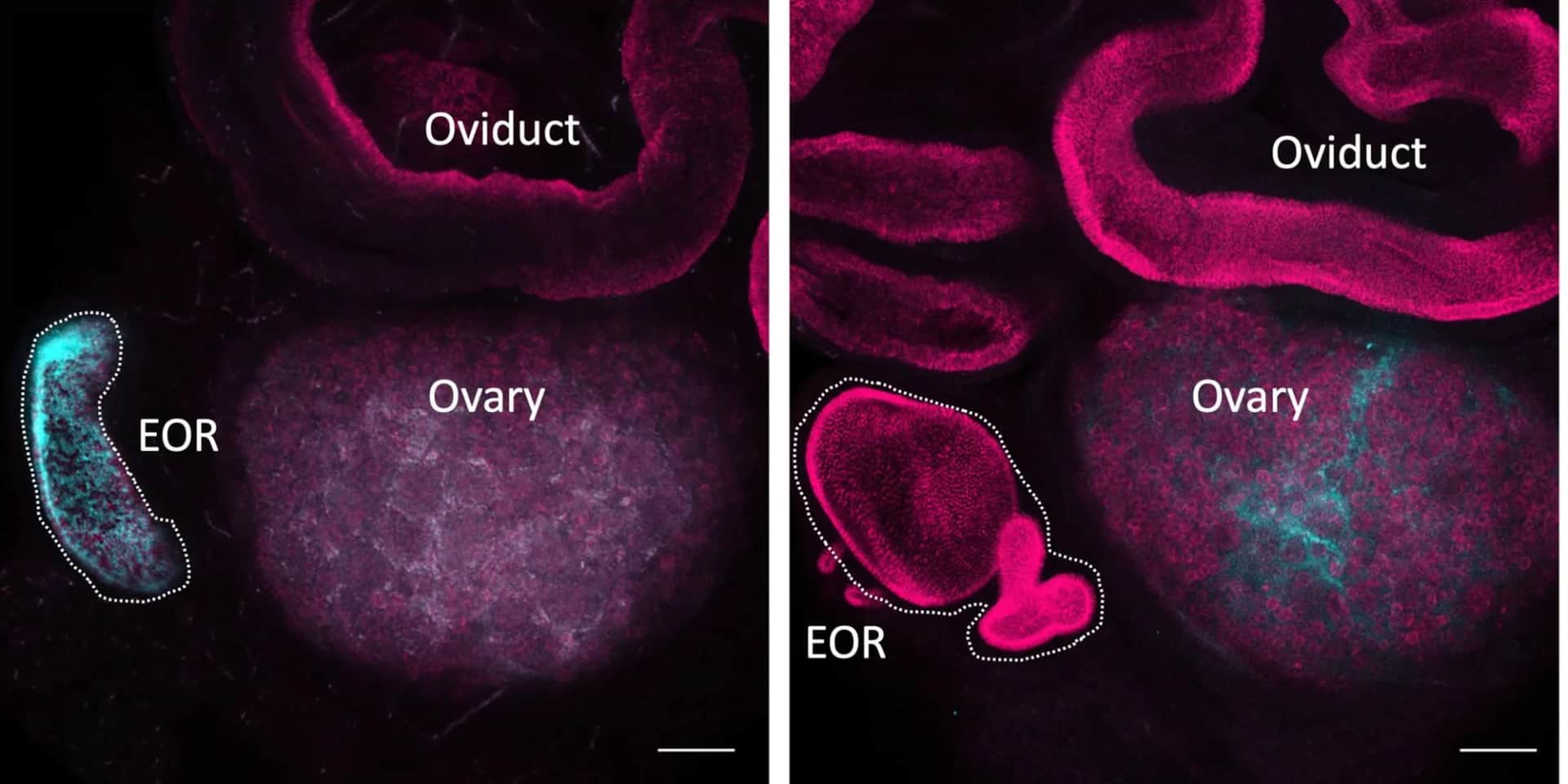
That changed when developmental biologist Jennifer McKey, then at Duke University, began imaging entire mouse ovaries in 3D. She kept noticing a curving, horseshoe-shaped structure at the base of the ovary, went back through the old anatomical literature, and matched it to the forgotten rete ovarii. Her team published the rediscovery in 2022.
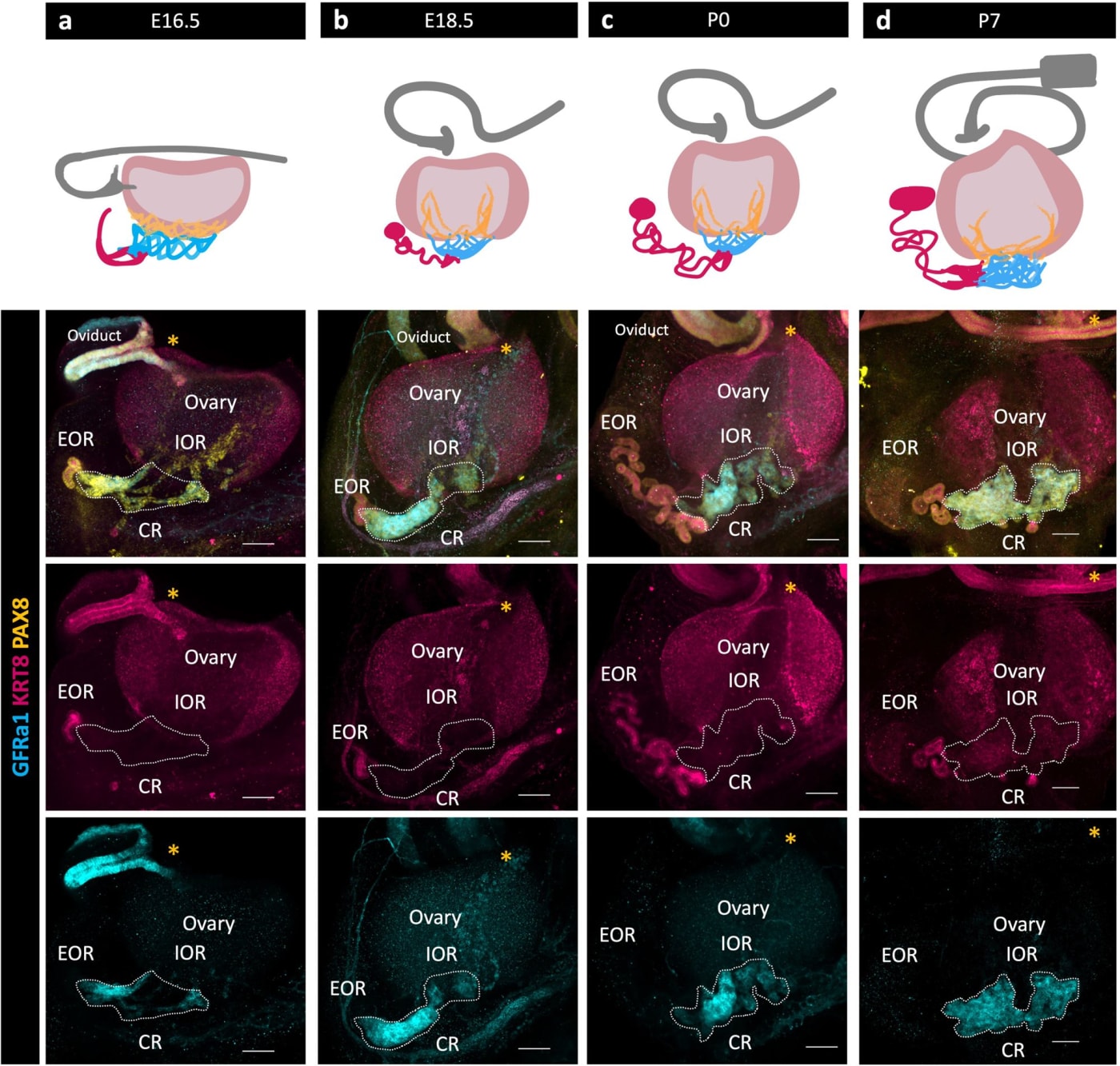
Mapped whole, the rete ovarii turned out to have three distinct regions: a fine network of cell cords inside the ovary, a long coiled tube outside it that ends in a swollen tip, and a connecting section that joins the two. All three persist from development into adulthood.
What the new research actually found
The study behind the latest wave of headlines was published in the journal eLife in March 2025 by Dilara Anbarci, McKey and colleagues at Duke. Its central experiment is simple to describe. The team injected a fluorescent dye, made of molecules too large to seep passively through tissue, into the swollen tip of the external tube in week-old mice. Within 15 minutes, the dye had flowed through the rete ovarii and spread into the ovary. When they injected dye into the ovary instead, it stayed put and never flowed back.
In other words, fluid moves one way: from the rete ovarii into the ovary. When the researchers analysed that fluid, they found it contained secreted proteins, some of them potentially important to how the ovary works. The tube is also wrapped in smooth muscle that could squeeze it, threaded with blood vessels, surrounded by immune cells, and directly touched by nerve fibres.
An earlier paper from the same group, published in 2024, found that some genes in the rete ovarii switch on when estrogen levels peak. Put together, Anbarci’s interpretation is that the structure might work something like an antenna for the ovary, picking up signals from the body and sending supplies in response.
There's still so much we can't even begin to comprehend about female anatomy.
— Dilara Anbarci, developmental biologist, to Science News (2025)
The rete ovarii, by the numbers
What we don’t know yet
Here’s where the viral version runs ahead of the science. Everything above comes from mice, and most of the key experiments were done in very young animals. Nobody has yet shown what happens to fertility if the rete ovarii is removed or switched off, which is the test that would prove it matters.
Serge Nef, a developmental biologist at the University of Geneva who wasn’t involved in the work, told Science News the experiments show “there’s something going on,” but called it “just the beginning of the story.” It is also still unknown whether the human rete ovarii behaves the same way, although single-cell studies have identified its cells in human fetal gonads.
So “scientists discovered a new organ” is wrong, and “scientists proved a forgotten organ controls fertility” would be wrong too. The accurate version is less punchy but more interesting: a structure everyone wrote off for a century turns out, at least in mice, to be connected, active and sending something into the ovary.
Key dates
- 1870The German anatomist Wilhelm Waldeyer first describes the rete ovarii.
- 20th centuryIt is dismissed as a functionless leftover of development and drops out of textbooks.
- 2022Jennifer McKey and colleagues at Duke rediscover it while imaging whole mouse ovaries in 3D.
- 2024The team finds rete ovarii genes that switch on when estrogen peaks.
- Mar 2025An eLife study shows fluid flowing from the rete ovarii into the mouse ovary.
- Sep 2026News coverage revives the story, and it spreads online as a 'new organ'.
I don’t think the real story needs exaggerating. It’s a useful reminder that “we know everything about the body” is never quite true, and that some of what we think we know is just what nobody bothered to check. The rete ovarii was never hidden. It was ignored, and that is a different kind of discovery.
Read next: why PCOS is being renamed PMOS, what really happens to the body after birth, and the study that mapped where emotions live in the body.
Sources
- Dilara N. Anbarci, Jennifer McKey, Daniel S. Levic, Michel Bagnat and Blanche Capel, “Rediscovering the rete ovarii, a secreting auxiliary structure to the ovary,” eLife (2025) (published March 19, 2025).
- Jennifer McKey et al., “Integration of mouse ovary morphogenesis with developmental dynamics of the oviduct, ovarian ligaments, and rete ovarii,” eLife (2022)
- Dilara N. Anbarci et al., “Bulk and single-cell transcriptome datasets of the mouse fetal and adult rete ovarii and surrounding tissues,” Scientific Data 11, 383 (2024)
- Yan Zhang and Hua Zhang, “Revisiting the rete ovarii,” eLife Insight (2025)
- Meghan Willcoxon, “An overlooked organ may help the ovary function,” Science News (April 11, 2025).
- “‘Useless’ female organ discovered over a century ago may actually support ovaries, study finds,” Live Science
- Patrice Peck, “A female body part disappeared from textbooks because doctors thought it was useless — it’s not,” New York Post (September 24, 2026).
- Images: Figures 1 and 3 from Anbarci et al., eLife (2025), © 2024 Anbarci et al., licensed CC BY 4.0. Figure 3 cropped for the cover.