A long passage about life after childbirth has been circulating online, and it lands because it names things new mothers are rarely told in advance. You bleed for weeks. Your uterus shrinks by contracting, and it hurts. Your hormones crash. Your hair falls out months later. And there is a word for the whole upheaval, matrescence, that most people have never heard.
Most of it holds up well against the medical literature. A couple of details are overstated, and one is close to backwards. But the larger point, that recovery from birth is far longer and more total than the six-week checkup implies, is one that obstetricians have been making themselves.
The wound nobody sees
When the placenta detaches after birth, it leaves a raw area on the inside wall of the uterus where it was attached. The post describes that wound as roughly the size of a dinner plate. The placenta itself is about that size, but the site shrinks fast. The uterus clamps down immediately, contracting the area to less than half the placenta's original diameter, and the standard obstetrics textbook, Williams Obstetrics, describes it as roughly palm-sized right after delivery. By the end of the second week it is about 3 to 4 centimetres across.
That wound is the main reason for the bleeding afterwards, which is called lochia. The first few days really are heavy, red bleeding. After three or four days it turns pinkish-brown, and after about ten days it becomes a pale, yellowish-white discharge. The whole process usually lasts four to six weeks, with the average somewhere between 24 and 36 days. Many women also notice a brief return of red bleeding one to two weeks after birth, when the scab over the placental site comes away. It usually settles on its own, though heavy bleeding at any point is a reason to call a doctor.
Shrinking a uterus
The post's most striking image is the shrinking uterus, and the numbers behind it are real. Right after birth the uterus weighs about 1,000 grams. It drops to roughly 500 grams within a week, 300 grams by two weeks, and around 100 grams by four weeks, eventually settling near 60 grams. The comparison to a watermelon becoming a pear is a fair one.
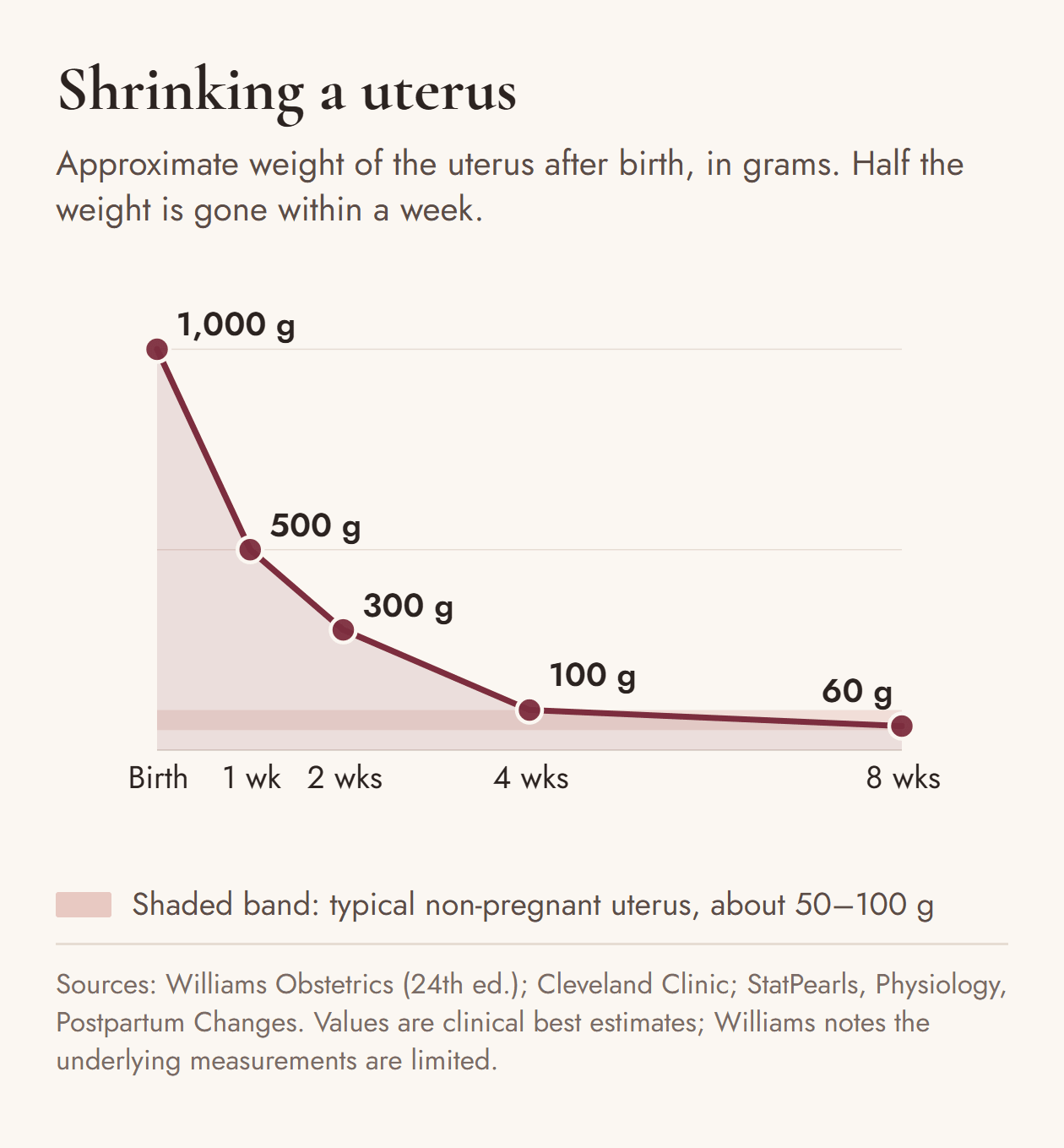
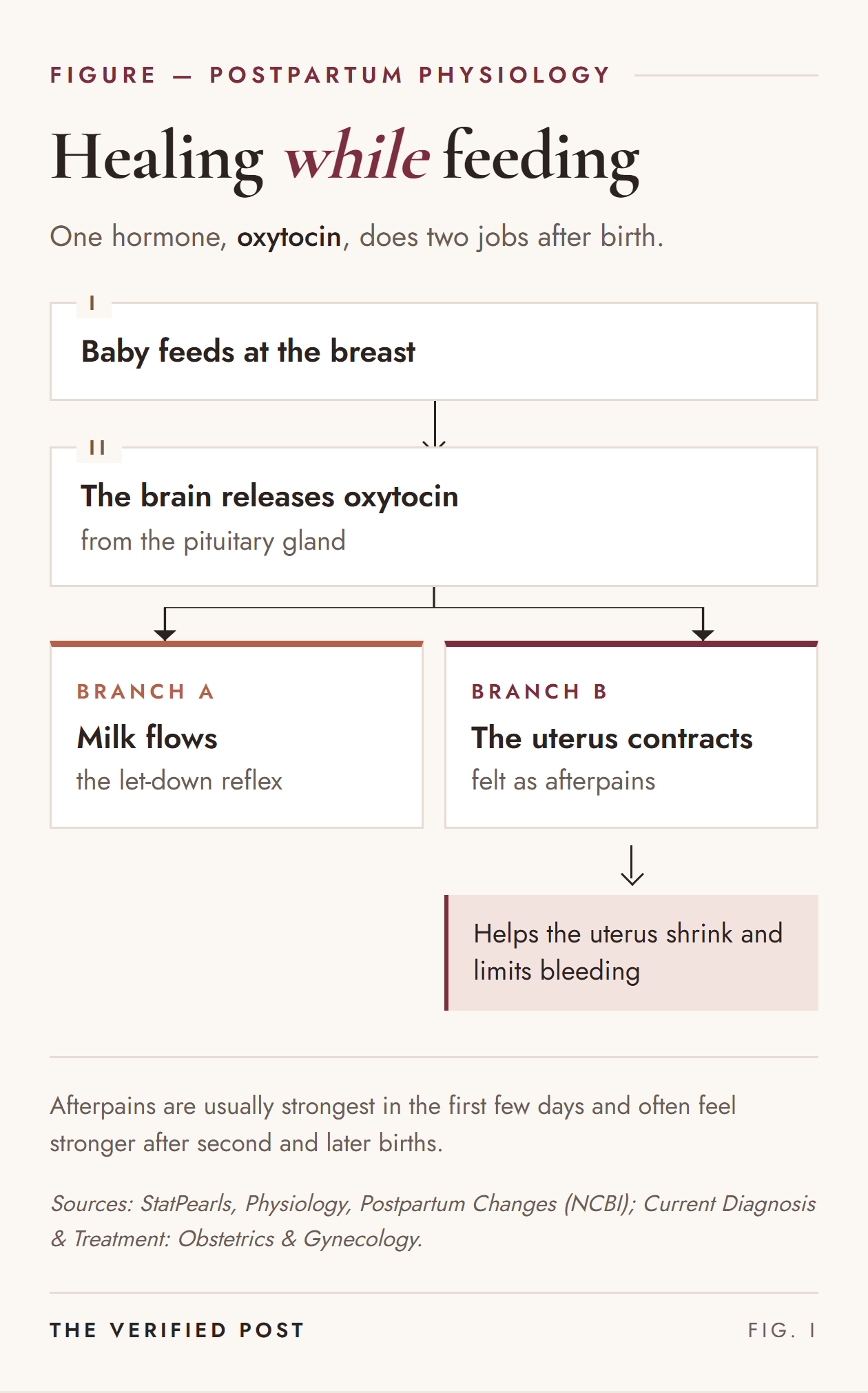
The uterus does this mostly by contracting and by breaking down the enlarged muscle cells it built during pregnancy. The contractions are what women feel as afterpains. Medical references note that they cause more discomfort in women who have given birth before than in first-time mothers, which matches the post's claim that they can feel worse with each baby.
The post is also right about what triggers them. When a baby feeds at the breast, the pituitary gland releases oxytocin. That single hormone does two jobs at once: it makes milk flow, and it makes the uterus contract. Clinicians have long noted that afterpains get stronger during nursing for exactly this reason. It is one of the more elegant arrangements in human biology. Feeding the baby also helps the mother's body close the wound and control bleeding.
The hormone drop
During pregnancy the placenta produces enormous amounts of oestrogen and progesterone. Once it leaves the body, those levels fall abruptly, and that fall is part of what drives uterine recovery. It is also linked to the emotional swings that follow.
The "baby blues" are extremely common. Estimates vary with how they are defined, but reviews put them at roughly half to three-quarters of new mothers. They typically show up within the first week, with crying spells, irritability, anxiety and a sense of not quite recognising yourself, and they usually lift within about two weeks without treatment. Crying is often part of it, and there are reasons why a good cry can leave you feeling better. The blues are not an illness. But if low mood lasts longer than two weeks or becomes disabling, that is a signal to seek help.
Sleep: broken, not light
Here the viral text gets something close to backwards. It says new mothers spend more time in light sleep because the brain has become hypersensitive to the baby. Sleep studies that record brain activity overnight have tended to find the opposite. Research on postpartum mothers has found less light sleep and preserved or even increased deep sleep, as if the body is working to recover what it can.
The real problem is fragmentation. One study that tracked mothers through the first four postpartum months found they slept about 7.2 hours a night on average, more than the researchers expected, but were awake for nearly two hours of the night in pieces. The authors compared the pattern to fragmenting sleep disorders such as sleep apnea, which leave total sleep time intact while wrecking its quality. The post is closer to the mark on one point. Japanese researchers found that mothers' night-time waking was tightly synchronised with their infants' movements, so the sense of waking just before the baby cries has some basis.
The six-week myth
The single checkup around six weeks has long been treated as the finish line. The American College of Obstetricians and Gynecologists changed its guidance in 2018 to say otherwise. Its committee opinion recommends that postpartum care be an ongoing process rather than a single visit, with contact within the first three weeks and a comprehensive visit no later than twelve weeks after birth, covering mood, sleep, physical recovery and more. The organisation described the weeks after birth as a "fourth trimester."
Some recovery simply takes longer than six weeks. The uterus is back near its pre-pregnancy size by about then, but the cervix can take months to regain its firmness, and breastfeeding keeps oestrogen low, which slows the recovery of some tissues.
Recovery after birth: what happens when
- BirthThe placenta detaches and the uterus, about 1 kg, starts contracting to close the wound and limit bleeding.
- Days 1 to 4Heaviest bleeding, bright red (lochia rubra). Afterpains are strongest, especially during feeds.
- First weekBaby blues commonly begin. They usually lift within about two weeks.
- 1 to 2 weeksA short return of red bleeding is common as the scab over the placental site comes away.
- Within 3 weeksACOG recommends a first check-in with an obstetric care provider.
- 4 to 6 weeksDischarge usually ends. The uterus is back near its pre-pregnancy size.
- By 12 weeksACOG recommends a comprehensive postpartum visit covering mood, sleep and physical recovery.
- 3 to 4 monthsHair shedding typically starts around three months and peaks around four.
- 3 to 6 monthsThe highest reported rates of depressive symptoms, in fathers as well as mothers.
- First birthdayMost women's hair has returned to its normal fullness.
- 2 years and beyondBrain changes from pregnancy are still measurable on MRI scans.
Hair, and the months that follow
The hair loss the post mentions is real, common and temporary. Dermatologists call it telogen effluvium. During pregnancy, high oestrogen keeps more hair in its growing phase, and when oestrogen falls after birth, that hair sheds at once. The American Academy of Dermatology says shedding usually peaks around four months after birth and that most women regain their normal fullness by their child's first birthday. In one Japanese survey of more than 300 mothers, over 90 percent reported postpartum hair loss, which began on average at about three months.
The post's warning that difficulties can surface months in, rather than in the first weeks, also has support, though the exact timing it gives, five to seven months, is not what the research shows. Perinatal depression, which affects about 1 in 7 women, can begin at any point in pregnancy or the first year after birth. A widely cited 2010 meta-analysis in JAMA found that about 10 percent of fathers experience depression during pregnancy or the first postpartum year, with the highest rates reported between three and six months after birth. The same analysis found maternal rates also peaked in that window. Postpartum depression is not a problem of the first few weeks alone, and screening that stops at six weeks can miss it.
A word for all of it
The term the post ends on is genuine. Matrescence was coined in the 1970s by Dana Raphael, a medical anthropologist who studied birth and breastfeeding and who also popularised the word "doula." She argued that the transition into motherhood was a developmental passage that researchers had overlooked, one that deserved study in its own right.
Giving birth does not automatically make a mother out of a woman.
Dana Raphael, anthropologist, Being Female (1975)
The idea sat largely unused for decades until the clinical psychologist Aurélie Athan revived it, defining matrescence as a transformation that is at once biological, psychological, social and cultural. The comparison to adolescence, which the viral post makes, is now a serious research framing. Both are periods of dramatic hormonal change, shifting identity and brain remodelling, and a 2019 study found that the brain's structural changes in pregnancy resemble those seen in adolescence.
The brain evidence is the strongest part of the story. A landmark 2017 study in Nature Neuroscience scanned women before and after their first pregnancy and found consistent reductions in grey matter volume in regions involved in social cognition, changes so reliable that they correctly identified every woman who had been pregnant. Those changes were still present two years later, and they predicted measures of the mother's attachment to her baby. Researchers describe the process less as loss than as fine-tuning, a brain reorganising itself for a new job. Later work suggests some of these changes can be traced for years.
The science of women's bodies has often lagged behind women's experience of them, from how long endometriosis goes undiagnosed to how little attention the months after birth receive, even as research on the first 1,000 days of a child's life grows. The viral post overstates a wound and misreads the sleep research. On the part that matters most it is right: a woman who has given birth is not supposed to simply snap back to who she was. Her body, her brain and her life have been rebuilt, and the medical establishment is only beginning to plan care that reflects how long that takes.
Sources
- StatPearls, "Physiology, Postpartum Changes," NCBI Bookshelf (updated 2026).
- Williams Obstetrics, 24th edition, Chapter 36, "The Puerperium."
- Current Diagnosis & Treatment: Obstetrics & Gynecology, 11th edition, "The Normal Puerperium."
- Cleveland Clinic, "Uterus Involution" (2025).
- MSD Manual Professional Edition, "Postpartum Care."
- StatPearls, "Perinatal Depression" and "Postpartum Blues," NCBI Bookshelf.
- ACOG Committee Opinion No. 736, "Optimizing Postpartum Care," Obstetrics & Gynecology, 2018.
- Paulson JF, Bazemore SD. "Prenatal and postpartum depression in fathers and its association with maternal depression." JAMA, 2010.
- Montgomery-Downs HE, et al. "Normative longitudinal maternal sleep: the first 4 postpartum months." American Journal of Obstetrics & Gynecology, 2010.
- Nishihara K, Horiuchi S. Studies of postpartum sleep and infant movement, 1998 and 2001.
- American Academy of Dermatology, "Hair loss in new moms."
- Hirose A, et al. "Investigation of exacerbating factors for postpartum hair loss," 2023.
- Athan AM. "A critical need for the concept of matrescence in perinatal psychiatry," Frontiers in Psychiatry, 2024.
- Hoekzema E, et al. "Pregnancy leads to long-lasting changes in human brain structure." Nature Neuroscience, 2017.
- Carmona S, et al. "Pregnancy and adolescence entail similar neuroanatomical adaptations." Human Brain Mapping, 2019.