The internet has a confident explanation for why you feel better after crying. It involves a molecule discovered at the Pasteur Institute, a painkiller six times stronger than morphine, and your body heroically self-medicating every time the tears fall.
None of that is accurately described. The molecule is real. The six-times-stronger claim is not supported by the science. The Pasteur Institute origin story is fabricated — the molecule in question was first identified in brain extracts in 1975 by researchers John Hughes and Hans Kosterlitz, not in 2006, and not in Paris.
The actual research into why crying produces relief is messier, more conditional, and more honest than any viral post can capture. It is also, once you sit with it, considerably more interesting.
Not All Tears Are the Same
The first thing the science establishes is a distinction most people have never considered. Human eyes produce three chemically distinct types of tears, and they are not interchangeable.
Basal tears are the continuous film that lubricates and protects the eye surface — produced constantly, never noticed. Reflex tears are the ones triggered by physical irritants: smoke, dust, the sulphur compounds released when you cut an onion. These are purely mechanical responses and share little chemically with the third type.
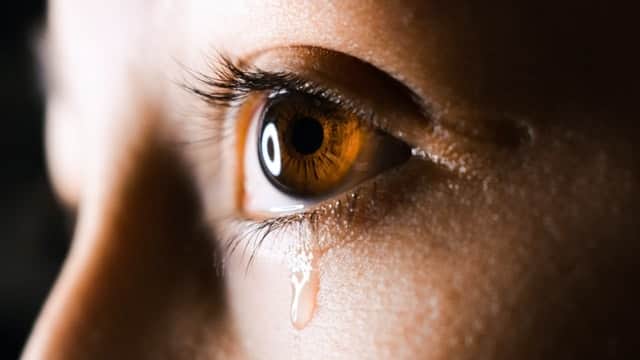
Emotional tears — also called psychic tears — are chemically different from both. In the 1980s, biochemist William H. Frey II at the Tear Research Center in Minnesota ran some of the first serious laboratory studies comparing their composition. He found that emotional tears contain significantly higher concentrations of cortisol, prolactin, and adrenocorticotropic hormone (ACTH) than reflex tears — all substances associated with the stress response. Emotional tears also contain leucine-enkephalin, a naturally occurring opioid neuropeptide. Frey proposed that crying was essentially an excretory process — the body flushing stress chemicals it had accumulated.
Related: how scientists mapped where you feel emotions in your body.
This hypothesis was appealing and widely repeated. The problem, as subsequent researchers noted, was that it was difficult to verify. Most tears are actually absorbed through the nasal passages rather than falling from the face, making collection in laboratory conditions genuinely challenging. And a complicating finding emerged: similar cortisol reductions were observed in young rhesus monkeys separated from their mothers — animals that do not produce emotional tears but do emit distress calls. If cortisol dropped without tears, the tears themselves might not be doing the flushing. Something else might be responsible.
It seems that crying begins just after the peak of physiological arousal as sympathetic activity starts to decrease and parasympathetic activity increases, helping to bring the body back to homeostasis.
— Dr. Lauren Bylsma, assistant professor of psychiatry, University of Pittsburgh
The Nervous System Switch
The more robust explanation for post-crying relief centres not on tear chemistry but on the nervous system — specifically on the transition from one mode of operation to another.
When a person is under emotional stress, the sympathetic nervous system activates — the fight-or-flight system that raises heart rate, tightens muscles, shallows breathing, and generally puts the body on high alert. Crying, the research suggests, tends to begin just after this peak of sympathetic arousal. As tears flow, the parasympathetic nervous system — responsible for rest, digestion, and recovery — begins to take over.
Research from Tilburg University led by Ad Vingerhoets — a professor of medical and clinical psychology and the world's leading academic expert on crying — demonstrated that most people who cry experience a measurable increase in parasympathetic activity in the twenty to thirty minutes after crying begins. This is the physiological equivalent of a system returning to standby after running hot. Heart rate slows. Breathing deepens. Muscle tension decreases. The sensation of relief has a direct physical correlate: the body genuinely is calming down, and crying appears to be part of the mechanism by which that happens.
During this process, the brain also releases endorphins and oxytocin — chemicals associated with pain relief, calm, and social bonding. This is likely responsible for the warm, heavy exhaustion that often follows intense crying — not a breakdown, but a physiological settling. The system that was running at high intensity has found its way back to rest.
When It Doesn't Work — and Why That Matters
One of the most important and least-discussed findings in the science of crying is that it does not always produce relief. This is not a minor caveat. It is central to understanding what the research actually shows.
In 2008, Lauren Bylsma, Vingerhoets, and Jonathan Rottenberg published a landmark study in the Journal of Social and Clinical Psychology titled "When Is Crying Cathartic?" They collected self-report data from 5,096 students across 35 countries — one of the largest cross-cultural studies on crying ever conducted. Their finding was not that crying always helps. It was that whether crying helps depends heavily on context.
The factors most strongly associated with post-crying mood improvement were having a supportive person present, crying in a safe and private environment, and crying over a situation that could be resolved. When people cried in public, in front of multiple people, or in situations involving shame or embarrassment, mood tended not to improve and sometimes worsened. When researchers induced crying in laboratory settings — asking participants to cry on demand while watching a sad film — the effects were smaller and less consistent than those reported in natural, real-life crying episodes.
A further complication: laboratory studies that measured mood immediately after crying often found that those who cried were in worse moods than those who didn't — at least in the short term. The relief, when it came, took time. Vingerhoets and colleagues found that the positive effects of crying needed space to develop — they were not instantaneous. The common expectation that crying produces immediate catharsis is not, on average, what the data shows. The relief tends to arrive after the crying has stopped, not during it.
The research is not that crying always helps. It is that crying can help — under specific conditions, after a delay, and through a combination of nervous system activity and social response that is far more conditional than any viral post suggests. The honest finding is also the more interesting one.
The Social Dimension — What the Science Actually Emphasises
If there is one finding that the crying research consistently emphasises above the biochemistry, it is this: the social context of crying matters more than most people assume.
Vingerhoets, whose 2013 book Why Only Humans Weep remains the definitive academic text on the subject, argues that emotional crying evolved primarily as a social signal — a visible, audible display of distress that communicates helplessness and invites help from others. Human infants are among the most helpless creatures at birth of any species — unable to cling to fur, unable to follow their parents like other animals. Crying is the mechanism by which they summon care. Adult emotional crying, Vingerhoets argues, retains this fundamental function. It communicates: I need you. Help me.
This framing changes how to interpret the relief that follows crying. It may not primarily be about the chemistry of tears or the nervous system switch — though those mechanisms are real. It may primarily be about what crying does in a social environment: it signals vulnerability, it invites connection, and it tends to produce comfort from others when the social conditions are right. The mood improvement, in this view, is partly the mood improvement of having been heard.
Bylsma's research found that the presence of a single intimate person — a close friend, a parent, a partner — during a crying episode was the single factor most strongly associated with post-crying mood improvement. The presence of multiple people, by contrast, was associated with less improvement, possibly because it introduced shame or self-consciousness. Crying alone in a safe space produced intermediate results. The variable was not the tears. It was who was there.
What the Honest Answer Actually Is
The science of why you feel better after crying, assembled from the published research, looks like this: emotional tears are chemically distinct from other tears and contain stress-related hormones. Crying tends to coincide with a shift from sympathetic to parasympathetic nervous system activity — a biological de-escalation that produces measurable physical calm. The brain releases endorphins and oxytocin during and after intense crying. All of this is real and documented.
But whether any individual person feels better after crying on any particular occasion depends on: who is present, what the situation is, whether support is available, and how much time passes after the crying ends. Roughly 60 to 70 percent of people report mood improvement after crying. Thirty to forty percent do not. The research does not support the unconditional claim that crying always helps, or that the mechanism is a miraculous painkiller in the tears.
What it does support is something quieter and perhaps more useful: that emotional crying is a genuine physiological and social process with real effects, that those effects are conditional rather than guaranteed, and that the most important variable in whether crying helps is not the chemistry of what falls from your eyes but whether there is someone trustworthy to witness it.
The Point
The viral post says your tears contain a painkiller six times stronger than morphine and your body is self-medicating. The published research — drawn from studies across 35 countries, thousands of participants, and decades of work by researchers including Ad Vingerhoets, Lauren Bylsma, and William Frey — says something more conditional and more honest: crying shifts the nervous system from high alert toward rest, releases stress-related hormones and endorphins, and tends to help about 60 to 70 percent of the time, depending heavily on who is there. The most important factor is not the molecule in the tear. It is whether someone you trust is in the room.
Read next: Why you might feel people don't like you.
Sources
- Bylsma, Vingerhoets & Rottenberg — When is crying cathartic? An international study, Journal of Social and Clinical Psychology, 2008
- Gračanin, Bylsma & Vingerhoets — Is crying a self-soothing behaviour?, Frontiers in Psychology, 2014 — PMC
- Bylsma, Gračanin & Vingerhoets — The neurobiology of human crying, PMC / NIH, 2018
- Sharman, Dingle, Vingerhoets & Vanman — Using crying to cope: physiological responses to stress following tears of sadness, Emotion, 2020 — PubMed
- Frey, W.H. — Crying: The Mystery of Tears, Winston Press, 1985 (foundational biochemistry research)
- Vingerhoets, A.J.J.M. — Why Only Humans Weep: Unravelling the Mysteries of Tears, Oxford University Press, 2013
- Time Magazine — Why Do We Cry? The Science of Crying — time.com (Vingerhoets interview)
- Reader's Digest Asia — 14 ways a good cry affects your body and mind — rdasia.com (Bylsma and Vingerhoets interviews)