The question sounds simple enough. If humans had wings, how big would they need to be?
The answer, when you work through the physics, is both more precise and more humbling than you might expect. According to calculations by Ty Hedrick, a professor of biology at the University of North Carolina at Chapel Hill — using an equation developed by Robert Nudds, a senior lecturer in biological sciences at the University of Manchester and published in the Journal of Avian Biology — a person weighing around 155 pounds and standing five feet tall would need a wingspan of approximately 20 feet just to get off the ground.
Yale Scientific Magazine puts the figure slightly higher for an average adult male — at least 6.7 metres, or roughly 22 feet. That is the wingspan of a Cessna 152 light aircraft. It is four times the average human arm span. It is wider than most living rooms are long.
And the wings, it turns out, would be the easiest part of the problem.
The Law That Makes Everything Hard
In 1638, the Italian scientist Galileo Galilei identified a principle that would later become one of the most important constraints in the biology of large animals. He called it the square-cube law, and it works like this: when you scale up any object proportionally, its volume — and therefore its weight — increases with the cube of its dimensions, but its surface area increases only with the square.
For flight, this is catastrophic. Wings generate lift based on their surface area. Body weight works against lift. Double the dimensions of a flying animal and its weight increases eightfold, while its wing surface only quadruples. The ratio between the two — what engineers call wing loading — gets worse with every increase in size. This is why the largest flying birds in the world today top out at around 15 to 20 kilograms, and why no flying animal in the entire history of life on Earth has come close to the mass of an average adult human.
An 80-kilogram human would need at least 3.2 square metres of wing surface just to hit the absolute ceiling of what physics allows for avian flight — a wing loading of 25 kilograms per square metre, beyond which sustained flight becomes impossible. In practice, for controlled and sustainable flight rather than a brief, desperate glide, the wings would need to be considerably larger. Hence the 6 to 7 metre estimates. Hence the bus.
Someone who's about 155 pounds and at least 5 feet tall would have a wingspan of about 20 feet — which I thought was surprisingly small.
— Ty Hedrick, Professor of Biology, University of North Carolina at Chapel Hill, speaking to Live Science
The Body You Would Need to Actually Use Them
Assume for a moment that you have the wings. Twenty feet of them, folded behind you like a nightmare version of angel iconography. You still cannot fly. Not with this body.
In birds, between 16 and 30 percent of total muscle mass comes from the muscles dedicated to flight — primarily the massive pectoral muscles of the chest. In some species the chest muscles alone account for nearly a third of the entire body's weight. This is what allows a bird to generate the sustained power needed to flap wings against the resistance of the air. A human chest contains nothing remotely comparable. To power wings of the required size, your pectoral muscles would need to project outward by approximately 1.25 metres from your chest. You would need what biomechanists describe as a keel bone — a large protruding structure running down the centre of your breastbone, giving the expanded muscles a rigid anchor point further from the shoulder joint to increase mechanical leverage.
Your skeleton would need to be fundamentally different. Human bones are dense, marrow-filled, and engineered for absorbing the impact of terrestrial locomotion — walking, running, falling. Bird bones are hollow, round in cross-section, and thin-walled — a shape that resists the twisting forces of flight while keeping weight to a minimum. A flying human would require partially hollowed bones, a redesigned ribcage, and a respiratory system incorporating air sacs that extend into the abdomen and potentially into the bones themselves — the way bird lungs work, cycling air continuously rather than the in-out bellows system of human lungs.
Your legs would need to be dramatically lighter — spindly structures barely adequate for standing, let alone running. Your centre of gravity, currently positioned in your pelvis for bipedal walking, would need to shift upward. Your heart would need to be roughly half again larger than it is, beating faster than a human heart to pump oxygenated blood to the enormous muscle mass of the chest. You would need patches of bare skin under the wings and around the face to shed the tremendous heat generated by sustained flight.
What you would end up with, as ScienceInsights summarised the calculations, would look far less like a human with wings and far more like a very large bird with a human-like head — and hands, perhaps, at the wing joints. The person would be gone. Something else would be there instead.
The Creature That Actually Did It
Six million years ago, in what is now Argentina, something flew that weighed approximately as much as a modern adult human.
Argentavis magnificens — the giant teratorn, whose name translates from Latin as "the magnificent Argentine bird" — had an estimated mass of 70 to 72 kilograms and a wingspan of approximately 7 metres. Its fossils were first discovered in Argentina's La Pampa province by researchers from the Museo de La Plata and formally described in a landmark 1980 paper by Kenneth Campbell Jr. and Eduardo Tonni. It remains the heaviest flying bird ever found in the fossil record.
It had a skull 55 centimetres long with a massive hooked beak large enough to swallow a rabbit whole. Its humerus — the upper arm bone — was barely shorter than an entire human arm. Its territories covered more than 500 square kilometres of the Argentine pampas and the foothills of the Andes.
And it almost certainly could not flap those wings for any sustained period of time.
A 2007 study published in the Proceedings of the National Academy of Sciences — using a flight simulation model originally developed for helicopter aerodynamics — found that Argentavis was probably too heavy to sustain continuous flapping flight or to take off from flat ground under its own muscle power. Instead, it was almost certainly a master soarer. It extracted energy from the atmosphere itself — riding thermals rising from the hot, dry Argentine plains, spiralling upward in columns of warm air, and then gliding outward at a shallow angle of approximately three degrees before finding the next thermal. Its estimated cruising speed was 67 kilometres per hour. The researchers calculated it could stay aloft indefinitely as long as thermals were available — which, in the hotter, drier Late Miocene climate of six million years ago, they reliably were.
Argentavis was pushing the absolute limit of what the physics of flight permits for a creature of that mass. Any heavier and the thermals could not have kept it aloft. The Late Miocene climate of Argentina provided exactly the right conditions — powerful, reliable thermals — for an animal of this exact size to exist. When the climate changed, Argentavis disappeared.
Argentavis magnificens weighed roughly as much as a modern adult human and had a wingspan the size of a small aircraft. It almost certainly could not sustain flapping flight. It soared instead — riding columns of warm air across 500-kilometre territories at 67 kilometres per hour. It was the closest nature ever came to a flying human. And it worked only because the climate of six million years ago provided exactly the right conditions. When those conditions changed, it was gone.
What Humans Actually Achieved Instead
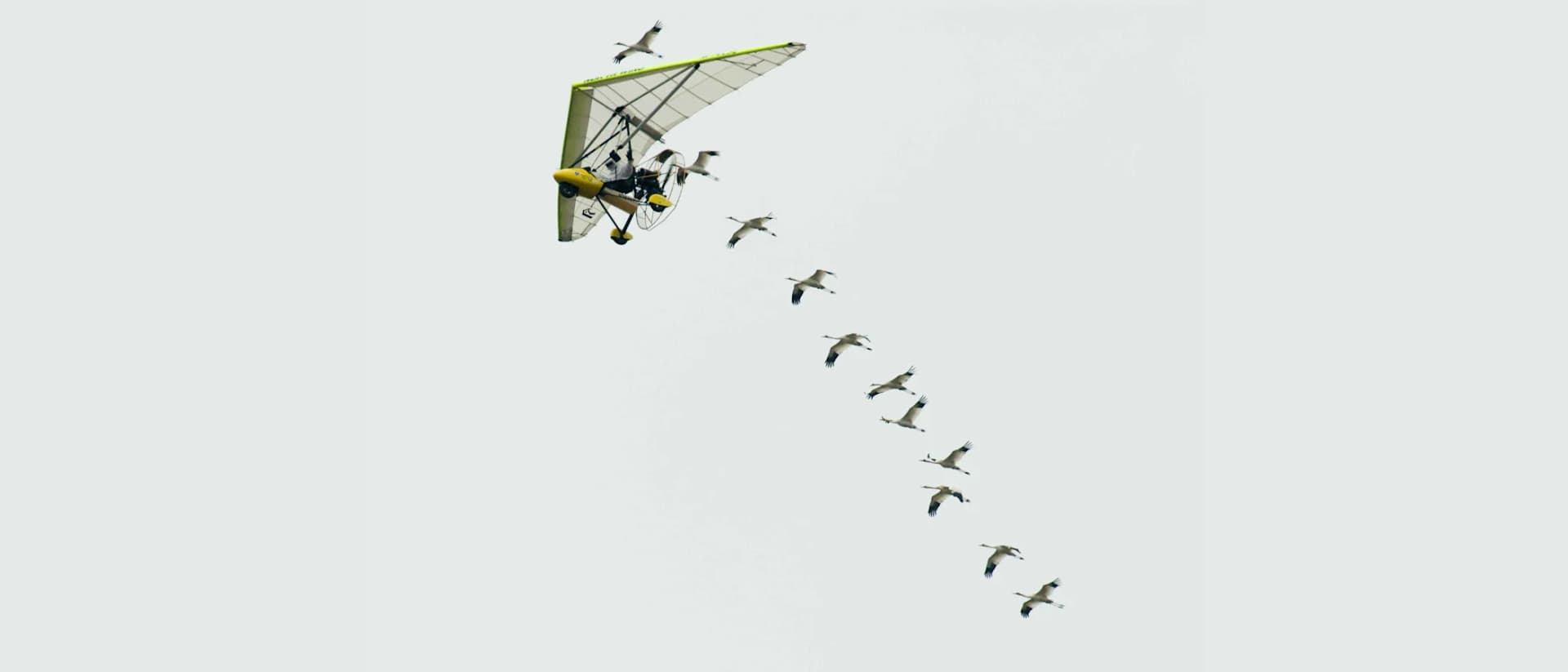
On August 23, 1977, a cyclist named Bryan Allen sat in a cockpit made of 4.5-millimetre-thick transparent Mylar film and pedalled a mechanism connected to a propeller. The aircraft around him — the Gossamer Condor, designed by engineer Paul MacCready — had a wingspan of 96 feet and weighed 70 pounds. Allen pedalled it through a figure-eight course one mile long in 7.5 minutes, winning a $100,000 prize and becoming the first human to achieve sustained, controlled, human-powered flight.
Two years later MacCready designed the Gossamer Albatross, a carbon-fibre successor. Allen flew it across the English Channel — 22 miles above the waves at a top speed of 18 miles per hour, in just under three hours. It now hangs in the Smithsonian National Air and Space Museum.
The Gossamer Condor's wingspan was nearly five times what scientists estimate a human would need to fly biologically. MacCready had solved the problem the only way it can be solved for an animal with our body plan: by separating the lifting surface from the body generating the power, and by making the aircraft extraordinarily light. The human body provided the engine. The machine provided everything the biology cannot.
It is perhaps the most honest summary of why we cannot fly and what we did about it: we are too heavy, too dense, too poorly shaped, and our muscles are in the wrong places. So we built something that compensated for every one of those deficiencies, and we flew anyway. We just looked nothing like angels when we did it.
What the Impossibility Reveals
The reason the question of human flight is interesting is not really about humans. It is about what the answer reveals about the animals that do fly.
A sparrow is not a simplified human with wings attached. It is an entirely different solution to the problem of existing — a body plan shaped over hundreds of millions of years of evolutionary pressure specifically around the demands of powered flight. Its bones are hollow not as a convenience but as a precise engineering response to the twisting forces generated by a wing in motion. Its respiratory system processes oxygen continuously rather than in cycles because powered flight demands more oxygen per second than a mammalian lung can deliver in time. Its chest muscles represent, in some species, a third of the animal's total body weight — not because birds are unusually muscular but because that is the minimum ratio that makes flapping possible at that scale.
The wandering albatross — the living bird with the longest wingspan, at up to 3.5 metres — can stay aloft for years without landing, covering hundreds of thousands of miles over the open ocean by riding the boundary between wind layers. It achieves this not by being strong but by being impossibly precise — a body calibrated to the aerodynamics of the Southern Ocean with an accuracy that no human engineering has yet replicated.
We cannot fly. We are the wrong shape, the wrong weight, the wrong density, built for a completely different set of physical demands. The fact that the calculations produce a number — 6.7 metres, 22 feet, the wingspan of a small aircraft — makes the impossibility feel manageable, as if we are simply a few engineering modifications away from the sky. We are not. We are millions of years of evolution away from it. And the creatures that made that journey are, in their own way, more extraordinary for having done so than any angel ever drawn.
The Point
A 155-pound human needs a 20-foot wingspan just to generate lift. They also need hollow bones, a keel-shaped sternum, chest muscles projecting 1.25 metres outward, a redesigned respiratory system, a larger heart, thinner legs, and a shifted centre of gravity. At that point they are no longer human — they are something that took nature hundreds of millions of years to build, and that evolution has built independently multiple times because the physics of flight are so unforgiving that only one design works. The reason we cannot fly is not a deficiency. It is the price of being built for the ground — for walking upright, for dense bone that absorbs impact, for hands that can hold tools, for a body plan that conquered the surface of the Earth while everything with wings stayed just above it.
Read next: Why volcanoes don't erupt the moment pressure builds.
Sources
- Live Science — If humans could fly, how big would our wings be? — livescience.com (Ty Hedrick, University of North Carolina; Robert Nudds, University of Manchester)
- Robert Nudds — Scaling of avian wing parameters, Journal of Avian Biology, 2007
- Yale Scientific Magazine — wingspan calculation for average adult male
- Wikipedia — Argentavis — en.wikipedia.org
- Chatterjee, Templin & Campbell — The aerodynamics of Argentavis, the world's largest flying bird from the Miocene of Argentina, PNAS, 2007 — doi:10.1073/pnas.0702040104
- National Geographic — Argentavis, the Largest Flying Bird, Was a Master Glider — nationalgeographic.com
- BBC Science Focus Magazine — If humans had wings, what would their wingspan be? — sciencefocus.com
- ScienceInsights — What If Humans Had Wings: How Your Body Would Change — scienceinsights.org
- PMC / PNAS — Ancient Argentavis soars again — pmc.ncbi.nlm.nih.gov
- Guernseydonkey.com — If Humans Could Fly How Big Would Their Wings Have to Be? — guernseydonkey.com (Gossamer Condor details)
Related on The Verified Post: Abby and Brittany Hensel, conjoined twins who live — and teach — as two people in one body.