The clip is short. A woman stands in a kitchen with her hand pressed over her face, and the caption above her says the hardest part of motherhood is postpartum. Another account on X quoted it with a harder message: motherhood is a choice, not an obligation, and nothing is more selfish than expecting a woman to give up her body, her freedom and her future to complete someone else's idea of a family.
You can argue with the tone. It's much harder to argue with the medicine. Birth ends a pregnancy, but it doesn't end what pregnancy set in motion. Hormones collapse within days, recovery runs long past the checkup that's supposed to close it, and at least 40 million women a year are left with a long-term health problem caused by childbirth. Something that costs that much can't honestly be assigned to anyone as a duty.
The hormone fall nobody can prepare you for
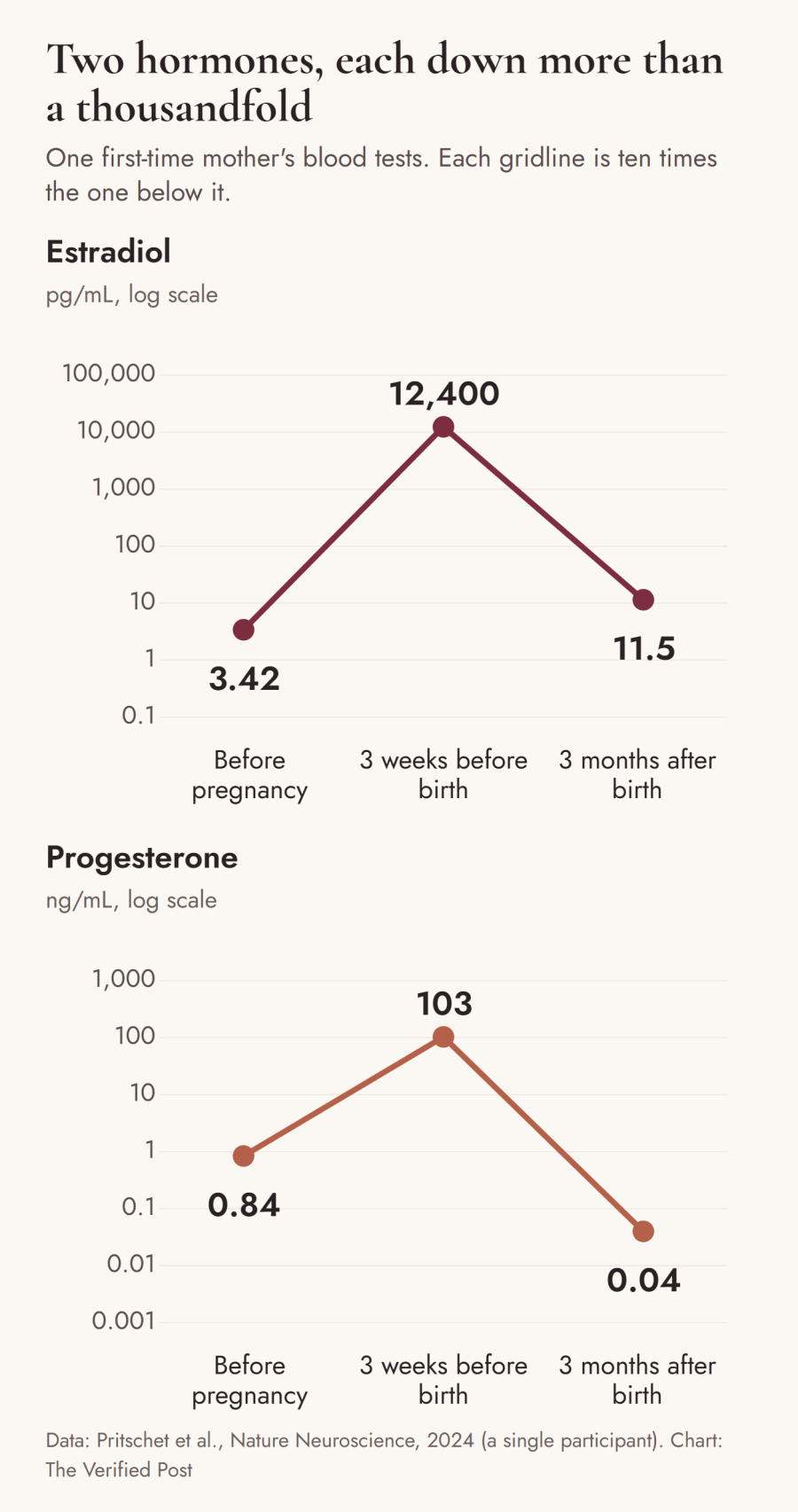
For nine months the placenta works as a hormone factory. Then it's delivered, and the supply stops. Estrogen and progesterone drop sharply and reach roughly pre-pregnancy levels by about the fifth day after birth. That's around the time many women are home, stitched or sore, leaking milk, and being congratulated by everyone who visits.
The clearest picture of the scale comes from a 2024 study in Nature Neuroscience that followed one first-time mother from before conception until after delivery. Three weeks before birth, her estradiol stood at 12,400 pg/mL. Three months after, it was 11.5. Her progesterone went from 103 ng/mL to 0.04. She's one person, and nobody should treat her numbers as an average, but the shape of that curve is the one the researchers describe as typical.
Here's the part that makes it more than a mood story. The body converts progesterone into a neurosteroid called allopregnanolone, which calms the brain by acting on GABA-A receptors, the brain's main braking system. By one estimate, brain levels sit around 150 nanomolar late in pregnancy and fall back to about 5 after birth. The leading theory is that the receptors adapted during those months and, in some women, are slow to readjust. So the brakes are weak at the exact moment a newborn starts crying at 3 a.m.
That theory isn't settled. Studies comparing hormone levels with postpartum mood have been inconsistent, and every woman who gives birth goes through this fall while most don't develop depression. Prior depression, stress and an unwanted pregnancy are all recognized contributors too. That last one should stop you for a second, given what this argument is about: a pregnancy a woman didn't want is itself on the list of things linked to postpartum depression.
Still, the drugs tell us something. Brexanolone, a 60-hour hospital infusion approved in 2019, is a formulation of allopregnanolone itself. Zuranolone, a two-week course of pills approved by the FDA in August 2023, targets the same pathway. Both were built on the idea that this crash matters.
More than half of new mothers feel some version of it as the baby blues, starting around day three or four: tearful, anxious, irritable, unable to say why. It usually lifts on its own within about two weeks, and a good cry can genuinely help. If you've ever been told you were overreacting during those days, you weren't imagining the chemistry.
Six weeks was never the finish line
We've already covered the wound inside the uterus, the weeks of bleeding and the shrinking womb. What gets less attention is what's still there after all that has healed.
Postnatal care has historically ended at about six weeks. In 2023, a Lancet Global Health paper argued that this cutoff helped create the false impression that later problems are rare or unimportant. Its authors gathered the available data on what persists beyond that point, and it's a list most women never see before they're pregnant.
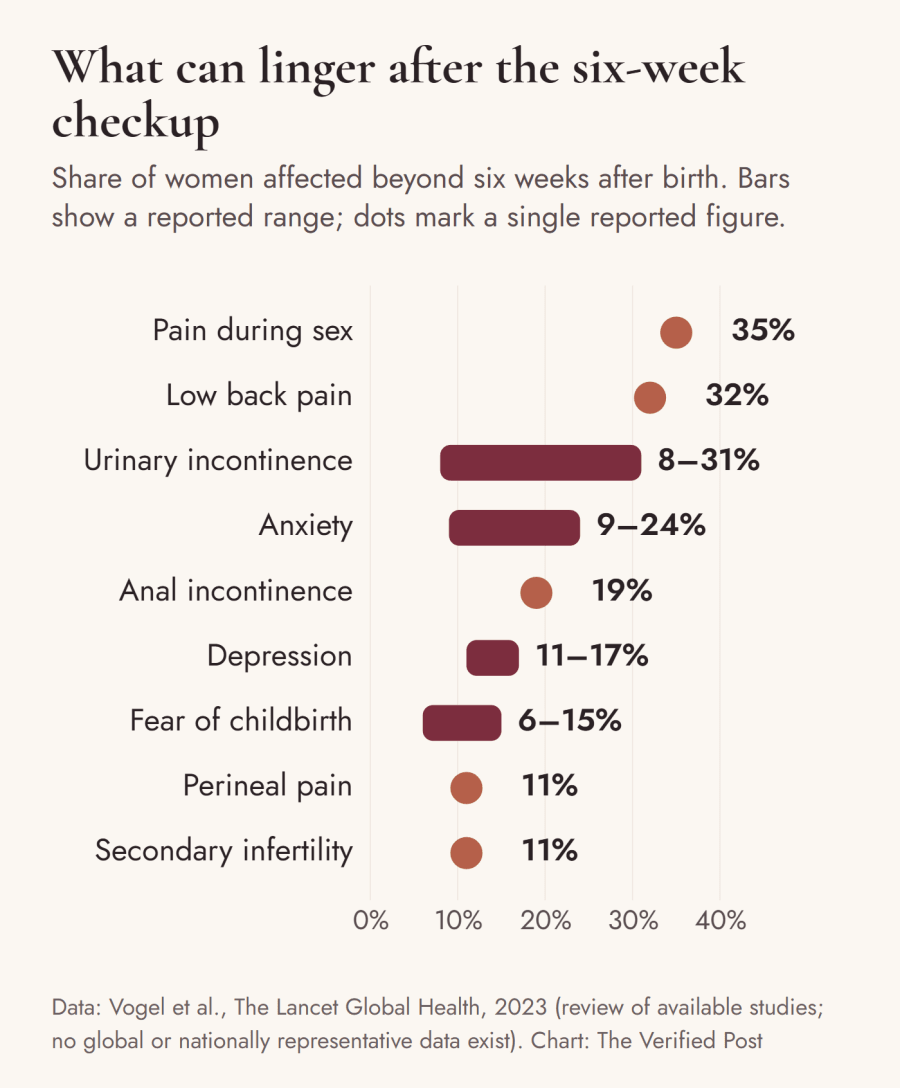
Read that as a woman and it lands differently than it does as a table. Pain during sex means a private misery that too often goes unreported. Incontinence means planning your day around where the toilets are. Some of it starts with real structural injury: imaging studies find the levator ani, a key pelvic floor muscle, torn away from the pubic bone in roughly 13 to 36 percent of women after vaginal birth. One follow-up found that about 62 percent of those tears healed within a year, which is reassuring and also means a lot of them didn't.
The WHO notes these conditions can happen however a woman gives birth, even without complications. The same research found no recent high-quality treatment guideline for 40 percent of the 32 priority conditions it examined.
Many postpartum conditions cause considerable suffering in women's daily life long after birth
Dr Pascale Allotey, WHO, 2023
Fairness matters here, because these figures can scare people. The evidence is patchy, there are no global or nationally representative studies, and plenty of women recover well. A percentage in that chart isn't a forecast for you. It does mean anyone calling this the easy, natural part of being a woman hasn't read the literature.
Your brain changes too, and your sleep may not come back
A 2017 study scanned first-time mothers and fathers before and after a baby arrived. Mothers lost gray matter volume in regions tied to social cognition, the changes lasted at least two years, and fathers didn't show the same pattern. In the 2024 single-participant study, 80 percent of the 400 brain regions measured declined in volume across pregnancy. A 2025 study found a U-shaped path with partial recovery after birth.
This isn't brain damage, and I'd push back hard on anyone who uses it to sneer about "mom brain." The changes predicted measures of mothers' attachment to their babies, and the researchers read them as adaptation. But a woman should still be told that it happens.
Then there's sleep. Researchers tracking German parents found that in the first three months, mothers lost an average of 62 minutes a night compared with before pregnancy. Fathers lost 13. Neither parent's sleep had fully recovered six years after a first child, and neither household income nor having a partner made much difference to that recovery. Sixty-two minutes against thirteen is the whole conversation about who's carrying what, reduced to one line of data.
How long postpartum really lasts
- First 5 daysEstrogen and progesterone fall to roughly pre-pregnancy levels.
- First 2 weeksBaby blues begin around day 3 or 4 and usually lift on their own.
- 4 to 6 weeksPostpartum bleeding can continue this long.
- 6 weeksWhere postnatal care has traditionally stopped.
- 12 weeksACOG's latest date for a full postpartum visit. As many as 40% of US women had been missing theirs.
- First 3 monthsMothers' sleep hits its lowest point.
- Up to 1 yearMore than half of US pregnancy-related deaths happen between 7 days and a year after birth.
- 2 yearsGray matter reductions still measurable in mothers.
- 6 yearsSleep still not fully back to pre-pregnancy levels.
The part people don't like saying out loud
Most people picture the danger of childbirth as the delivery room. In the United States, among pregnancy-related deaths with known timing in 36 states from 2017 to 2019, 53 percent came between a week and a year after birth, long after the flowers have died. The leading underlying cause in that data was mental health conditions, including suicide and overdose, at about 23 percent. In 2022 data it rose to nearly 28 percent.
Worldwide, about 260,000 women died during or after pregnancy and childbirth in 2023, most from preventable causes and 92 percent of them in low- and lower-middle-income countries. A woman's lifetime risk of maternal death is about 1 in 66 in low-income countries and 1 in 7,933 in high-income ones. So what a woman is being asked to accept depends heavily on where she was born.
When it's more than exhaustion
- Low mood, hopelessness or anxiety lasting beyond two weeks can be postpartum depression. It's common and treatable, and it can begin any time in the first year.
- Confusion, hallucinations, delusions or a sudden change in behavior can mean postpartum psychosis, which affects about 1 to 2 in 1,000 births and is a medical emergency.
- CDC urgent warning signs in the year after birth include severe headache, chest pain, trouble breathing, fever, dizziness or fainting, and thoughts of harming yourself or your baby. Get care right away and say you recently gave birth.
- In the US, the National Maternal Mental Health Hotline is free, confidential and open 24/7: call or text 1-833-852-6262. Elsewhere, contact your doctor, midwife or local emergency services.
The freedom and the future have numbers as well
Economists have a blunt name for what happens to a woman's working life: the child penalty. Even in Denmark, known for generous family policy, a first child is linked to a long-term 20 percent drop in mothers' earnings relative to fathers'. A global atlas covering 134 countries found gaps in employment almost everywhere, though their size varies widely: 4 percent in China, 41 percent in Germany, 62 percent in Bangladesh. Fathers' careers absorb far less of it. When the post talks about a woman's future, this is the measurable version.
Where the post is right, and where I'd change it
On the law, the post is on firm ground. The UN's women's rights treaty, CEDAW, guarantees women equal rights to decide the number and spacing of their children, and the UN Population Fund describes deciding freely whether to have children as a basic right. Plenty of women already use it. In a 2024 Pew survey of Americans under 50 who are unlikely to have kids, 64 percent of women said a major reason was simply that they don't want to, compared with 50 percent of men.
Where I'd change it is the opening line, "more women need to realize." Many women realize it perfectly well. What they lack is power. Across 69 countries with data, 25 percent of women can't make decisions about their own healthcare, 24 percent can't say no to sex, and 11 percent can't make decisions about contraception. You can't realize your way out of that.
The post is also right that the insult is real. A study in Sex Roles found that people rated voluntarily childfree adults as less fulfilled, and the effect was driven by moral outrage: anger, disapproval and disgust. But it found that toward childfree men and women alike, and it doesn't show the judgment comes mainly from men. Pew's older childfree respondents add a useful detail: 42 percent of women felt pressure from society at least sometimes when they were younger, against 27 percent of men.
And "nothing is more selfish" overshoots. Wanting a child isn't selfish. Wanting one with a willing partner who knows the cost isn't selfish either. The selfish act is narrower and more specific: treating another person's body as the thing your plans are entitled to. The same principle protects the women on the other side of this argument too, because the UN's data shows most people do want children and many can't have as many as they'd like. A real choice has to include yes.
A woman can love her child more than her own life and still stand in a kitchen with her hand over her face. Both things can be true at once. What almost nobody gets is the full bill in advance, and in any other part of medicine, that would count as a failure of informed consent. Every woman deserves to see the whole price before she decides, and then to have her answer respected, whichever way it goes.
Read next: Matrescence: what really happens to your body after birth · Endometriosis isn't just a "bad period" · Why you feel better after crying
Sources
- Vogel J.P. et al., Neglected medium-term and long-term consequences of labour and childbirth, The Lancet Global Health (2023)
- World Health Organization, More than a third of women experience lasting health problems after childbirth (2023) and Maternal mortality fact sheet
- Pritschet L. et al., Neuroanatomical changes observed over the course of a human pregnancy, Nature Neuroscience (2024)
- Hendrick V. et al., Hormonal changes in the postpartum and implications for postpartum depression, Psychosomatics (1998)
- Reddy D.S. et al., Neuroendocrine insights into neurosteroid therapy for postpartum depression, Trends in Molecular Medicine (2023)
- Walton N. and Maguire J., Allopregnanolone-based treatments for postpartum depression: Why/how do they work?, Neurobiology of Stress (2019)
- University of Illinois Chicago Drug Information Group, How do brexanolone and zuranolone compare?
- US Food and Drug Administration, FDA approves first oral treatment for postpartum depression (2023)
- Massachusetts General Hospital, Postpartum Psychosis Project
- American College of Obstetricians and Gynecologists, Committee Opinion 736: Optimizing Postpartum Care (2018, reaffirmed 2025)
- StatPearls, Physiology, Postpartum Changes
- Update on Diagnosis and Treatment for Levator Avulsion, review; van Delft K., Levator ani muscle avulsion following childbirth, thesis
- Hoekzema E. et al., Pregnancy leads to long-lasting changes in human brain structure, Nature Neuroscience (2017)
- Servin-Barthet C. et al., Pregnancy entails a U-shaped trajectory in human brain structure, Nature Communications (2025)
- Richter D. et al., Long-term effects of pregnancy and childbirth on sleep satisfaction and duration, Sleep (2019)
- Centers for Disease Control and Prevention, Pregnancy-Related Deaths: Data From Maternal Mortality Review Committees in 36 US States, 2017-2019 and Urgent Maternal Warning Signs
- Policy Center for Maternal Mental Health, Latest NVSS and MMRC maternal mortality data (2022 figures)
- Health Resources and Services Administration, National Maternal Mental Health Hotline
- Kleven H., Landais C. and Leite-Mariante G., Parenthood and gender inequality around the world, VoxDev, on the Child Penalty Atlas
- UN Population Fund, State of World Population 2025: The Real Fertility Crisis; UN Human Rights Office, Sexual and reproductive health and rights
- Pew Research Center, The Experiences of U.S. Adults Who Don't Have Children (2024)
- Ashburn-Nardo L., Parenthood as a moral imperative?, Sex Roles (2017), and ScienceDaily summary
- Images: cover, Sarah Chai / Pexels (illustrative). Charts: The Verified Post, made with AntV G2.