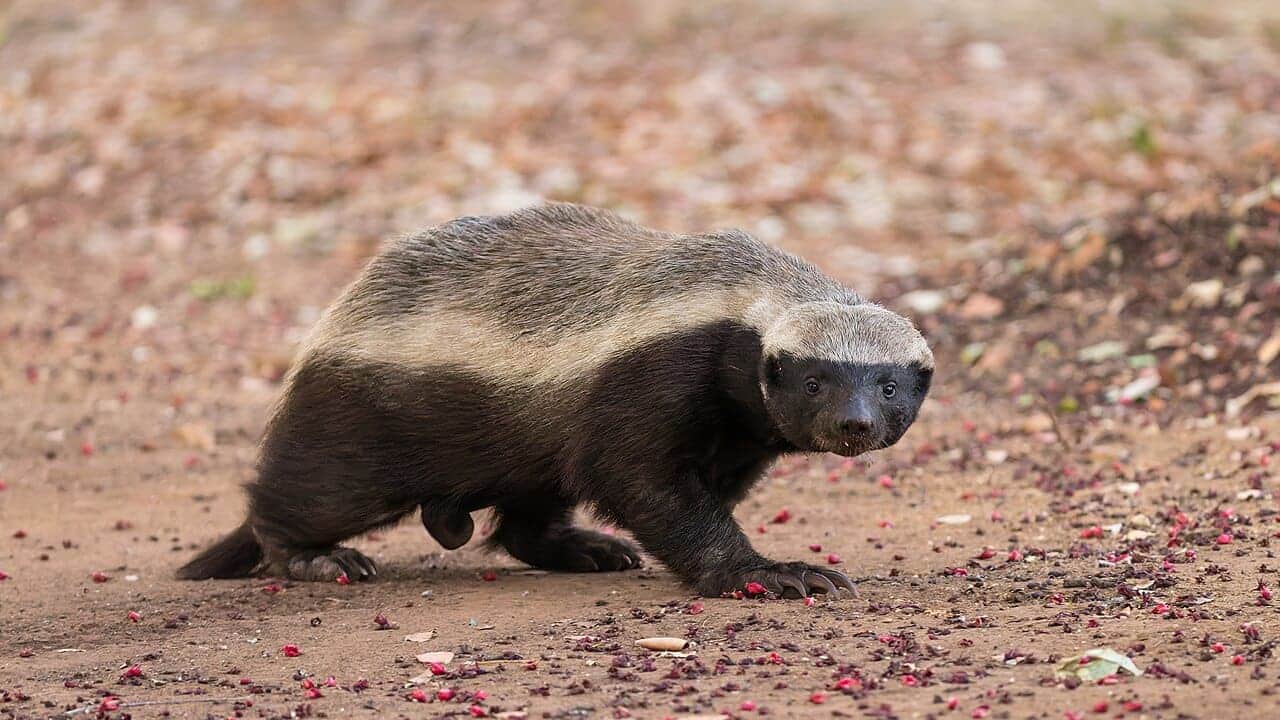
A post doing the rounds on X sums up Stoffel the honey badger in two sentences. He was so determined to fight the lions next door that he kept escaping, it says, and when his keepers gave him a female partner to calm him down, he used her as a ladder and climbed out again.
Stoffel is real, and he really did escape, over and over, for years. He is still alive, too, which is its own small surprise. But the version travelling on social media has rearranged the story in a way that makes it funnier and less accurate. The lions were not the reason he kept getting out. And the most famous escape, the one involving his partner Hammie, was not a case of one badger climbing over another. It was closer to teamwork.
Who Stoffel is
Stoffel lives at the Moholoholo Wildlife Rehabilitation Centre, near Hoedspruit in South Africa's Limpopo province. The centre was founded in 1991 by Brian Jones, who has spent decades taking in injured, orphaned and poisoned animals, from vultures to leopards, and releasing them where he can. Animals that cannot be released stay on, and some become ambassadors for the centre's education work. Stoffel became the most famous of them by accident.
How he got there depends on who is telling it. In a 2014 interview with South Africa's Sunday Times, Jones said Stoffel had been raised by farmers for two years before coming to the centre, roughly 18 years earlier. An American newspaper account from the same period described him as having been rescued from a trap. Both versions agree on the important part: he arrived as a badger that was used to people, could not simply be turned loose, and had no intention of staying where he was put.
The escape artist
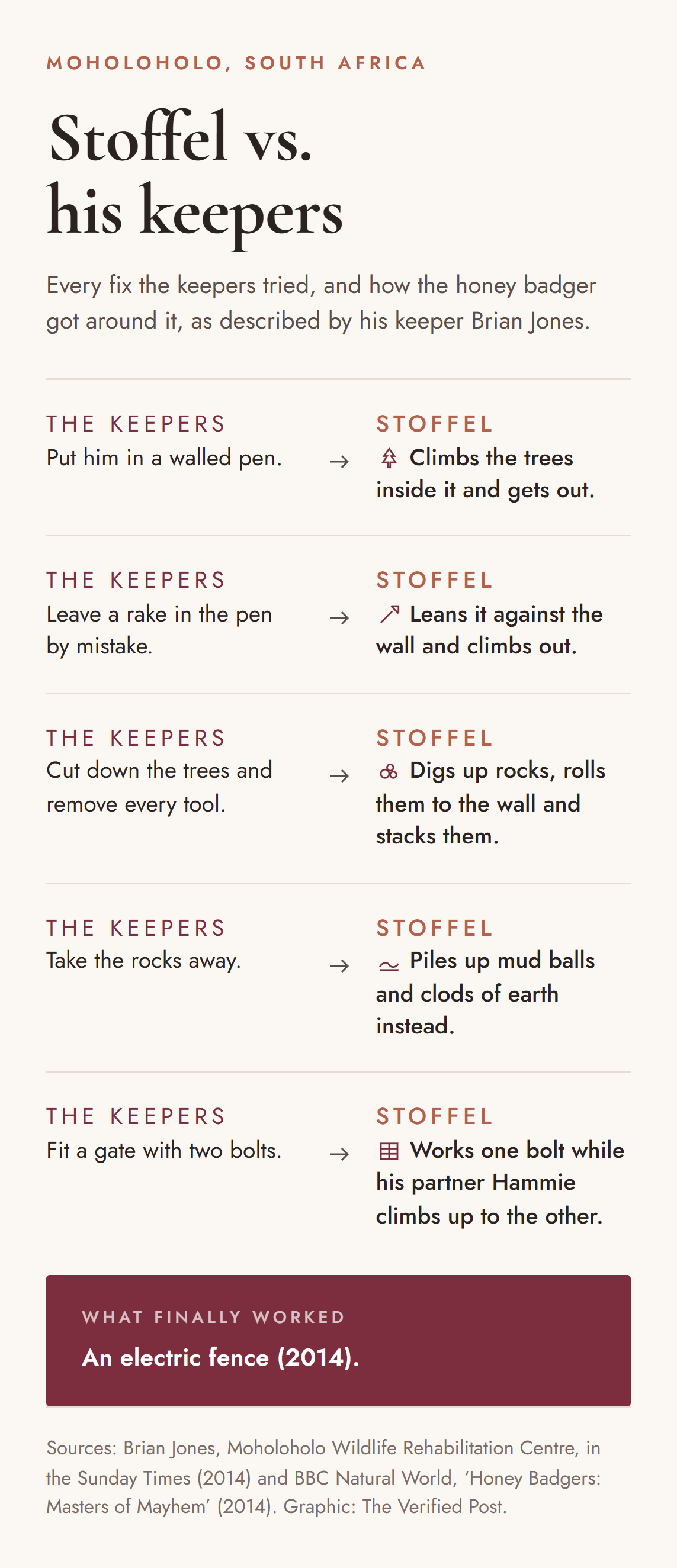
The pattern Jones described to reporters is almost comic in its back-and-forth. Stoffel was kept in a walled enclosure. He climbed the trees inside it and dropped over the wall. The keepers cut the trees down. One day someone left a rake in the pen, and Stoffel leaned it against the wall and used it to climb out. After that, tools were removed. So he dug up rocks, rolled them to the wall and stacked them high enough to get over. When the rocks were taken away, he made balls of mud and clods of earth and piled those up instead.
None of this was a one-off trick. Jenny Jones, writing on the centre's blog in 2008, described Stoffel breaking into the family's house at night and having to be coaxed back to his enclosure with honey. The same post records that he had bitten two of the centre's guides, Jan Last and Hugo Crouse. A badger that has learned where the food is, and is unafraid of the people standing near it, is a very different animal to manage from a wild one that keeps its distance.
People think it's a hoax, but it's not - that's Stoffel.
— Brian Jones, founder of Moholoholo, speaking to the Sunday Times in 2014
What actually happened with the lions
The viral post's opening claim, that he kept escaping because he wanted to fight the lions next door, is where the story drifts furthest from the record. Jones has said that Stoffel attacked two lions, and the BBC, which filmed him in 2014, reported that one of his outings ended with him being severely mauled by lions. That much is real, and it is consistent with what honey badgers are known for: they will stand their ground against animals many times their size.
What no source supports is the idea that lions were his motive. His escapes ran across years and in every direction, into the house, into other enclosures, into whatever was on the other side of the wall. The lion encounter was one result of that restlessness, not the reason for it. Turning it into a grudge against the neighbours makes a better caption, but it puts a motivation into an animal's head that nobody recorded.
The mauling did change how he was kept. After it, Stoffel was moved to a new enclosure, and the centre introduced a female honey badger, Hammie, to share it with him. Pairing a solitary, bored animal with a companion is a common step in captive care, and the viral account's version, that she was meant to distract him, is a fair enough summary of the hope.
What the viral post says
Stoffel kept escaping because he wanted to fight the lions next door. When keepers gave him a female partner to distract him, he used her to climb out.
What the record shows
Stoffel escaped for years, by every route he could find. On one outing he attacked lions and was badly mauled. He was then given a new pen and a partner, Hammie, and the pair worked on the gate together.
Hammie and the gate
This is the part that made Stoffel internationally famous. The new enclosure had a gate fastened with two bolts, an arrangement meant to defeat a single animal. In footage filmed for the BBC's Natural World documentary Honey Badgers: Masters of Mayhem, Stoffel works at one bolt while Hammie climbs up to deal with the other. Two badgers, one gate, two locks.
The social media version, in which Stoffel uses Hammie as a step to climb out, turns a moment of apparent cooperation into a punchline about a male exploiting his partner. It is a small distortion, but it inverts the point. What startled viewers was not that a honey badger climbed on something. Stoffel had been climbing on things for years. It was that two of them appeared to be dividing a problem between them.
The documentary aired in the United States on PBS's Nature series in February 2014, and clips of the gate scene have circulated ever since, usually stripped of context and often captioned with claims that grow with each repost. The same programme included a puzzle test in which Stoffel's son, Stumpy, pushed a crate into position so he could climb up and reach a box of food. It is a nice scene, but it is worth being careful about what it proves. It is a filmed demonstration, not a controlled experiment, and a single animal solving a single task on camera says little about the species as a whole.
The fence that finally held
In the end the solution was not cleverer locks. In 2014 the centre put up an electric fence, and that, according to Jones, is what finally kept Stoffel in. After nearly two decades of trees, rakes, rocks, mud and bolts, the answer was a barrier he could not dig under, climb over or work loose.
He did not fade from view. In September 2025, coverage of the centre gave his age as 27. In July 2026 the South African site Good Things Guy quoted Moholoholo as saying that Hammie and Stoffel were "still doing really well", at 21 and 29, and described them as the centre's geriatric residents. The badger whose escapes went viral is, these days, mostly sleeping in.
Stoffel's story in dates
- 1991Brian Jones founds the Moholoholo Wildlife Rehabilitation Centre near Hoedspruit, Limpopo.
- Mid-1990sStoffel arrives at Moholoholo. Jones has said he was raised by farmers for two years; another account says he was rescued from a trap.
- 2008Jenny Jones writes that Stoffel has broken into the family's house at night and had to be lured back with honey.
- Before 2014On one escape Stoffel attacks lions and is badly mauled. He is moved to a new enclosure and given a partner, Hammie.
- Feb 2014BBC Natural World's Honey Badgers: Masters of Mayhem, including the two-bolt gate scene, airs in the US on PBS Nature.
- 2014An electric fence finally stops the escapes.
- Jul 2026Moholoholo says Stoffel, 29, and Hammie, 21, are still doing well.
Why honey badgers behave like this
Stoffel's reputation sits on top of a species reputation that is mostly earned. The honey badger, Mellivora capensis, is found across much of sub-Saharan Africa and into the Middle East and South Asia. It is not a true badger at all but a member of the weasel family in its own genus, and it is listed as Least Concern by the International Union for Conservation of Nature.
Some of its toughness is physical. Honey badgers have thick, loose skin that makes them hard for a predator to grip and gives them room to twist round and bite back. They also eat venomous snakes. In a long-term study in the southern Kalahari, the zoologist Colleen Begg and colleagues found that snakes, including highly venomous species, could make up as much as a quarter of a honey badger's diet. A 2015 paper in the journal Toxicon by Danielle Drabeck, Andrew Dean and Sharon Jansa helps explain how they survive it: honey badgers carry changes in the nicotinic acetylcholine receptor, the target that cobra-type neurotoxins latch onto, similar to changes that evolved independently in mongooses, hedgehogs and pigs.
Honey badger essentials
- Scientific name Mellivora capensis; a member of the weasel family, not a true badger.
- Range: much of sub-Saharan Africa, the Middle East and South Asia.
- IUCN status: Least Concern, though often killed in conflict with beekeepers.
- Thick, loose skin makes them hard for predators to hold.
- Genetic changes to a nerve receptor give them resistance to some snake venom.
- There are no peer-reviewed studies of honey badger intelligence; claims about it rest largely on anecdotes and filmed demonstrations.
The intelligence is harder to pin down. Honey badgers are routinely described online as the most fearless or most intelligent animal in the world, and a frequently repeated claim credits them with a Guinness World Record for fearlessness, which we could not verify. What the science actually has to say about their cognition is thin. There are no peer-reviewed studies of honey badger problem-solving to set beside the decades of research on crows, primates or dolphins. Much of what people believe about the species' cleverness comes from Stoffel himself, which means one famous captive individual, filmed by a documentary crew, is standing in for the evidence.
That does not make the stories false. A badger that stacks rocks against a wall to get over it is doing something interesting, whatever label you put on it. It just means the honest summary is that honey badgers are persistent, physically formidable and good at exploiting whatever their surroundings offer, and that how they compare to other animals in cognitive terms has not been properly tested.
The badger behind the meme
The reputation has real consequences in the wild. Honey badgers raid beehives for larvae and honey, which puts them in direct conflict with beekeepers, and many have been trapped, shot or poisoned as a result. In 2002 the Endangered Wildlife Trust in South Africa began promoting "badger-friendly" honey, backing beekeepers who raise their hives out of reach rather than killing the animals. It is a less shareable story than an escape video, but it is the one that decides how many honey badgers survive.
Viral animal stories tend to work this way. Like the viral claim about stillborn calves near a Texas data centre, the version that spreads keeps the outline and swaps in a more satisfying cause. In Stoffel's case the truth was already strange enough. He did escape for years. He did fight lions, and lost. He and Hammie did appear to tackle a two-bolt gate between them. And he is, by his keepers' account, still around at 29. For another case where an animal and the people living alongside it ended up in the headlines, read our report on the Dandeli crocodile case in Karnataka, and for the physics of why animal bodies are built the way they are, our explainer on what it would really take for a human to fly.
Sources
- Sunday Times / TimesLIVE (South Africa), interview with Brian Jones on Stoffel (2014).
- BBC Natural World, Honey Badgers: Masters of Mayhem (2014), and BBC coverage of the programme; PBS Nature, Honey Badgers: Masters of Mayhem (US broadcast 19 February 2014).
- The Denver Post, report on Stoffel and Moholoholo (2014).
- Moholoholo Wildlife Rehabilitation Centre blog, post by Jenny Jones (2008).
- Good Things Guy, update on Stoffel and Hammie quoting Moholoholo (16 July 2026).
- Drabeck, D. H., Dean, A. M. and Jansa, S. A. (2015), "Why the honey badger don't care: Convergent evolution of venom-targeted nicotinic acetylcholine receptors in mammals that survive venomous snake bites", Toxicon 99.
- Begg, C. M., Begg, K. S., Du Toit, J. T. and Mills, M. G. L. (2003), "Sexual and seasonal variation in the diet and foraging behaviour of a sexually dimorphic carnivore, the honey badger (Mellivora capensis)", Journal of Zoology 260.
- IUCN Red List, Mellivora capensis; Endangered Wildlife Trust, badger-friendly beekeeping initiative.