The post is short and devastating: a Texas farmer says every single calf born on his farm since a data center was built next door has been stillborn. It has travelled across X, LinkedIn and Facebook, and it has been repeated at public hearings in other states as evidence of what these facilities do to the land around them.
It is also a claim that nobody has been able to check. There is no named farmer, no named farm, no named facility and no veterinary report. The story traces back to a single account told by a political candidate, and in his own retellings, the facility next door is not always a data center.
That does not mean the fears behind it are baseless. Rural Texans are dealing with real, documented disruption from the data center and crypto-mining boom, and at least one community has taken its noise complaints to court. But the stillborn-calf story, as it is being shared, is not a verified fact. Here is what can and cannot be established.
Where the claim came from
The account comes from Clayton Tucker, a rancher from Lampasas, secretary of the Texas Farmers Union and the Democratic nominee for Texas agriculture commissioner in the November 2026 election. Opposition to the rapid spread of AI data centers is a central plank of his campaign, and the Texas Farmers Union has called for a statewide moratorium on their construction.
In a quote shared by a Florida group opposing a data center project, Tucker said he had talked to "one farmer who lives next to a data center," adding that "not one calf has been born since they built that data center. Nothing but stillbirths." When a speaker repeated a version of the story at a data center hearing in Murray, Kentucky, in June, the local paper, The Murray Sentinel, attributed it to Tucker and added an editor's note that the claim "was not independently verified."
Tucker has since told the story in more detail on podcasts. On one, he described a man who grew up in Dallas, retired and bought a farm north of the city. After "a center moved right across the fence," Tucker said, the cattle stopped sleeping in their meadow and pressed against the far fence line instead, and there was "stillbirth after stillbirth." The man sold the ranch, Tucker said, losing about $100,000. But the published notes for another podcast episode describe the same rancher's losses as coming after a battery energy storage facility, not a data center, went in across the road.
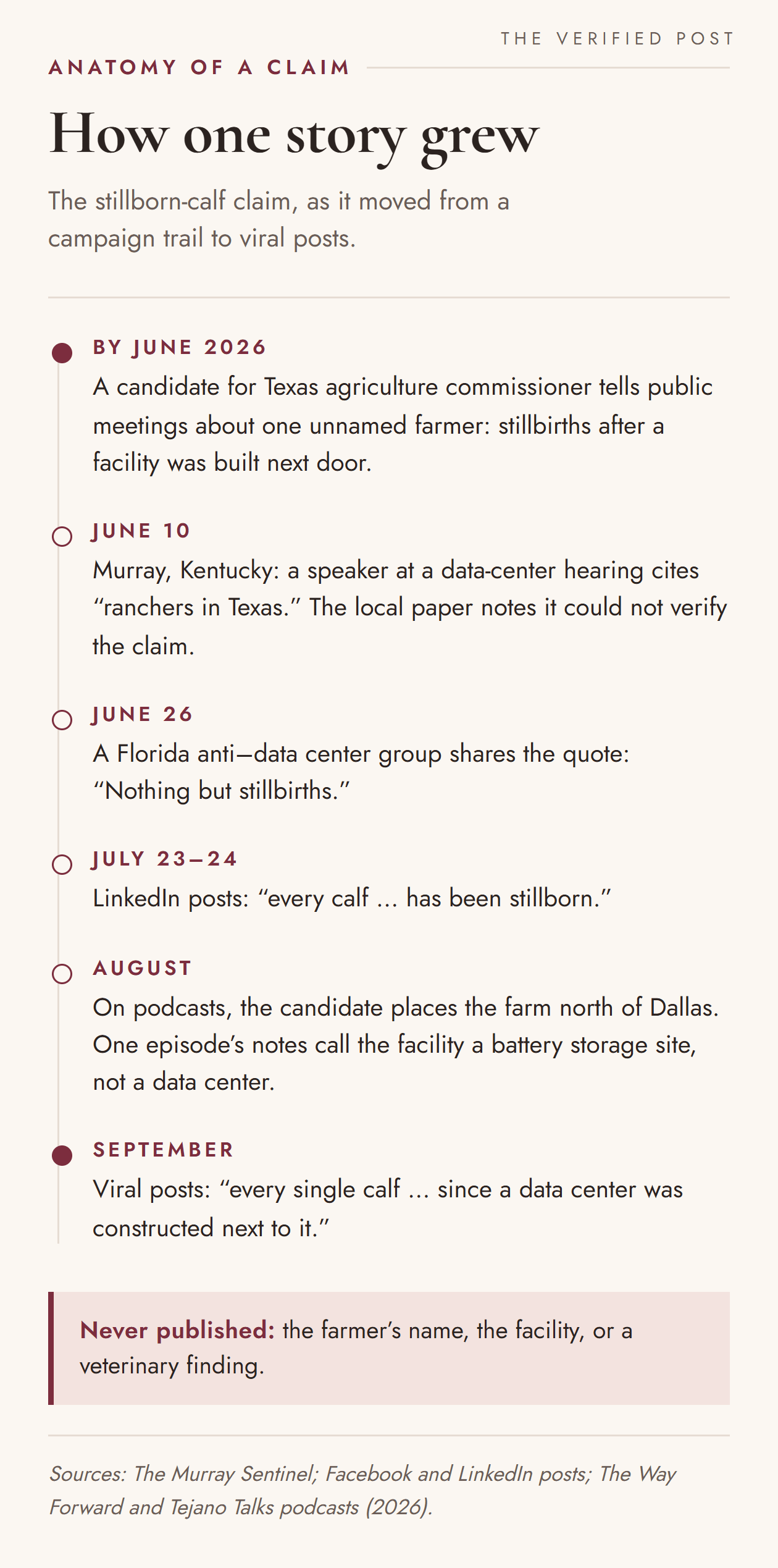
At no point has the farmer been named, and no veterinarian, diagnostic laboratory or state agency has been cited. By the time the story reached viral posts in September, "stillbirth after stillbirth" had become "every single calf," and the facility had firmly become a data center.
What the viral post says
A Texas farmer says every single calf born since a data center was built next to his farm has been stillborn.
What can be documented
A candidate for agriculture commissioner has described one unnamed rancher north of Dallas with repeated stillbirths. In one account the facility was a battery storage site. No name, facility, or veterinary finding has been published.
The real concerns it is attached to
The story spreads because it lands on genuine anxiety. Texas is in the middle of a data center building boom, and farmers have been among its most vocal critics. The Texas Tribune has reported on farmers losing rented land to data center buyers, roads damaged by construction traffic and worries about groundwater. The state's current agriculture commissioner, Sid Miller, a Republican, has complained that the projects are going onto some of the state's most fertile farmland.
There are also named ranchers raising alarms, though not about stillbirths. In June, KWTX reported on a Bell County rancher near Temple whose family has farmed since the 1870s and who lives within five miles of a $700 million data center under construction by Rowan Digital Infrastructure. He told the station he feared constant noise from the site would make it impossible for his cattle and goats to breed, and said it could cause grown cattle to lose 30 percent of their body weight. His concern was about what might happen once the facility runs, and the figure he cited was not attributed to any study. His story is sometimes bundled with the stillborn-calf claim online, but he has not reported losing calves.
The facility in Tucker's podcast account may matter too. Fannin County, north of Dallas, does have a contested battery storage project, a 300-megawatt facility built by the energy company Engie near the town of Savoy. Residents and county officials fought it for over a year, largely over fire safety, noise and property values, and the dispute went to court before the two sides reported resolving their differences in 2026. There is no public reporting linking that site, or any named facility, to livestock losses.
What Granbury shows, and doesn't
The best-documented case of an industrial computing site disturbing its neighbours in Texas is in Granbury, southwest of Fort Worth. There, a bitcoin mine operated by MARA Holdings, which uses industrial fans and liquid cooling for more than 20,000 computers, has drawn years of complaints. A county constable issued dozens of noise citations in 2024, residents have filed several lawsuits, and those suits describe hearing loss, migraines, vertigo and sleeplessness among people living nearby. The company says its noise falls between 63 and 78 decibels, within state limits, and a 2024 county study found it compliant.
The Granbury complaints include animals. One resident told KERA News her cattle ran from the noise. A lawsuit describes anxious horses and a dog so distressed it pulled out its own fur, and a later suit mentions "unexplained" chicken deaths. What the Granbury filings do not describe, despite years of scrutiny, is a herd in which every calf was stillborn. The case shows that noise from these facilities is real enough to go to court over. It does not show that noise causes stillbirths.
Can noise do this to cattle?
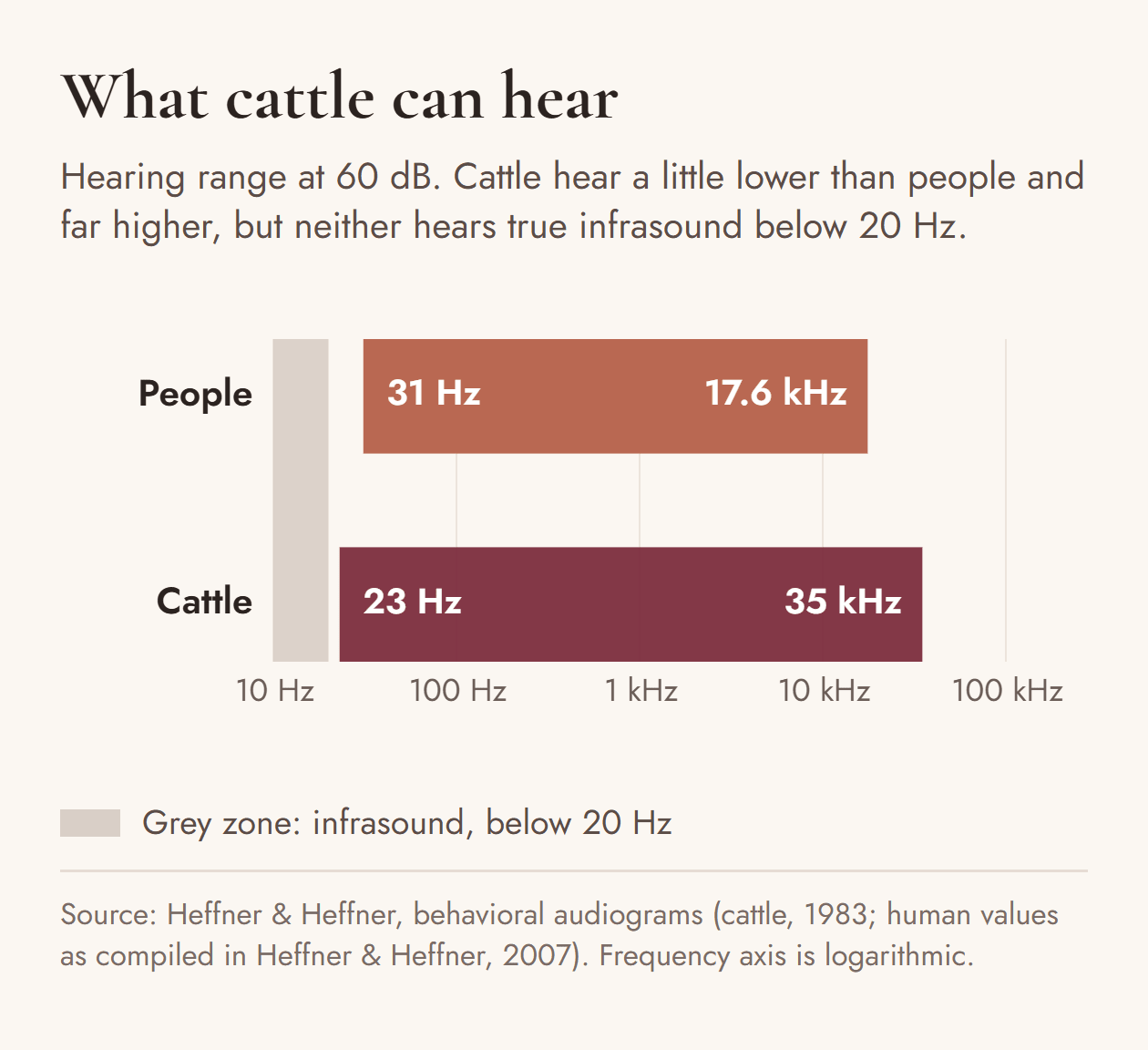
A common version of the claim says data centers produce low-frequency sound that animals can hear but humans cannot. For cattle, that is only partly true. Behavioural hearing tests by the researchers Henry and Rickye Heffner found that cattle hear from about 23 hertz to 35 kilohertz, measured at 60 decibels. People, measured the same way, hear from about 31 hertz to 17.6 kilohertz. Cattle do reach slightly lower, by about half an octave, but their real advantage is at the high end. True infrasound, below 20 hertz, is outside the range of both.
Noise can stress cattle. Research reviews describe raised heart rates, hormonal changes and lower milk yields in cows exposed to loud or unfamiliar sounds, and chronic stress is known to affect fertility. But the same literature also finds that animals often habituate to steady noise, and reviewers repeatedly note that the evidence on long-term effects, particularly on reproduction, is thin and needs more research. There is no published study showing that noise from a data center, or any similar facility, causes a herd's calves to be stillborn.
What actually kills calves
Stillbirths happen on every cattle operation, and they have well-understood causes. Difficult births account for a large share: in one study of nearly 6,000 calvings across several beef breeds, about 7 percent of calves were stillborn, and 70 percent of those stillbirths followed a difficult delivery. Infectious diseases are the other major driver.
Common causes of calf losses
- Difficult calving (dystocia), especially in first-calf heifers and with oversized calves.
- Viral infections, including bovine viral diarrhea (BVD) and infectious bovine rhinotracheitis (IBR).
- Bacterial and protozoal infections such as leptospirosis, vibriosis, trichomoniasis and Neospora.
- Nutrition: mineral and vitamin deficiencies, and toxins such as nitrates or moldy feed.
- Heat stress, which is linked to lower conception rates and higher pregnancy loss.
Some of these can produce exactly the pattern Tucker described. Texas A&M AgriLife notes that when bovine viral diarrhea enters a herd that has no immunity, losses tend to arrive as a wave: abortions before calving season, then premature births and stillbirths, then weak calves that die within hours. A cluster of stillbirths on a single ranch is a textbook reason to call a veterinarian and send samples to a diagnostic lab.
The cause of most bovine abortions is unknown.
Texas A&M Veterinary Medical Diagnostic Laboratory
That caution cuts both ways. The state's own diagnostic lab says even modern testing often fails to find a cause, which means a rancher who lost calves near a new facility could be left without a clear answer. But it also means that a string of losses near a new facility is not evidence that the facility caused them. The lab recommends investigating when losses reach 2 to 3 percent of pregnancies. A herd losing every calf would be far beyond that, and exactly the kind of case where testing the calves, the placentas and the cows' blood could rule infections in or out.
What would settle it
None of this proves the unnamed rancher's losses had nothing to do with the facility near him. It means the story, as it is being shared, cannot carry the weight being put on it. A single secondhand account from a candidate campaigning against data centers, which in some versions involves a battery storage site rather than a data center, is a reason to ask questions. It is not evidence that data centers cause stillbirths.
The questions are worth asking properly. Water use is one of the sharpest points of conflict, as the backlash to comments about AI and water use showed, and the companies racing to build AI are driving demand for ever-larger facilities. Tucker has proposed that the state require agricultural impact studies before approving new data centers. Whatever one thinks of that idea, studies of that kind are how a claim like this one would be tested: named farms, measured noise, veterinary records and diagnostic results. Until someone produces them, the most accurate version of the viral post is much smaller than the one being shared.
Sources
- The Murray Sentinel, "Murray residents demand data center ban at ordinance hearing," June 2026.
- Clayton Tucker interviews: Tejano Talks (August 2026) and The Way Forward with Alec Zeck, Episode 256 (August 2026); Spectrum News, April 2026.
- KWTX, "Temple rancher worries data center construction threatens family farm dating back to 1870s," June 27, 2026.
- The Texas Tribune, "Data center boom threatens Texas agriculture industry," August 27, 2026.
- KTEN and KXII reporting on the Engie battery storage project in Fannin County, 2025 to 2026.
- Earthjustice, Citizens Concerned About Wolf Hollow v. Marathon Digital Holdings (2024); Dallas Observer, May 11, 2026; KERA News, February 2024; Inside Climate News, October 2024.
- Heffner HE, Heffner RS. "Hearing in large mammals: horses and cattle," Behavioral Neuroscience, 1983; "Hearing ranges of laboratory animals," 2007.
- Review: "Noise as a factor of environmental stress for cattle," Annals of Animal Science, 2023; "The Role of Sound in Livestock Farming," PMC, 2023.
- Texas A&M AgriLife Extension, "Reproductive Diseases in Cattle" and "Understanding Bovine Viral Diarrhea in Beef Herds."
- Texas A&M Veterinary Medical Diagnostic Laboratory, "Bovine abortion: Diagnostic insights for herd health management," 2026.
- NDSU Extension, "Several Factors May Contribute to Pregnancy Losses in Beef Cattle," 2022.