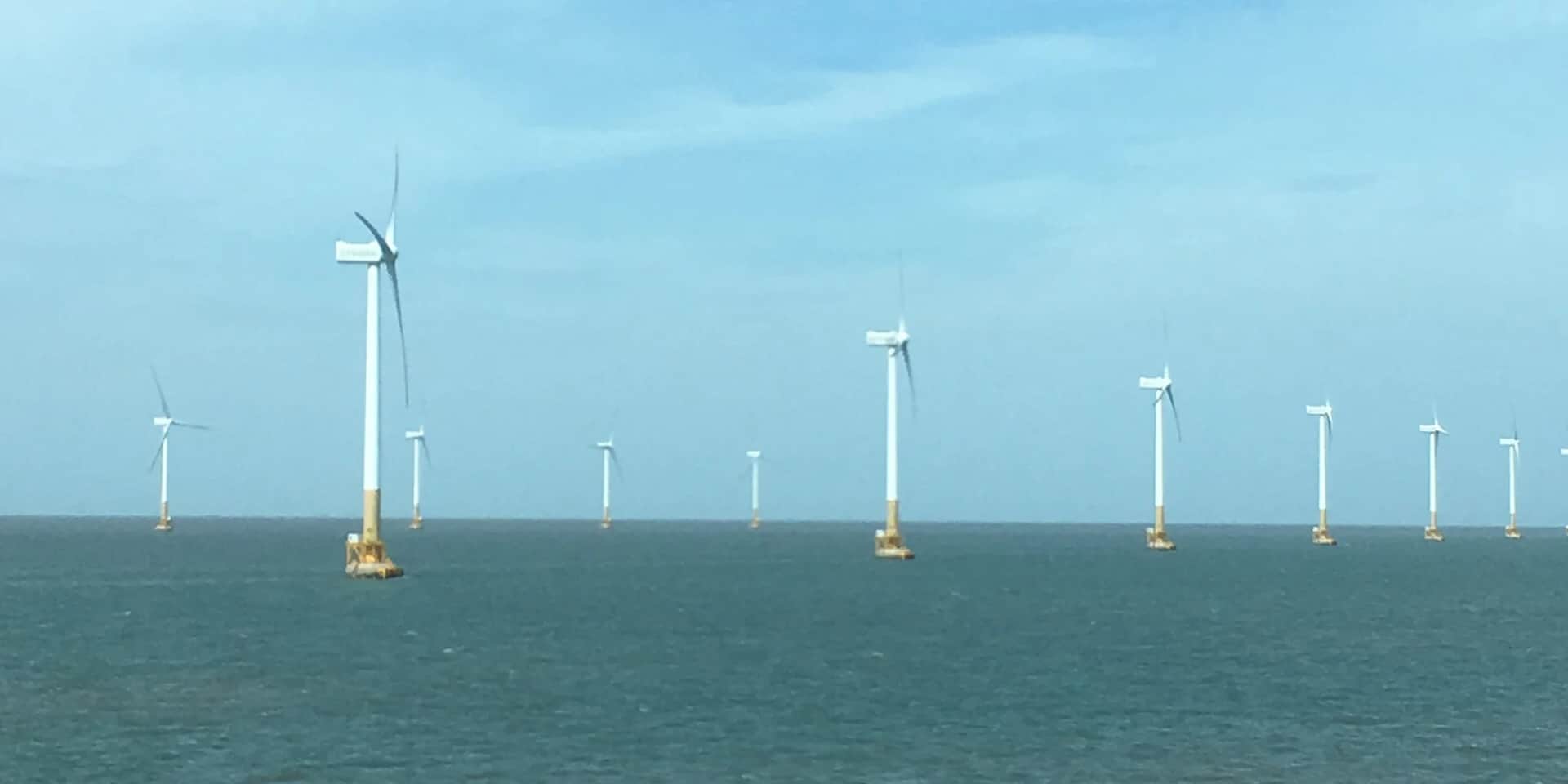
About 10 kilometres off the coast of Shanghai, a yellow platform rises out of the East China Sea among a field of wind turbines. The interesting part is underneath it. Ten metres down, sealed inside pressure vessels on the seabed, servers are running AI workloads, cooled by the sea around them and powered largely by the turbines overhead.
A post going around on X sums it up like this: "China put a data center under the sea powered by offshore wind and cooled by the ocean. It uses no fresh water. Almost no one is talking about it." The first three claims hold up. The last one doesn't, and the details the post skips are where the real story is.
What the post says
China put a data center under the sea, powered by offshore wind and cooled by the ocean, with no fresh water, and almost no one is talking about it.
What the record shows
The 24 MW Lingang facility is real, wind-linked and seawater-cooled. But it has been widely reported since 2025, and its efficiency figures come from the developer, not independent audits.
What China actually built
The facility is the Shanghai Lingang underwater data centre, built by Shanghai HiCloud Technology, a subsidiary of the Shenzhen-listed marine equipment maker Highlander, together with state-owned partners. It sits off the Lingang Special Area, the free-trade zone on Shanghai's eastern edge that is also home to Tesla's gigafactory. The cooperation agreement was signed in June 2025, Xinhua reported that construction was complete on October 21, 2025, and Chinese media reported it entering operation in May 2026.
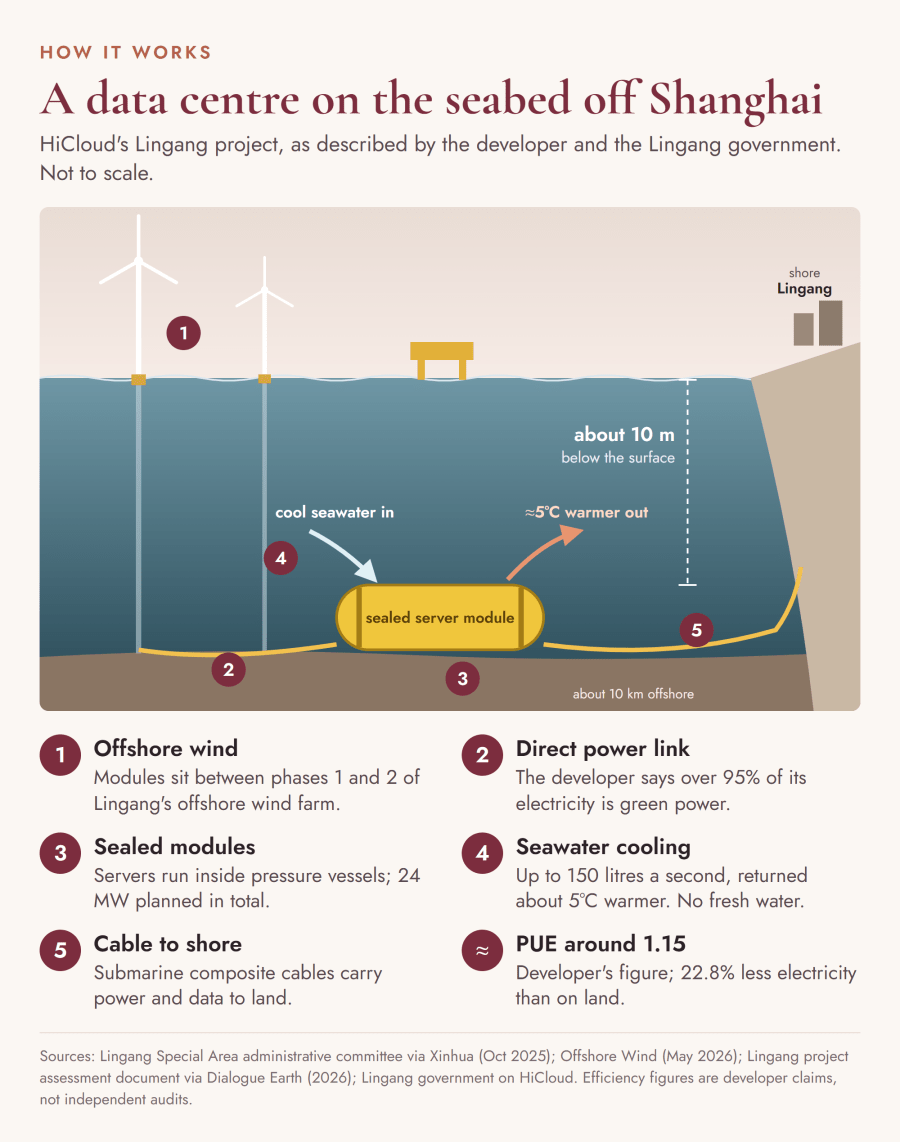
The headline figures come from the Lingang administrative committee: 1.6 billion yuan (about $226 million) of investment and a planned capacity of 24 megawatts. The first phase was a 2.3 MW demonstration unit. According to the trade publication Offshore Wind, the modules sit between the first and second phases of Lingang's offshore wind farm and take electricity straight from it. The GPU servers inside handle data annotation and the training of Chinese large language models, with China Telecom among the companies that have moved computing clusters in.
So the core of the post is accurate. There is a data centre under the sea, it is wired to offshore wind, and seawater does the cooling.
Why put servers in the sea at all
Servers turn electricity into heat, and getting rid of that heat is one of the biggest running costs of any data centre. The Guardian, reporting on Lingang, noted that cooling can account for 25% to 40% of a conventional facility's electricity demand. Many land-based sites also evaporate fresh water in cooling towers to keep up.
Underwater, the ocean becomes the heat sink. HiCloud's system pumps seawater through a heat exchanger and sends it back out a little warmer. The company's project lead, Chen Xiyi, told China Central Television that a comparable 2.3 MW data centre on land would need roughly 40,000 tonnes of fresh water a year for cooling, about what 100 households use. The Lingang modules use none.
The government's list of benefits goes further: 22.8% less electricity than a land-based equivalent, more than 90% less land, over 95% green electricity, and a power usage effectiveness (PUE) of around 1.15, where a perfect 1.0 would mean every watt goes into computing. Those are impressive numbers. They are also the developer's and the local government's numbers. I couldn't find an independent audit of any of them, and that's a bigger caveat than the post lets on.
The "no fresh water" line is true, with a footnote: it's about cooling. The wind doesn't blow all the time, and the developer's own claim is "over 95%" green power, not 100%. That's still a striking figure for a data centre. It just isn't the whole picture.
"Almost no one is talking about it"
This is where the post falls apart. Xinhua and China's official government website announced the project when construction finished in October 2025. When it switched on, it was covered by the South China Morning Post, the Guardian, Data Center Dynamics, Offshore Wind and a long list of tech sites. Dialogue Earth published a detailed look at its environmental questions in October 2026.
What is true is that it hasn't become a mainstream conversation in the US or Europe, where the data centre debate tends to stay local: grid strain, power bills, water rights. Personally, I think that's the more useful point. Nobody is hiding this story. It's mostly being read by people who already follow data centres, and it deserves a wider audience because it bears directly on the water fights playing out everywhere else.
One more thing worth knowing: many of the pictures shared alongside this claim are illustrations, not photographs. The real modules, photographed by AFP at a shipyard in Nantong in September 2025, are big yellow cylinders.
China wasn't first, but it got furthest
Microsoft tried this years earlier. Its Project Natick sank a shipping-container-sized vessel full of servers off Orkney, Scotland, in 2018, running on the islands' renewable grid. When the vessel was hauled up in 2020, Microsoft reported that its servers had failed at one-eighth the rate of a matching group on land. The team credited the sealed nitrogen atmosphere and the lack of people knocking things around. Then the project went quiet, and in 2024 Microsoft confirmed to Data Center Dynamics that Natick was finished and that it wasn't building subsea data centres anywhere.
HiCloud took the idea further. It began testing off Hainan island in 2021, opened what it calls the world's first commercial underwater data centre there in 2023, and then built Lingang as the first one tied directly to an offshore wind farm. Hanjiang Dong of Hong Kong Polytechnic University told the Guardian that Microsoft was earlier in proving the concept, while China was quicker to pull together demand, marine engineering and policy support into a working commercial project.
Key dates
- June 2018Microsoft sinks its Project Natick server vessel off Orkney, Scotland.
- July 2020Natick is retrieved; Microsoft reports a server failure rate one-eighth that of its land-based control group.
- 2021HiCloud begins underwater data centre trials off Hainan island.
- 2023HiCloud opens a commercial underwater data centre in Hainan.
- June 2024Microsoft confirms Project Natick is no longer active.
- June 2025Cooperation agreement signed for the Lingang wind-powered project off Shanghai.
- October 21, 2025Xinhua reports construction of the Lingang facility is complete.
- May 2026The 24 MW Lingang underwater data centre enters operation.
The questions that are still open
Heat doesn't vanish when you pour it into the sea. The Lingang project's assessment document, cited by Dialogue Earth, says the system can discharge 150 litres of water a second at about 5°C warmer than it came in. The document concludes that the outflow will mix quickly and have "no significant effect on the marine environment." HiCloud separately says a sea trial found warming of less than 1°C within two metres of its heat exchanger.
Independent scientists are mostly relaxed about the big picture and less certain about the immediate surroundings. Rick Stafford, a marine biologist at Bournemouth University, told the Guardian that an underwater data centre is "likely a good idea" because any warming stays local. John Abraham, a mechanical engineering professor at the University of St. Thomas in Minnesota, told Dialogue Earth that a noticeable rise in regional water temperature was unlikely, but that animals living right beside the pipes could feel it.
A 4-5C increase can certainly matter biologically, particularly during hot summer conditions when organisms may already be near their thermal limits.
— John Abraham, University of St. Thomas, to Dialogue Earth
Other questions go beyond heat. Stanford marine scientist Stephen Palumbi and Hu Zhenyu, director of the China Sustainable Development and Marine Economy Institute, both raised concerns about anti-fouling paint flaking off the hulls; the project's approval documents say the anti-corrosion layer won't affect marine sediment. Hu also pointed out that AI chips may need replacing every year or two, which is costly when they're sealed on the seabed, and that a damaged cable or a typhoon could knock a sea-based facility offline for days or weeks. When Dialogue Earth published, HiCloud had not responded to its request for operating data.
The economics will decide whether any of this spreads. HiCloud says it eventually wants 100 capsules off Hainan, and other countries are watching: South Korea's ocean ministry announced its own pilot off Ulsan in April 2026.
So is the post right? Mostly. China really did put a wind-powered, sea-cooled data centre on the seabed, and it really does skip the fresh water that many land sites burn through. Where the post goes wrong is the idea that the world missed it, and in what it leaves out: the efficiency figures are the builder's own, and the long-term effect on the water around it is still being worked out. Lingang is a serious experiment in where AI's infrastructure might go. Whether it becomes a model or a one-off depends on data China hasn't published yet.
Read next: why Jeff Bezos's comments on AI and water use caused a backlash · what's actually known about a Texas data center and stillborn calves
Sources
- Xinhua via gov.cn: China completes construction of world's first wind-powered underwater data center (October 21, 2025)
- Offshore Wind: China puts 'world's first' offshore wind-powered underwater data centre into operation (May 18, 2026)
- The Guardian: World's first wind-powered underwater datacentre starts operating in China (June 9, 2026)
- South China Morning Post: China turns to offshore wind farms, subsea data centres to ease AI computing bottleneck (April 2026)
- Dialogue Earth: Concerns raised as data centres go underwater in China (2026)
- Data Center Dynamics: HiCloud's offshore wind-powered underwater data center up and running (May 2026)
- Microsoft Research: Project Natick
- Data Center Dynamics: Microsoft confirms Project Natick underwater data center is no more (June 2024)
- Images: cover photo "Donghai Bridge Wind Farm" by SSYoung, Wikimedia Commons, CC BY-SA 4.0, cropped. Diagram: The Verified Post, based on the sources above.