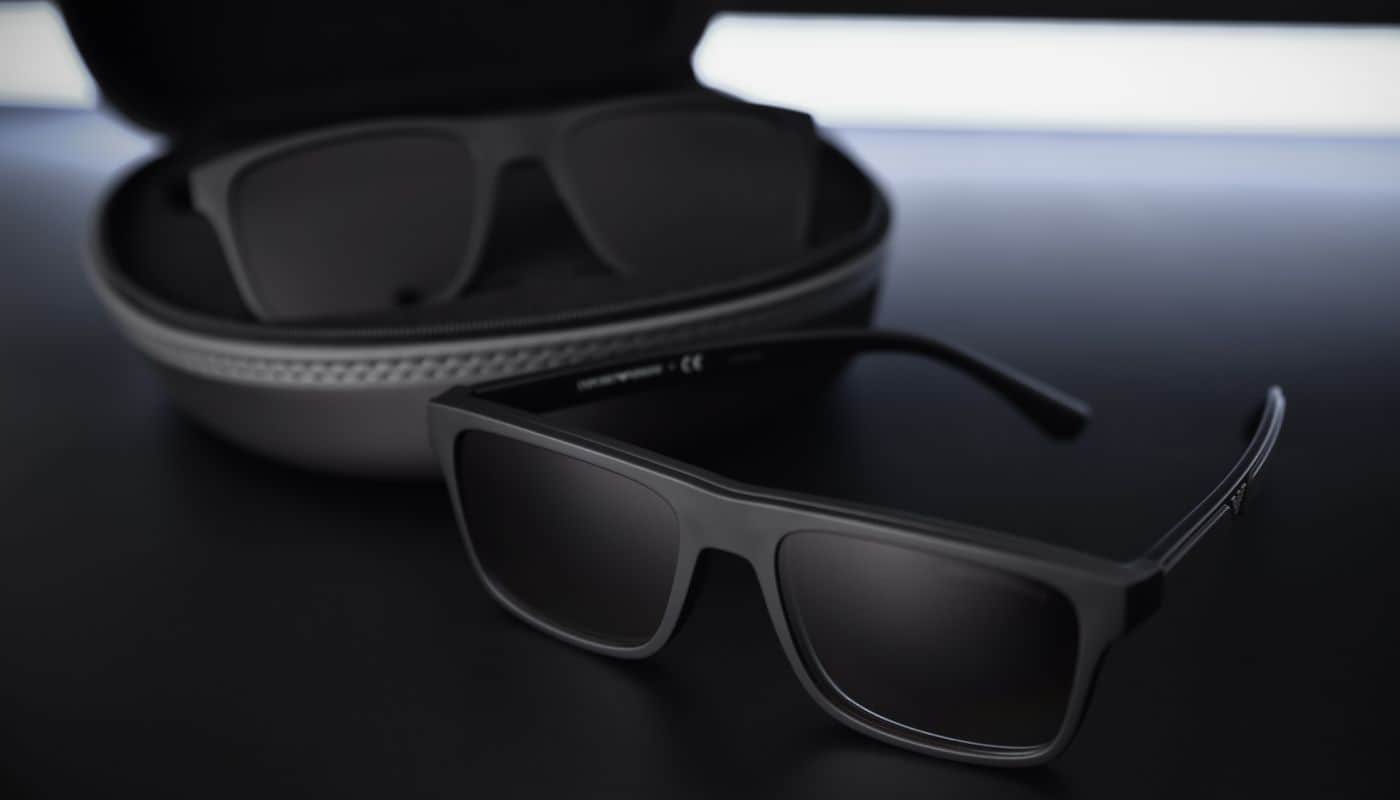
The advice started spreading in late July, on LinkedIn, Threads and Facebook, and it sounds almost too neat. If you think a man wearing Meta's smart glasses is secretly filming you, play a Disney song. The theory is that the copyrighted music will trip the automated filters on YouTube, TikTok or Instagram, and the video will never make it online.
The tip went viral with a bitter punchline attached, one that turns up on the post now circulating: music, apparently, is more protected than women. That line is the real story. As a defence, the Disney trick is far weaker than it sounds. As a diagnosis of how platforms treat copyright and how they treat people, it is uncomfortably accurate.
Why anyone needs a trick at all
Meta's Ray-Ban glasses look almost exactly like ordinary sunglasses or prescription frames. A tap on the frame or a spoken command starts a small camera hidden in the corner. Meta says a white LED lights up whenever the camera is recording, and that tamper-detection stops the glasses filming if the light is covered. They have sold well. The BBC reported in January that Meta had sold around two million pairs in less than a year.
They have also become the tool of choice for a genre of online video in which men approach women in public, ask for their name or number, and film the whole interaction from their own point of view. The women usually have no idea. In January, a BBC investigation spoke to seven women in the UK, the US and Australia who had been filmed this way. One, Oonagh, was approached on a beach in Brighton. The video of her reached about a million views and drew hundreds of sexual and derogatory comments, and when she went to the police she was told it is not illegal to film people in public. Another woman, Dilara, found the video of her had 1.3 million views on TikTok. Her phone number was visible in it, and for weeks she received calls and messages, sometimes in the middle of the night.
The cases keep coming. A DJ known as Manic Muse, who gave her number to a man in a Texas grocery store, later found he had filmed her with smart glasses. She asked him not to post it. He posted it anyway, and it passed 23 million views. In London, a woman the BBC called Alice said that when she asked the man who filmed her to take the video down, he told her removal was "a paid service." None of the women the BBC spoke to remembered seeing a recording light.
That light is the weak point. The BBC confirmed that some online methods can hide it while recording. The Wall Street Journal found people in at least 30 US states offering to physically modify it, and stickers marketed to dim it spread on TikTok. Meta says it has since updated the glasses to disable the camera if the light is tampered with. But even a working light is small, dim in daylight and easy to miss, and most people have no idea what it means.
The trick the police used first
Using copyrighted music to stop a video spreading is not a new idea, and the people who pioneered it were not women protecting themselves. They were police officers trying to stop citizens filming them.
In 2021, Beverly Hills officers were recorded playing music, including songs by Sublime and the Beatles, while an activist livestreamed his encounters with them on Instagram, apparently in the hope that the platform's filters would cut the stream. Months later, an Alameda County sheriff's sergeant played Taylor Swift's "Blank Space" while activists filmed him outside a courthouse in Oakland, and explained why: "You can record all you want. I just know it can't be posted on YouTube." In 2022, a Santa Ana officer played a string of Disney songs from a patrol car while a YouTuber filmed police, from "You've Got a Friend in Me" to "We Don't Talk About Bruno."
How 'copyright hacking' spread
- Feb 2021Beverly Hills police play music while an activist livestreams them on Instagram, apparently to trigger copyright filters.
- July 2021An Alameda County sheriff's sergeant plays Taylor Swift's "Blank Space" so, he says, the video "can't be posted on YouTube." It spreads anyway.
- April 2022A Santa Ana officer plays Disney songs, including "We Don't Talk About Bruno," while being filmed. The department says it is not its policy.
- Jan 2026BBC investigations document women secretly filmed with Meta smart glasses for pick-up videos.
- July–Aug 2026The Disney tip spreads online as a defence against smart-glasses filming, and is picked up by Mashable, CNN and others.
The departments involved said playing music was not part of their policy, and the tactic did not work reliably for them either. The Oakland video, far from disappearing, was widely shared, and the department later acknowledged the attempt had backfired. That history matters, because it shows exactly what copyright filters can and cannot do.
What the filters actually do
The idea rests on real technology. YouTube's Content ID system compares uploads against a library of audio and video supplied by rights holders, and Disney guards its music closely. But a match does not automatically mean a video disappears. On YouTube, the rights holder chooses whether to block a matched video, track it, or monetise it by taking its advertising revenue, and YouTube's own help pages say monetising "is the most common policy applied to music claims." In that case the video stays up.
There is one stricter rule. YouTube says any Short longer than one minute with an active Content ID claim is blocked worldwide, whatever policy the rights holder chose. Shorter clips are not covered by that rule, and neither are most of the other places videos get posted. TikTok can mute a flagged sound while leaving the video itself online, and the uploader can simply add a different track.
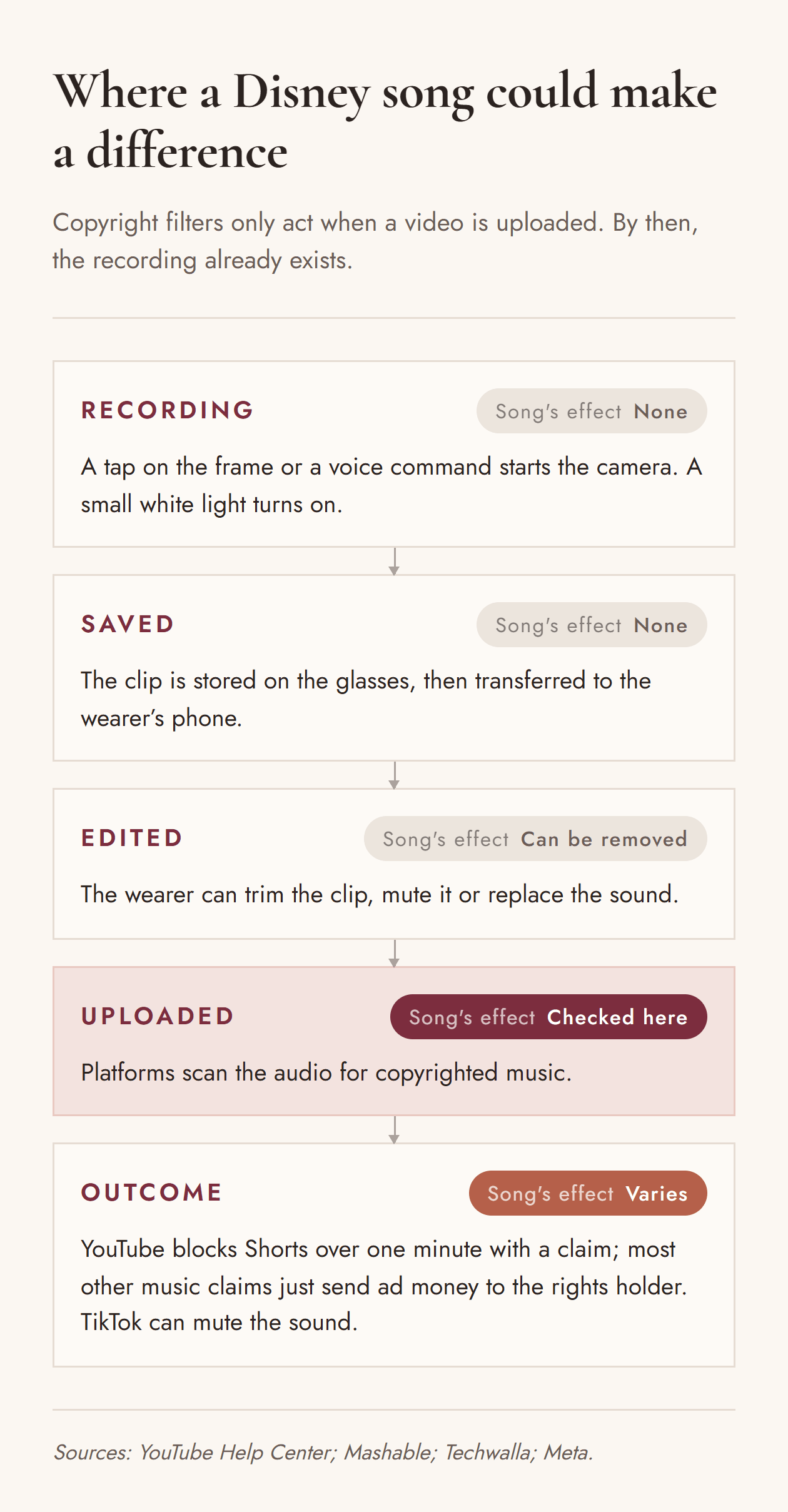
That points to the bigger problem. A filter only acts at the moment of upload, which is the last step in a much longer chain. By then the glasses have already recorded the encounter and the clip is sitting on the wearer's phone. Anyone determined to post it can trim the song out, mute the audio, replace it, or use editing tools that separate voices from background music. And the tip assumes the woman realises she is being filmed in time to find a song and press play. The whole reason smart-glasses videos work is that she usually doesn't.
Why the punchline stuck
If the trick is so unreliable, why did it spread so fast? Because it exposes something that is plainly true. Platforms have built automated systems that detect a few seconds of copyrighted music within moments of upload and act on it before anyone presses report. Protection for a person filmed without consent usually works the other way around. She has to discover the video exists, often because a friend sends it to her, find the account, report it, explain the problem and wait.
Copyrighted music
Detected automatically by software, often within moments of upload, before the video spreads. Rules apply the same way across countries.
A person filmed without consent
Usually has to find the video herself, report it and wait for a decision. Laws on filming in public vary by country, and in many places it is legal.
The results can be uneven even when women do report. A woman in Vancouver told CBC that Meta removed the video of her within 24 hours of her request, while TikTok did not. Dilara told the BBC that TikTok initially found no violation, and removed the video only after journalists contacted the company. The law is not much help either. In the UK there is no specific offence of filming someone in a public place, though harassment laws can apply, and campaigners have argued that the rules have not caught up with cameras people wear on their faces. England and Wales did create a specific offence for one kind of covert filming after Gina Martin's campaign against upskirting, but it does not cover a man filming a conversation in the street.
There are signs of pressure working. Instagram's head, Adam Mosseri, has said the platform will take down smart-glasses content that shows people being taken advantage of or harassed. The UK safeguarding minister Jess Phillips told the BBC that "covert filming of women and girls is vile, and we will not let anyone profit from it." Pubs run by JD Wetherspoon, some theatres and Comic Con Northern Ireland have banned filming with the glasses, and in September Meta unveiled a version of its Ray-Bans with no camera at all.
We have teams dedicated to limiting and combating misuse, but as with any technology, the onus is ultimately on individual people to not actively exploit it.
Meta spokesman Tracy Clayton, to the BBC
That statement is the heart of the complaint. Critics of the Disney tip, many of them women, have pointed out that it is one more safety rule asked of the people being filmed rather than the people filming, in the same line as covering your drink and sharing your location. It also arrives as questions multiply about how the technology companies behind AI treat women, from bias in AI systems to devices that make covert recording effortless.
What actually helps
None of the options are perfect, and none of them should be the responsibility of the person being filmed. But they are more reliable than a song.
If you think you are being filmed
- Look for a small white light near the lens. It can be dim in daylight, and its absence does not prove the glasses are not recording.
- Say it out loud: ask whether they are recording and that you do not consent. It creates a record and may deter posting.
- Move away. Ending the interaction limits what is captured.
- If a video of you appears, report it through the platform's harassment or privacy tools. Some have removed such videos within a day.
- Keep screenshots and links, and report threats, stalking or demands for money to the police.
So should you play a Disney song? It will not hurt, and on the right platform, with the right clip length and a lazy uploader, it might occasionally make a video harder to post. But it cannot stop a recording, it can be undone in seconds, and it depends on noticing something designed not to be noticed. The reason the tip spread is not that it works. It is that, for many women, it was the only lever that looked automatic, and the lever belonged to Disney.
Sources
- Mashable, "Being filmed by Meta smart glasses? The internet says to play Disney music," July 28, 2026.
- YouTube Help Center, "Learn about Content ID claims" and "Understand three-minute YouTube Shorts."
- Techwalla, "Disney Music Meta Smart Glasses Privacy Trick: What the Viral Advice Gets Wrong," July 29, 2026; IBTimes UK, August 12, 2026.
- BBC News, "Smart glasses: 'I was secretly filmed and trolled online'," January 8, 2026; "Women filmed in secret for social media content," January 24, 2026; "'Man in smart glasses filmed me in London then told me to pay'," May 7, 2026; "Smart glasses are 'an invasion of privacy'," May 13, 2026; "Meta glasses: Is it okay to film people in public places?" September 12, 2026; "They were labelled 'pervert glasses'," September 24, 2026.
- CBC Radio, "Meta's smart glasses make it easy to secretly film people," March 25, 2026.
- Reporting on police use of copyrighted music in Beverly Hills (2021), Alameda County (2021) and Santa Ana (2022), as summarised by Mashable and Gadget Review.