How a Fictional Buff Colombian Woman Outsold Disney's Marketing Department, Proved Every Assumption Wrong, and Accidentally Became a Role Model for a Generation
Turns out children relate harder to women who are strong, honest, flawed and interesting than those who are just seen as beautiful. Go figure.
— Viral tweet, January 2022
Somewhere in a Disney boardroom in 2021, a group of executives looked at the merchandise lineup for their upcoming animated film Encanto and made a decision. The pretty one — Isabela, the graceful eldest sister who conjures flowers and wears lacy dresses — would be the big seller. That was the bet. Garden room playset. Hair play doll. Makeup and jewelry. Barbie. Pajamas. Multiple T-shirts. The works.
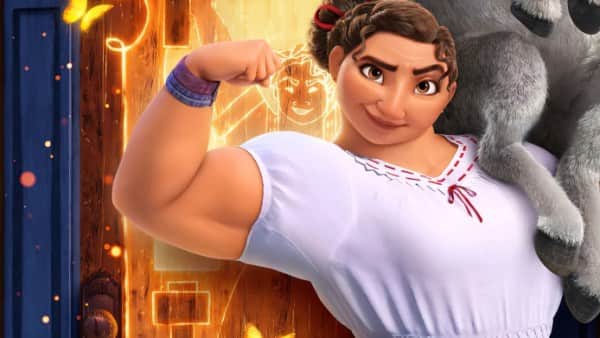
Luisa — the enormously strong, visibly muscular middle sister who bench-presses donkeys and cries about anxiety — got a single doll with a barbell. The executives had spoken. Little girls want the pretty one. They always want the pretty one. This is what little girls are like.
The little girls had not been consulted.
The Fight to Make Her Real
Before Luisa could outsell anyone, she had to exist. And getting her to look the way she looks — with the broad shoulders, the defined arms, the muscular frame that makes her silhouette immediately distinct from every other Disney female character in history — required a fight.
While the artists who worked on Encanto ultimately designed Luisa — the strong young woman with a sensitive spirit, voiced by Jessica Darrow — with a buff build and well-defined muscles, it appears that Disney execs were aiming for a more petite, traditionally Disney characterization. The artists on staff apparently advocated for keeping Luisa brawny.
Encanto illustrator and character modeling supervisor Dylan Ekren explained the fight with Disney to give Luisa a muscular physique that better fits the character. "I think we all just wanted to do it in a way that worked well with the style and really made sense for the character and I'm really proud of the way that she turned out. The entire team was so awesome. I just pushed buttons in the right order," Ekren wrote. It is the most diplomatic possible way of saying: we argued, we won, and here she is.
When people began freaking out over their love of Luisa Madrigal's massive muscles in the trailer, some of the Disney animators on the project confessed that they had to fight for her to look the way she did. The corporate instinct, as it has been throughout Disney's history, was toward the slim, the graceful, the conventionally beautiful. The artists pushed back. They won. And what they created changed the conversation.
"One of my favorite things about Encanto is this buff goddess. Her character design is everything — she's given muscles, but loses none of her femininity. The dances in her song, the way she cowers when she feels weak, her soft yet strong voice, just perfect."
— Fan response on social media after Encanto's release
Who Luisa Actually Is
It is worth pausing on what makes Luisa a genuinely remarkable piece of character design — not just because she has muscles, but because of what her muscles mean within the story. Luisa has the gift of super strength. However, she feels an immense amount of pressure to meet her family's expectations. As a result, she sings about the pressure that she feels weighing on her shoulders.
Her song "Surface Pressure" — performed by Jessica Darrow with an emotional precision that left parents weeping in multiplex seats — is about being the strong one. The dependable one. The one who never gets to fall apart because everyone else is counting on her not to. It is, in other words, a song that an enormous number of people — women especially, eldest daughters most of all — recognized as their own interior monologue set to music.
"A lot of clients relate to Luisa, who is experiencing the pressure of carrying the burden for their younger siblings, having that pressure of protecting the younger siblings from their own experiences," said one therapist. "It is eye-opening, and I'm so glad that I have clients that are very insightful and can relate to it." A Disney character was making it into therapy sessions. That does not happen with a barbie doll who conjures flowers.
The Merchandise Reckoning
It seems like Disney banked on the fact that outside of the lead, little girls would gravitate toward the pretty and perfect sister who was blessed with the gift to conjure beautiful flowers and plants — the closest thing to a "princess" in the film. The merchandise reflected that bet completely. Isabela has, among other things, a garden room play set, a hair play doll, a Barbie, a LEGO door set, pajamas, multiple T-shirts, and more.
Luisa was given a minute amount of merchandise, including a solo figure with a barbell and inclusion among the full family sets. While fans are grateful for anything with Luisa on it, the amount of merchandise featuring Mirabel and her flowery sister Isabela is extreme and plastered on just about everything Encanto.
The Kids Had Other Plans
The Kids Had Other Plans
And then the film came out. And then the children got to choose. Luisa merchandise began selling out fast, especially compared to her sisterly counterparts. Parents started calling out the discrepancy publicly. One mother wrote online: "My daughter just asked for a Luisa themed bday party and literally everything Encanto has Mirabels or Isabellas face on it. And I'm not in the financial situation to have everything custom made. Disney needs to step it up with Luisa merch."
What the Children Were Actually Saying
Here is the thing about the Luisa phenomenon that goes deeper than merchandise sales. When children gravitated to Luisa over Isabela, they were not making a statement about preferring muscles over flowers. They were making a statement about what they needed to see. They needed to see someone who looked like effort. Someone whose body showed that she worked, that she carried things, that she was built for something other than being looked at.
Seeing Yourself on Screen
Seeing Yourself on Screen
One TikTok user who went viral for looking similar to Luisa opened up about how extraordinary it was to see a character like her. "I was surprised to see a masculine-yet-feminine presented female character," she told BuzzFeed. "I've always been told I look too 'masculine' to be feminine, but seeing Luisa just made me feel comfortable with loving myself even more."
This is what representation actually means. Not a checkbox. Not a diversity footnote. A child seeing a screen and recognizing herself — her body, her anxiety, her feeling of carrying too much — and feeling, for the first time, that the screen was looking back. Disney stumbled into it accidentally, almost against its own will, because a group of animators pushed back hard enough. And the children found it immediately, instinctively, the way children always find the things that tell them the truth.
"We want muscle lady and awkward 'talentless' girl. My three year old mimics her dancing and it's taken over."
— Parent commenting online after Encanto's release
Disney's Long History of Getting This Wrong
The Luisa situation did not happen in a vacuum. It happened against a backdrop of decades of Disney female character design that has been, with some notable exceptions, relentlessly consistent in its beauty standards: slim waist, large eyes, small nose, delicate frame. The princess body. The body that is designed to be looked at, to be rescued, to stand in a beam of light and look luminous while things happen around her.
A Century of the Same Silhouette
A Century of the Same Silhouette
Even before Encanto was really off the ground, Disney was already falling into traditional habits that would have likely backfired. T he instinct to make Luisa slimmer, to sand down her muscles, to bring her silhouette into line with the Disney standard — this instinct did not come from nowhere. It came from a century of corporate muscle memory about what a Disney woman is supposed to look like. And it was wrong, not just artistically, but commercially. The children told them so in the only language that gets through: sales figures.
It's a shame that the merchandise reflects the perpetuation that beauty is the most important marketing tool for little girls. B ut the Luisa story is also proof that this assumption, so deeply embedded in Disney's institutional DNA, is not inevitable. It can be challenged. It can be beaten. It just requires someone willing to fight for it — and then a generation of children willing to vote with their birthday party wishlists.
This Is Not Isabela's Fault
One important clarification, because it matters: none of this is about Isabela being a lesser character. Within the film, Isabela has her own arc — her own moment of liberation, her own song about breaking free from the expectation of perfection. She is not the villain of this story. She is another young woman trapped by what her family and her world expects her to be. The film treats her with compassion.
The villain, to whatever extent there is one, is the assumption — Disney's assumption, the market research's assumption, the boardroom's assumption — that "classically beautiful" is automatically what children will choose. That slim and graceful is the safe bet. That you can predict what little girls want by looking at what little girls have always been given. Luisa proved that assumption wrong so comprehensively that it should be a case study in every entertainment marketing department on Earth.
What Happens When You Trust the Artists
The animators who fought for Luisa's muscles were not making a political statement. They were doing what good artists do: they were trying to make the character true. Luisa's power is strength. Her body should show that. Her physique should make sense for who she is. The fight was not ideological — it was craft. It was the insistence that a character's appearance should reflect her reality, not a corporate template.
What happened when they won that fight — the merchandise lines, the viral TikToks, the therapy sessions, the birthday parties, the three-year-olds mimicking her dance moves, the adults weeping to Surface Pressure in their cars — is what happens when art is allowed to be honest. The audience finds it. Children especially find it. Because children have not yet learned to pretend that the things that feel true are not true.
Disney wanted the pretty one to sell. The kids wanted the strong one. The kids, as usual, were right. And somewhere in a Disney boardroom, someone is hopefully writing that down.
A Final Word
Children do not need to be protected from strong women. They do not need to be steered toward the version of femininity that fits most neatly into a marketing deck. They need to see bodies that do things. Characters who carry weight — literally and emotionally — and keep going anyway. Luisa Madrigal is a fictional character in an animated film about magical Colombian family drama. She is also, apparently, exactly what a generation of little girls needed. Give them the muscle lady. They already know what they want.