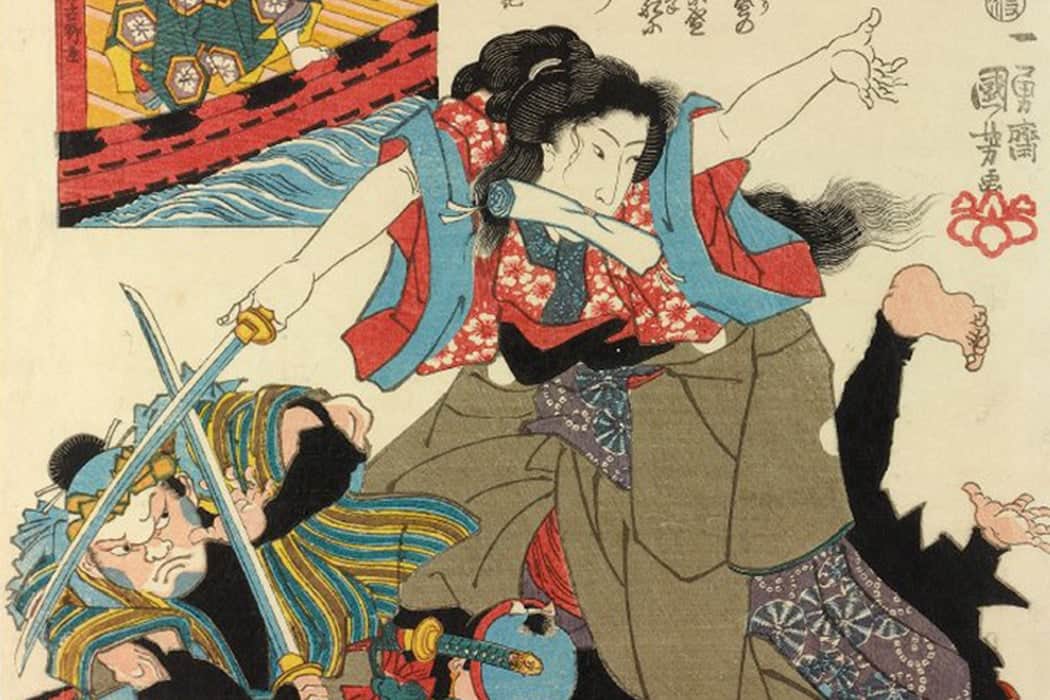
Every painting showed men. Every film cast men. Every textbook said men. Then they tested the bones — and a third of the warriors were women.
They dug them up expecting to confirm what everyone already knew.
Samurai were men. The battlefield was a man's domain. That was the story Japan had told itself for centuries and the story the rest of the world accepted without question.
Then the DNA results came back.
And the story collapsed.
We expected the remains to be overwhelmingly male. When over a third came back female, we had to reconsider everything we assumed about who fought and died on these fields.
— On the forensic analysis of remains from the Battle of Senbon Matsubaru, 1580
33%
Researchers conducted DNA analysis on remains from the site of the Battle of Senbon Matsubaru — a major engagement during Japan's Sengoku period, the century-long civil war that nearly tore the country apart.
Of the 105 bodies tested, 35 were female.
One in three.
These were not camp followers. Not nurses. Not bystanders caught in crossfire. They were combatants — buried with weapons, buried with armor, buried in the same positions and with the same battle injuries as the men beside them.
They fought. They died.
And then history pretended they were never there.
They Had a Name. They Always Had a Name.
Onna-bugeisha. Female martial artists of the Japanese warrior class.
Not a myth. Not folklore. Documented, named, and in some cases legendary — women who trained in combat from childhood, who mastered the naginata, the kaiken, and the bow, who rode into battle alongside men and were expected to fight and die with the same discipline.
Raised for the Blade
Girls in samurai households were taught the naginata — a long-bladed polearm that gave a smaller fighter reach and leverage against larger opponents. They trained in archery. They carried the kaiken, a short dagger kept in the obi sash, intended for close combat and, if capture was imminent, for ending their own life rather than surrendering.
They were not picking up weapons in desperation. They were raised for this.
But here is the strange part. Despite being real, documented, and now archaeologically confirmed — the onna-bugeisha were systematically erased from the dominant narrative of Japanese history. The samurai story that survived into the modern era was edited. The women were cut out. Not because they weren't there. Because a later era decided they shouldn't have been.
A Warrior Worth a Thousand
Some of them were too famous to disappear entirely.
Tomoe Gozen fought in the Genpei War in the late 12th century. According to "The Tale of the Heike" — one of Japan's most important literary epics — she was described as a warrior worth a thousand.
Worth a thousand.
She was a rider of unbroken horses, a swordswoman who charged at the front of the line. In one account, during the Battle of Awazu in 1184, she rode into the enemy ranks, pulled a mounted warrior from his horse, pinned him to her saddle, and took his head.
This was not a supporting character. This was one of the most formidable warriors of the entire war.
And still — for centuries afterward — historians debated whether she actually existed or was merely a literary invention. A woman that lethal, that central to a conflict — and the default academic response was to question whether she was real. The bones at Senbon Matsubaru suggest women like Tomoe Gozen were not the exception. They were a third of the army.
"Tomoe was especially beautiful, with white skin, long hair, and charming features. She was also a remarkably strong archer, and as a swordswoman she was a warrior worth a thousand, ready to confront a demon or a god."
— "The Tale of the Heike," 14th century Japanese epic
The Last Samurai Was 21. She Led the Charge Herself.
In 1868, during the Boshin War — the final chapter of samurai Japan — a woman named Nakano Takeko organized something the men wouldn't allow and the history books almost forgot.
She was 21.
When imperial forces advanced on the Aizu domain, Takeko requested that women be allowed to fight alongside the men. She was denied. So she formed her own unofficial unit — mothers, daughters, sisters — armed with naginata, ready to die for the same cause the men had claimed as theirs alone.
A Final, Furious Charge
At the Battle of Aizu, Takeko led her unit in a direct charge against imperial troops armed with modern rifles. She killed multiple soldiers with her naginata before a bullet struck her in the chest.
As she lay dying, she made one request.
Cut off my head. Don't let them take it.
Her sister did. She carried it from the battlefield and buried it under a pine tree at the Hokai-ji temple. A monument stands there today.
Nakano Takeko led one of the last samurai charges in Japanese history. She was 21 years old. And when people say "the last samurai," they almost never mean her.
How They Were Erased
The erasure didn't happen during the wars. It happened after them.
During the Edo period — the long era of peace under the Tokugawa shogunate starting in the early 1600s — the role of women in Japanese society was radically redefined. Neo-Confucian ideals became state doctrine. Women were pushed into domestic roles. Obedience, modesty, and submission became the expected virtues.
The warrior woman didn't fit the new story.
So she was written out of it.
The Rewriting Begins
Records were curated. Narratives were reframed. The samurai became an exclusively male archetype — stoic, disciplined, loyal, and always male. The women who had bled on the same battlefields and been buried with the same weapons became footnotes, then myths, then nothing.
By the time the Western world encountered the samurai through cinema and pop culture, the erasure was complete. The word "samurai" conjured one image: a man with a sword. The women had been gone so long that nobody even noticed they were missing.
"History is not what happened. It is what was recorded by those who had the power to decide what mattered. The bones are what actually happened."
— On the significance of forensic archaeology in correcting historical narratives
The Ground Doesn't Lie
Books can be rewritten. Paintings can be commissioned to show whatever the patron wants. Oral histories can be shaped by whoever is telling them.
Bones don't lie.
They don't care about ideology. They don't adjust for politics. They don't edit themselves to fit a narrative that came two hundred years later. They sit in the ground, exactly where they fell, holding the truth in their DNA until someone finally thinks to look.
And when someone finally looked — when modern forensic technology was applied to the remains at Senbon Matsubaru — the answer was unambiguous.
One in three.
Women fought. Women died. Women were samurai.
The history books said otherwise. The ground said the history books were wrong.
The Point
They fought the same wars, carried the same weapons, suffered the same wounds, and were buried in the same ground. Then the era of peace came and the men who wrote the history decided the women didn't belong in it. For four hundred years, it worked. Then someone tested the bones. One in three warriors on that battlefield was a woman. The scrolls lied. The paintings lied. The films lied. The ground told the truth. It always does.
Sources
1. Suzuki, M. (2008). DNA analysis of skeletal remains from the Senbon Matsubaru battlefield site. Japanese Archaeological Association.
2. Turnbull, S. (2010). "Samurai Women 1184–1877." Osprey Publishing.
3. "The Tale of the Heike" (14th century). Translated by Helen Craig McCullough, Stanford University Press, 1988.
4. Amdur, E. (2002). "Women Warriors of Japan: The Role of Arms-Bearing Women in Japanese History." Koryu Books.
5. Wright, D.E. (2001). "Female Combatants and Japan's Meiji Restoration: The Case of Aizu." War in History, 8(4), 396–417.
6. National Museum of Japanese History — Sengoku period warfare exhibits and publications.