A post doing the rounds on X says Denmark has proposed a copyright law that would give citizens ownership of their face, voice and body to fight AI deepfakes. It sounds like science fiction drafted by a lawyer. It's also mostly right, with two catches that change how you should read it: the bill hasn't passed, and it doesn't actually hand anyone a copyright in their own face.
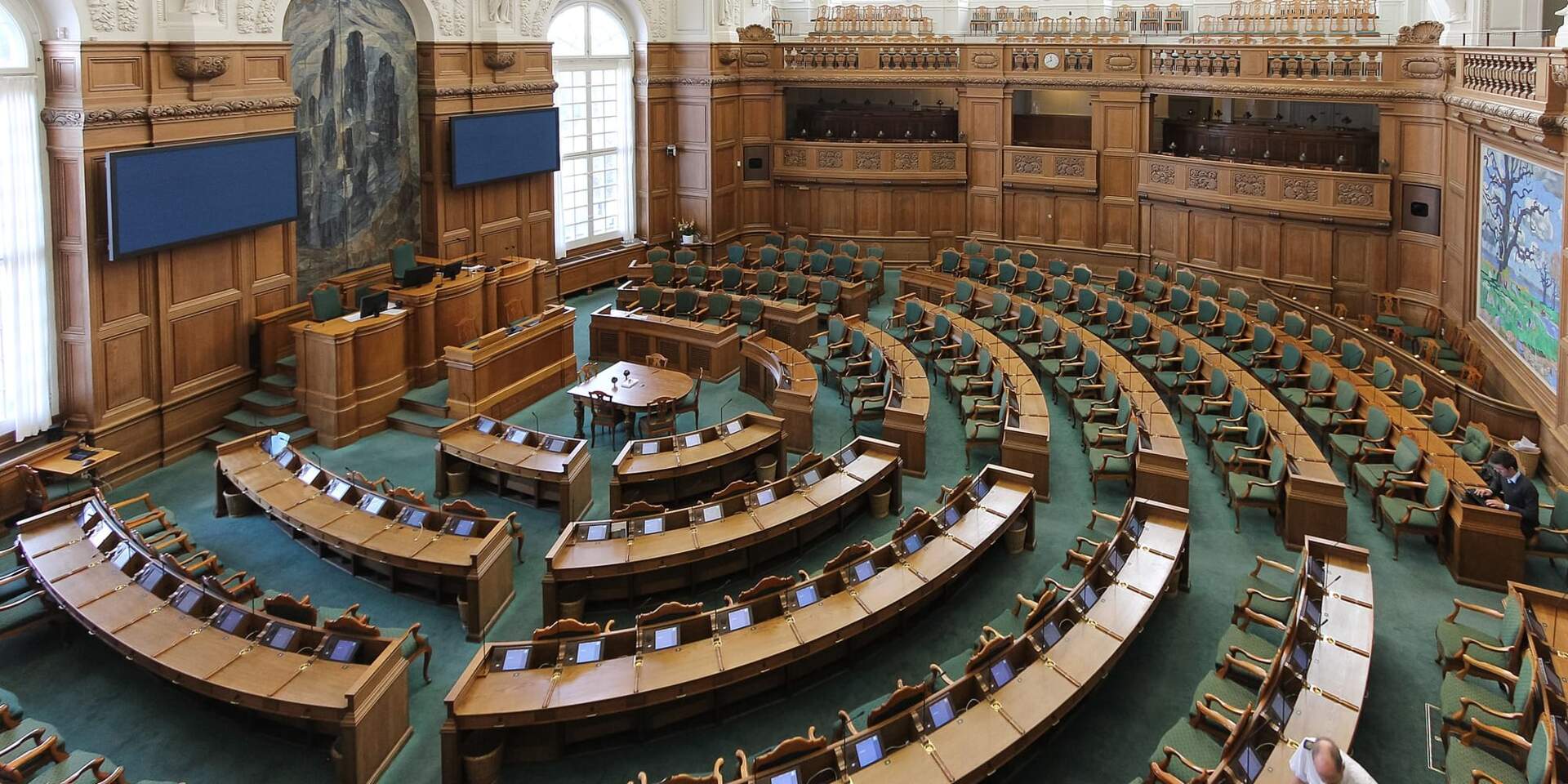
The short version is this. On 8 October 2026, Denmark's culture minister, Zenia Stampe, tabled bill L 49 in the Folketing, the Danish parliament. It would make it unlawful to make a realistic, digitally generated imitation of a person's appearance, voice or movements available to the public without that person's consent. Satire and parody get an exemption; dangerous misinformation doesn't. The government wants the law in force on 1 January 2027, but parliament still has to pass it, and this is the second time the idea has been put in front of it.
The idea is older than the post
The plan first made headlines in June 2025. On 26 June that year, the then government (a coalition of the Social Democrats, Venstre and the Moderates) struck a deal with six other parties to change the Copyright Act. The culture minister at the time, Jakob Engel-Schmidt, told the Guardian the bill would send "an unequivocal message that everybody has the right to their own body, their own voice and their own facial features." The Guardian reported that the plan was believed to have the backing of nine in ten MPs.
Human beings can be run through the digital copy machine and be misused for all sorts of purposes and I'm not willing to accept that.
— Jakob Engel-Schmidt, then Denmark's culture minister, speaking to the Guardian, June 2025
A draft went out for public consultation in the summer of 2025, and Denmark pushed the approach with other EU governments while it held the rotating Council presidency in the second half of that year. The change was expected to take effect on 31 March 2026. Then politics got in the way. On 26 February 2026, Prime Minister Mette Frederiksen called a snap election for 24 March, the bill lapsed, and the new minority government she leads wasn't appointed until 3 June. Stampe, the new culture minister, brought a revised version back in October. Somewhere in that gap, a lot of people online decided it was already law. It wasn't, and at the time of writing it still isn't.
Key dates
- 26 Jun 2025Nine parties agree to protect people's faces and voices through Denmark's Copyright Act.
- Jul–Aug 2025The first draft goes out for public consultation.
- Jan–Feb 2026The draft is under EU review, open for comments until 3 February.
- 26 Feb 2026A snap election is called. The planned 31 March start date falls away and the bill lapses.
- 24 Mar 2026Denmark holds its general election.
- 3 Jun 2026A new government is appointed, with Zenia Stampe as culture minister.
- 8 Oct 2026Stampe tables a revised bill, L 49.
- 1 Jan 2027Proposed start date, if the Folketing passes the bill.
What the bill would actually do
The heart of it is one new section, 73 a, and it's a single sentence: realistic digitally generated imitations of a natural person's personal, physical characteristics may not be made available to the public without that person's consent. The explanatory notes then spend pages pinning down each of those words.
"Realistic" means there is an obvious risk that someone could mistake the imitation for a real picture or recording of the person. The ministry's examples of what falls outside are oddly specific: a person turned into a fantasy creature, a lifelike figure with "neon green skin and pink eyes," or a digitally painted portrait nobody would take for a photo. "Digitally generated" covers AI and ordinary editing software alike. And only making the fake public counts. Creating one, or showing it around at a private party (the notes' own example), isn't covered.
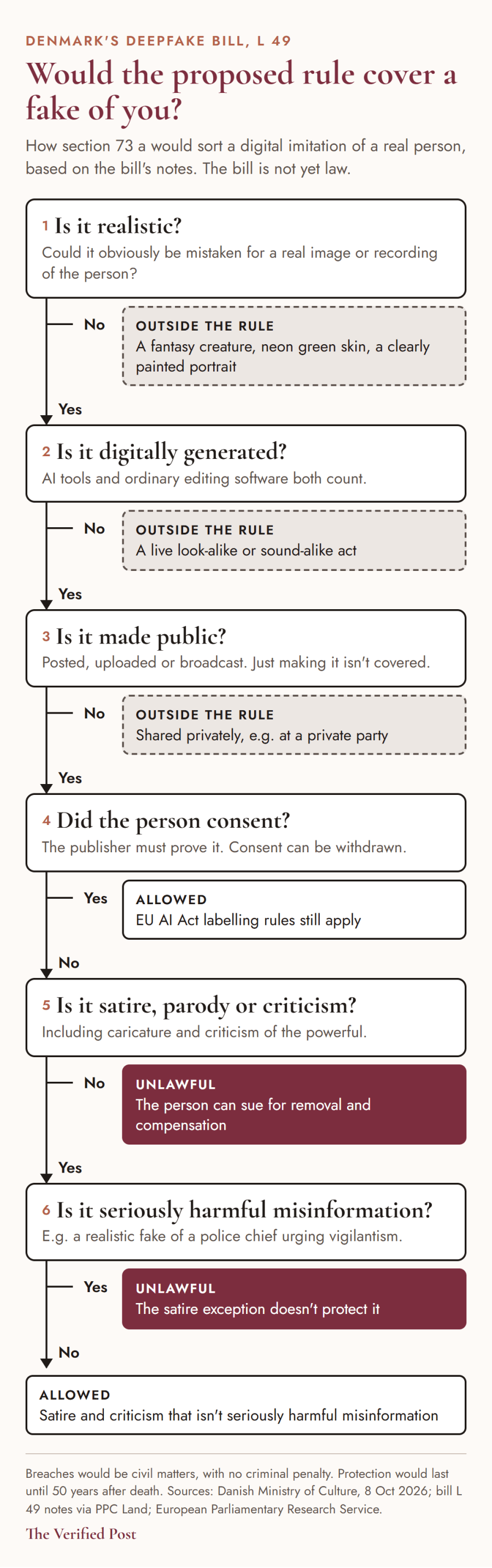
Three more details make it stricter than it first looks. The burden of proof sits with whoever publishes the imitation: they have to show that consent exists. Consent can be withdrawn at any time for future use, with no formalities. And intent isn't required, so accidental or careless publication is covered too. Protection would last until 50 years after the person's death, and it would apply to everyone, foreign nationals included, not only Danish citizens.
Performers get a second, separate right (section 65 a) against realistic digital imitations of their performances. The ministry's notes say streaming services increasingly carry tracks that clone musicians' vocals one-to-one and compete with the original music. That right covers performers from the European Economic Area.
So is it really "copyright" over your face?
Not in the usual sense, and this is where I'd push back on the viral post. The rules sit inside Denmark's Copyright Act, which is why everyone calls it a copyright law. But copyright protects original creative works, and your face isn't something you authored. A European Parliament research briefing from January 2026 points out that, in the notes attached to the draft, the Danish authorities themselves say they don't intend to create a new copyright for citizens. What they've built is closer to a personality right: a legal right to stop realistic fakes of your face or voice being published without your say-so, which is a narrower thing than owning them the way a songwriter owns a song.
What the post says
Denmark is granting citizens ownership of their face, voice and body through a new copyright law.
What the bill says
A proposed consent right placed in the Copyright Act, covering anyone's appearance, voice and movements. It is not copyright in the strict sense, and it is not law yet.
Enforcement would be civil. Breaking section 73 a wouldn't be a crime; the bill deliberately keeps it outside the Copyright Act's fines. A victim could instead sue for compensation and ask a court to order the content removed from the platform where it was posted. Stampe has been blunt about who she has in mind. "One of the main goals of the bill is to get the tech giants to take down manipulated content quickly, so that it causes the least possible harm," she said in the ministry's announcement, as translated by Euronews.
Would it fix the deepfake problem?
Personally, I think the consent rule and the burden of proof are the smartest parts of the bill. Today, someone who finds a fake of themselves online usually has to show it's sexual, defamatory, fraudulent or used in advertising before any law clearly applies. Under L 49 the question gets much simpler: did you agree to this? That's a far easier thing to put in a takedown request.
The limits are just as real, though. Denmark already has rules on identity misuse in its Criminal Code and a ban on using someone's image in marketing without permission, and some lawyers cited in the European Parliament briefing argue that better enforcement of existing law might do as much as a new right. Geography is the bigger snag. According to the same briefing, the Danish rule could only be enforced inside Denmark, through very large platforms geo-blocking content there; a fake taken down for Danish users could stay up everywhere else. The ministry also admits a free-speech tension in its own notes. Satire made without consent could in principle be caught if it's realistic enough to be confused with reality.
Other countries are coming at the problem from different directions. France already bans sharing AI-generated images or audio of a person without consent when it isn't obvious or disclosed that the content is artificial. In England and Wales, creating or requesting non-consensual intimate deepfakes became a criminal offence earlier in 2026. EU countries have until 14 June 2027 to criminalise sharing sexual deepfakes under the bloc's directive on violence against women; Denmark isn't bound by it, because of its opt-out from EU justice rules. And according to the European Parliament's researchers, Denmark's culture minister said Ireland intended to follow the Danish model.
So the X post is right that Denmark proposed this, and the proposal is real, detailed and unusually ambitious. But nobody in Denmark holds a copyright in their own face today. If the Folketing passes L 49 on schedule, 1 January 2027 is the first day anyone could rely on it.
Read next: whether playing Disney songs really stops strangers filming you with Meta glasses · what UNESCO found about AI and gender bias · Denmark's compensation for Greenland's IUD scandal
Sources (9)
- Danish Ministry of Culture, Kulturminister vil dæmme op for delinger af digitale efterligninger fra årsskiftet (press release, 8 Oct 2026)
- Folketinget, L 49 (2026-27): Forslag til lov om ændring af lov om ophavsret
- PPC Land, Denmark's deepfake bill makes publishers prove consent from January 2027 (Oct 2026), quoting and translating the bill's explanatory notes
- European Parliamentary Research Service, The Danish approach to copyright and deepfakes: A model for the EU? (Jan 2026)
- Euronews, Denmark introduces bill to protect people's faces and voices from deepfakes (8 Oct 2026)
- The Guardian, Denmark to tackle deepfakes by giving people copyright to their own features (27 Jun 2025)
- Dennemeyer, A new sense of self: Denmark's copyright amendment against deepfakes (Feb 2026)
- House of Commons Library, Denmark: 2026 election and new coalition government
- Images: cover, Peter Leth, CC BY 2.0, via Wikimedia Commons; flowchart, The Verified Post