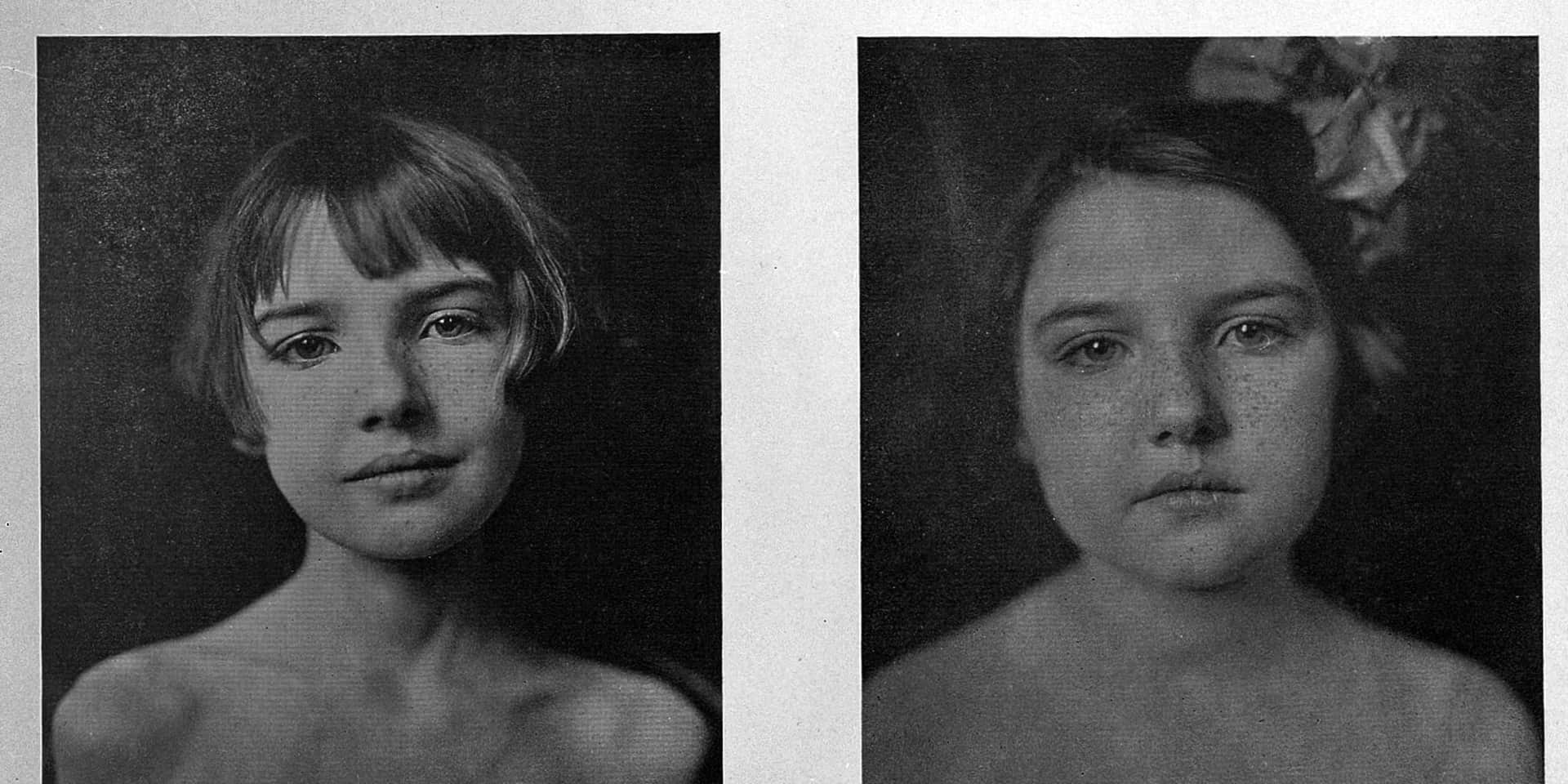
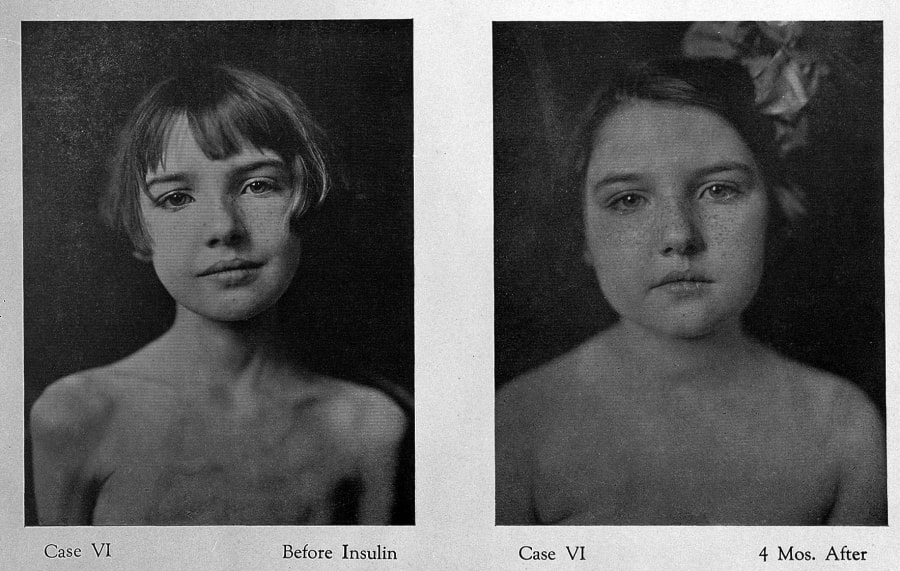
She has a neat fringe, a thin neck and collarbones you could count from across the room. In the second picture, the same girl has round cheeks, a ribbon in her hair and the slightly bored look of any kid made to sit still for a photographer. Between the two frames sit the words "Before Insulin" and "4 Mos. After."
The pair has circulated online for years, usually with a caption like the one we posted: in 1922 a little girl was wasting away from type 1 diabetes, and four months after doctors gave her a new experimental drug called insulin, she looked like a different child.
Viral medical photos have a bad track record. The famous before-and-after pictures often credited to Leonard Thompson, the first person ever given insulin, aren't actually of him at all. So we went back to the original 1923 journal to check this one. It holds up. And the hospital record behind the photographs tells a harder, more interesting story than the caption does.
Where the photos come from
The images were published in a paper titled The Use of Insulin in Juvenile Diabetes by H. Rawle Geyelin, George Harrop, Marjorie F. Murray and Eugenia Corwin of Columbia University's College of Physicians and Surgeons and the Presbyterian Hospital in New York. It ran in a special insulin issue of the Journal of Metabolic Research, edited by the diabetes specialist Frederick M. Allen.
There's a small dating wrinkle worth knowing. The issue is labelled November–December 1922, but its own preface admits publication delays meant it actually went to press in May 1923. Geyelin's paper was received on April 19, 1923. So the photographs belong to the winter of 1922–23, which is close enough that "1922" in a caption isn't wrong, just slightly compressed.
The paper followed nine diabetic children, aged two to sixteen, treated with insulin supplied by Eli Lilly under the name "Iletin." The hospital first got insulin for clinical use in August 1922, only months after the Toronto team of Frederick Banting, Charles Best, James Collip and J.J.R. Macleod had shown it worked in people.
The girl in the photos is identified only as Case VI, with the initials M.V.N. (written "M. van N." on her chart). The paper gives her age as 12. Her name was never published, and as far as we can find, no archive has publicly identified her or recorded what happened to her later. Anyone claiming to know her full name or life story should be asked for their source.
Two years on a starvation diet
What makes Case VI so striking isn't the second photo. It's what the first one is hiding.
According to the case history, her diabetes came on suddenly in late October 1920. She was thirsty, urinating constantly and losing weight, and within two weeks she was drowsy, vomiting and breathing in the deep, acetone-scented way doctors recognised as diabetic acidosis. She arrived at Presbyterian Hospital in November 1920 weighing 53.5 pounds, down from a best weight of 57.5.
Before insulin, the best that medicine could offer a child like her was the "Allen diet": cutting food until the urine stopped showing sugar, punctuated with fast days. It worked for a while. For eight months she stayed sugar-free as an outpatient. Then, around a year after onset, her tolerance collapsed.
By May 1922 she was back in hospital at 46 pounds. Doctors put her on a diet of no carbohydrate at all, 20 grams of protein and 20 grams of fat a day for two weeks. By my arithmetic that's roughly 260 calories for a growing child. Even that only briefly stopped the sugar spilling into her urine.
When she was admitted for insulin on October 31, 1922, she weighed 44 pounds. Her urine output averaged around 5,000 cc a day, and her basal metabolism was 38 percent below normal. The doctors summed up her condition in four words: "extreme weakness and lethargy."
This is the part the viral caption flattens. "Wasting away from type 1 diabetes" is true, but she was also wasting away from the treatment. Personally, I think that's the most important thing these photos show. The doctors weren't negligent. Starvation genuinely bought diabetic children time, sometimes years. But it was a holding pattern with a single, predictable ending, and everyone involved knew it.
One more note on terminology. Doctors in 1922 called her illness juvenile or severe diabetes. The "type 1" label didn't exist yet, but her sudden onset in childhood, ketoacidosis and complete dependence on insulin match what we'd call type 1 today.
Case VI, according to the 1923 report
- Oct 1920Symptoms begin suddenly: thirst, frequent urination, weight loss.
- Nov 1920Admitted to Presbyterian Hospital in diabetic acidosis, weighing 53.5 lb.
- Nov 1921About a year after onset, her carbohydrate tolerance collapses despite the diet.
- May 1922Readmitted at 46 lb; put on zero carbohydrate, 20 g protein and 20 g fat a day.
- Aug 1922Insulin first becomes available for clinical use at Presbyterian Hospital.
- Oct 31, 1922Admitted for insulin therapy at 44 lb, after a two-week control period without it.
- Nov 1922–Jan 1923On insulin: her daily food rises sharply, weight climbs and she grows about 3 cm.
- Apr 19, 1923The paper reporting her case is received by the journal.
What four months of insulin did
The hospital kept her off insulin for a two-week control period first, so they could measure how badly her body was handling food without it. Then insulin started in November 1922.
Her chart, reproduced below, is in its own way more remarkable than the photographs. The calories row tells the story. During the control period her measured daily intake sat at about 810 and then 539 calories. Once insulin began, it climbed steadily, passing 1,300, then 1,500, and reaching more than 1,900 calories a day by late January 1923. The dashed weight line rises from 44 pounds into the low 50s across the same weeks.
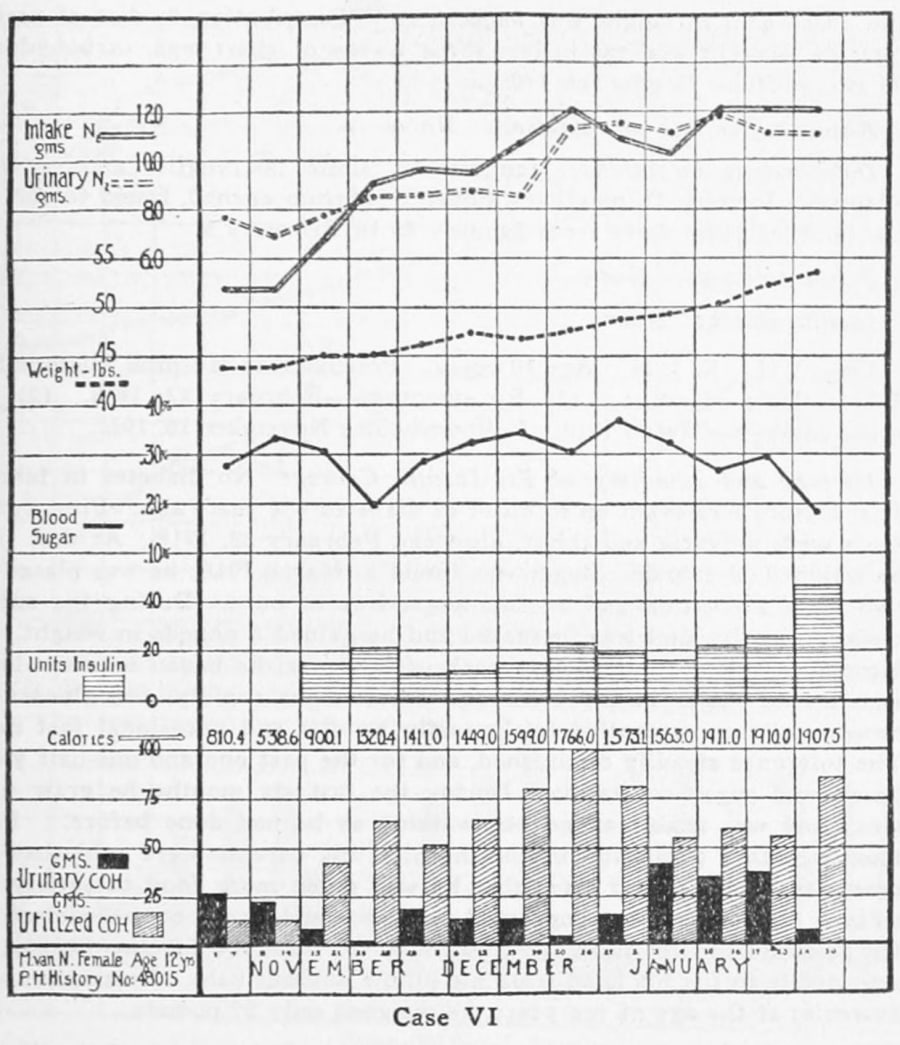
The doctors noted that the weight gain was "uninterrupted and was not accounted for by fluid retention," which mattered, because swelling could make a starving child look heavier than she was. She grew about 3 centimetres over the period covered by the chart.
It wasn't a clean run. Insulin was scarce, and the report says her treatment was "several times interrupted for a day or two at a time" because of supply shortages. In January she developed a throat infection and then sinusitis bad enough that surgeons opened and drained her maxillary sinus. Even so, the weight kept coming.
Why feed her so much, so fast? The paper is candid about it. These children were so undernourished that the team's priority was restoring weight and strength quickly, so most were put on two to three times the food they'd previously tolerated, with insulin raised to match. The aim was a diet "as nearly normal" as the disease and the insulin supply allowed.
What the viral post says
In 1922 a little girl wasting away from type 1 diabetes was given a new experimental drug called insulin, and four months later she looked like a different child.
What the 1923 record shows
Accurate. Case VI, a New York patient listed as 12 years old, weighed 44 lb when insulin began in November 1922. Her chart shows her food and weight climbing steadily; the 'after' photo was taken about four months in.
She wasn't the only one
Case VI was one of nine. The team reported gains in weight ranging from just two pounds in three months to twenty-two pounds in seven months, plus "great improvement in the patients' sense of mental and physical well-being." In those nine children and about thirty more they were still writing up, they said they had "met with no therapeutic failures."
The Presbyterian Hospital insulin study
It's worth reading those claims the way the authors did, cautiously. They stressed that their results covered only three to eight months, so "conclusions as to the continued beneficial effect of insulin over a period of years are not warranted." They also described frightening episodes of "insulin shock," the low blood sugar that could bring sweating, confusion and convulsions, and abscesses where injections went in. This was a new drug, and they treated it like one.
The historian Chris Feudtner later pointed out, as the diabetologist Robert Tattersall noted in his history of the disease, that the most dramatic before-and-after pictures of this era weren't typical. Most children kept alive on starvation diets had lost around 10 percent of their body weight. The ones in these photographs had lost 30 percent or more. Case VI was among the sickest of the sick. That's exactly why her doctors photographed her.
Insulin, administered under carefully controlled conditions, has proved a safe and remarkably effective therapeutic agent in the treatment of severe juvenile diabetes.
— Geyelin, Harrop, Murray and Corwin, Journal of Metabolic Research, 1923
Why the photos still hit so hard
Plenty of medical breakthroughs are invisible. You can't photograph a vaccine preventing an illness that never happens. Insulin was different. A child who'd been starved for two years could be fed again, and within weeks you could see it in her face.
That's why Geyelin's team, and other doctors such as Ralph Major in Kansas, put photographs next to their charts. In an era when European physicians were openly sceptical of the Toronto reports, a picture of a gaunt girl becoming a round-cheeked one was evidence anyone could read.
What most people overlook is that she didn't need a cure. Insulin doesn't cure diabetes. It replaces something her body could no longer make, and she would have needed it every day for the rest of her life. The "4 Mos. After" photo isn't the end of an illness. It's the first picture of a childhood she'd been about to lose, and of a disease that, for the first time, a child could live with.
Read next: How Elizabeth Hughes and Banting's discovery turned diabetes from fatal to manageable · The real medical story of Joseph Merrick, the "Elephant Man" · When nostalgia was diagnosed as a deadly disease
Sources
- Geyelin HR, Harrop G, Murray MF, Corwin E. "The Use of Insulin in Juvenile Diabetes." Journal of Metabolic Research, vol. 2, nos. 5–6 (nominally Nov.–Dec. 1922, published May 1923), pp. 767–792. Full scan: University of Toronto Libraries via Internet Archive.
- University of Toronto, The Discovery and Early Development of Insulin: Journal of Metabolic Research special insulin issue (catalogue record and preface).
- Thomas Fisher Rare Book Library, University of Toronto: "Case VI. The Use of Insulin in Juvenile Diabetes".
- Polonsky KS. "The Past 200 Years in Diabetes." New England Journal of Medicine, 2012;367:1332–1340 (uses the Case VI photographs as Figure 1).
- Tattersall R. The Pissing Evil: A Comprehensive History of Diabetes Mellitus (Swan & Horn, 2016), excerpt via Books from Scotland.
- "What Was Known About Childhood Diabetes Mellitus Before the Discovery of Insulin?" PMC9109214 (on the misattributed "Leonard Thompson" photographs).
- Images: Case VI photographs, Wellcome Collection L0031615, Wikimedia Commons, CC BY 4.0. Case VI chart, Journal of Metabolic Research vol. 2 p. 781 (1923), scan by University of Toronto Libraries, public domain in the US.