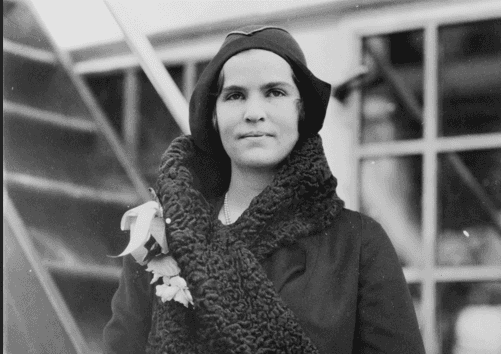
Back in 1922, diabetes was a ruthless adversary. It didn’t just take its time; it devoured you whole and then struck you down swiftly.
Before the discovery of insulin, living with diabetes was a grim reality. The best treatment available was a strict diet that severely limited carbohydrates, but sometimes these harsh regimens led to starvation, claiming lives before the disease could even take its toll.
Enter Elizabeth Hughes, a 14-year-old girl who weighed just 45 pounds when she arrived in Toronto that year. As the daughter of the U.S. Secretary of State, she had access to top-notch medical care, but unfortunately, nothing seemed to help her.
Everything changed on August 17, 1922, when she received her first insulin injection. Just two weeks later, she was enjoying a regular diet of 2,200 calories a day. Remarkably, she lived to the age of 73, spending 58 years on insulin, and none of her friends or colleagues ever suspected she had diabetes.
This is her incredible journey. And the tale of the man who made it possible.
Oh, it is simply too wonderful for words, this stuff.
Elizabeth Hughes, diary
Before Insulin — What Diabetes Actually Meant
To understand what insulin did for Elizabeth Hughes — and for the millions who followed — you first have to understand what diabetes meant before it existed.
A Disease Known for Thousands of Years, Untreatable Until 1922
Diabetes has been identified as a unique medical condition for over 3,000 years, yet its true origins remained a puzzle until the 20th century. Ancient doctors took note of it, and Roman scholars wrote about it. For centuries, our grasp of what was going on inside the body was mostly focused on its most apparent symptom — sweet-smelling urine — along with the unfortunate reality that those who fell ill with it often didn’t live for long.
The Only Treatment Available Was Starvation
Before the discovery of insulin in 1921, life expectancy for those with diabetes was quite grim; doctors had limited options to help. The best they could offer was a very strict diet with hardly any carbohydrates. While this approach might extend a patient's life by a few years, it was far from a cure. Some of these harsh diets were so extreme that they allowed for as little as 450 calories a day, which tragically led some patients to suffer from starvation.
What the Body Did Without Insulin
In both younger and older patients, the disease led to severe weight loss due to inadequate nutrition. Before the advent of insulin, children with diabetes often survived on a diet that barely kept them alive, sometimes even bordering on starvation. It’s fair to say that many of them merely existed rather than truly lived. Without insulin, their bodies couldn’t process glucose and started breaking down their own fat and muscle for energy. This heartbreaking process was unyielding, evident, and well-documented in clinical records, which noted that children were arriving at hospitals weighing less than they had just a few years earlier.
A Diagnosis That Was Also a Death Sentence
Before insulin became a standard treatment, being diagnosed with diabetes was pretty much a death sentence — often within just a few months, and sometimes even weeks. Dr. Frederick Banting noted in his personal journals that, prior to 1922, children with diabetes had a life expectancy measured in mere months. When parents took their kids to hospitals in the early 1920s, they weren’t searching for a miracle cure; they were simply hoping for a little more time.
Elizabeth Hughes — The Girl Who Had Everything Except Time
Among the hundreds of children dying of diabetes in 1922, Elizabeth Hughes had more advantages than almost any of them. None of those advantages were enough — until insulin.
Who Elizabeth Hughes Was
Elizabeth Hughes was just fifteen when she was the daughter of Charles Evans Hughes, a major figure in American public life during the early 20th century. Her father had quite the resume—he was a former governor of New York, a US Supreme Court justice, and even ran as the Republican candidate for President in 1916, narrowly losing one of the tightest elections in American history. Later on, he took on the roles of Secretary of State and Chief Justice of the Supreme Court, serving from 1930 to 1941.
Diagnosed at Eleven — and Already Losing Ground
One of Allen's patients, an eleven-year-old girl named Elizabeth Hughes, was put on a drastic 500-calorie-a-day diet. As a result, her weight plummeted from 75 to just 55 pounds, putting her life at serious risk. The starvation diet, which was the only treatment option available, felt to Elizabeth like it was just as harmful as the illness it was supposed to cure. In her eyes, both were slowly consuming her.
45 Pounds and Barely Walking
When Elizabeth Hughes made her way to Toronto, she was a mere 45 pounds and could hardly manage to walk on her own. At just 14 years old in 1922, she had fallen to this weight while battling what we now know as Type 1 diabetes. Despite her family's wealth and connections, which had granted her access to top-notch medical care in the United States, it simply wasn’t enough. By the summer of 1922, her last hope lay in Toronto, where the only person she could turn to was a surgeon named Frederick Banting.
What Her Letters Home Revealed
The Fisher Library at the University of Toronto houses a collection of letters penned by Elizabeth Hughes to her mother, capturing her life in Toronto both before and after her treatment by Banting. These letters don’t reflect the thoughts of a girl resigned to her fate; instead, they reveal the passionate voice of a teenager who desperately wanted to live and felt the clock ticking down on her chances.
Frederick Banting and the Discovery That Changed Everything
The insulin that would save Elizabeth Hughes was less than a year old when she arrived in Toronto. The story of how it came to exist is as unlikely as the recovery it produced.
A Surgeon Who Lectured Part-Time and Had an Idea
Banting, the son of a farmer from Ontario, was an orthopedic surgeon in Toronto who also taught part-time at the University of Toronto. It was in 1920 that he began to dive deep into researching the pancreas. At that time, he wasn’t a renowned researcher, nor did he have access to a lavishly funded lab. What he did possess was a clear theory about why earlier efforts to extract the active substance from the pancreas had stumbled, along with the relentless drive to put his idea to the test.
The Breakthrough in the Summer of 1921
In the summer of 1921, a remarkable breakthrough took place at the University of Toronto. Frederick Banting and Charles Best managed to isolate insulin from dogs, deliberately inducing diabetic symptoms in these animals. They then started a series of insulin injections that brought the dogs back to their healthy selves. The world learned about this groundbreaking discovery on November 14, 1921.
The First Human Patient — Leonard Thompson
On January 11, 1922, a 14-year-old named Leonard Thompson made history as the first person to receive an insulin injection for Type 1 diabetes. This groundbreaking moment would go on to change the course of medicine, ultimately saving millions of lives. At the time, the only treatment option was a harsh starvation diet, leaving Leonard weighing just 65 pounds when he arrived at Toronto General Hospital. He was in and out of a diabetic coma, and his father, desperate to save his son, agreed to let the doctors administer this newly discovered miracle drug, which had never been tested on a human before.
From Dogs to Dying Children — The Speed of Deployment
The Canadian teenager made an incredible turnaround, prompting the University of Toronto to quickly give pharmaceutical companies the green light to produce insulin without any royalties. As word of Leonard's astonishing recovery spread, the demand for insulin skyrocketed. Researchers worked hard to improve their production methods, allowing this groundbreaking treatment to be manufactured in larger amounts, and by October 1923, the first commercial batch of insulin was on its way.
The Injection — and the Transformation
This is the section the before-and-after photograph in the viral post was documenting. The transformation it showed was not unusual. It was, by the summer of 1922, the expected result.
August 17, 1922 — Elizabeth's First Injection
Elizabeth Hughes got her very first insulin injection on August 17, 1922, and made her way back home to Washington on November 30 of the same year. The treatment that had eluded her in the United States—despite her family's wealth and connections—was finally given to her in Toronto by the very man who had discovered it.
Two Weeks to a Normal Diet
Just two weeks after starting the treatment, Banting had Hughes on a healthy girl's diet, consuming between 2,200 and 2,400 calories a day. This was a remarkable change, especially considering she had been surviving on a meager 300 calories during the toughest times of her illness. The rapid turnaround—from weighing just 45 pounds and struggling to walk to enjoying a normal diet in such a short span—was what made the effects of insulin so hard for people at the time to explain without resorting to the term "miracle."
"Thrilling"
In her letters, Elizabeth expressed to her mother that she found her newfound energy to be "thrilling," emphasizing that living a "normal, healthy existence is beyond all comprehension." The choice of words is significant. She didn’t say she felt "relieved." Instead, she chose "thrilling" — a term that reflects the joy of someone who thought they would never experience such feelings again.
What the Doctors Wrote Down
"Banting's medical records captured a remarkable transformation in Leonard Thompson: 'The boy became brighter, more active, looked better, and said he felt stronger.' This was the same kind of language his colleagues used for patient after patient that summer, as children who had been on the brink of death began to reclaim a sense of normalcy. The clinical records from 1922 are brimming with the term 'resurrection' — not as a metaphor, but as the most fitting way to describe the incredible changes the doctors were witnessing."
What Happened to Elizabeth Hughes — and What Insulin Became
The story does not end with Elizabeth's recovery in Toronto. It ends 58 years later, in 1981, with a life that would not have existed without 11 words written in a medical record in 1922: "the boy became brighter, more active, looked better."
A Life Lived Entirely in Secret
Hughes lived to the age of 73, spending an impressive 58 years on insulin, yet none of her later friends or colleagues had any idea she was dealing with diabetes. She passed away in 1981. In a time when chronic illnesses were often stigmatized, she made a conscious decision to keep her condition under wraps. The girl who had once been one of the most well-documented patients in the history of a groundbreaking medical discovery chose to live the rest of her life as if that chapter had never happened.
A Career Built on the Life Insulin Made Possible
Hughes would go on to make a significant mark in civic affairs, particularly recognized for establishing the Supreme Court Historical Society in 1972, where she served as president until 1979. It's quite ironic that a woman who benefited from a medical breakthrough would later play a key role in preserving the history of the very institution her father once led. However, Elizabeth never made a fuss about this intriguing connection.
What Insulin Became in the Years That Followed
Back in 1923, Banting and Macleod were honored with the Nobel Prize in Medicine, sharing the spotlight with Best and Collip. Not long after, the pharmaceutical company Eli Lilly kicked off large-scale production of insulin. Before we knew it, there was enough insulin to meet the needs of the entire North American continent. By the end of that same year, insulin was widely accessible, saving countless lives around the globe — and the Nobel Prize was awarded in record time following a medical breakthrough, marking a historic moment in the prize's history.
The Before-and-After That Tells the Whole Story
The photograph making the rounds online — showing a child with diabetes before and after receiving insulin — is referred to in the University of Toronto archives as "a photo of a typical juvenile diabetic before and after treatment." It doesn’t focus on a specific individual; rather, it represents every patient. It captures Leonard Thompson at just 65 pounds in Toronto General Hospital. It tells the story of Teddy Ryder, a 5-year-old who weighed only 27 pounds when he arrived in Toronto but left in good health. It also reflects Elizabeth Hughes, who was 45 pounds and barely able to walk — and then, just two weeks later, she was writing the word "thrilling" in a letter to her mother.
The Number That Makes It Real
Today, insulin stands out as one of the most significant medical breakthroughs ever, having saved countless lives over the past century. It all began when Banting and Best extracted it in a makeshift lab in Toronto, using a handful of experimental dogs, a desperate patient, and a brilliant idea.