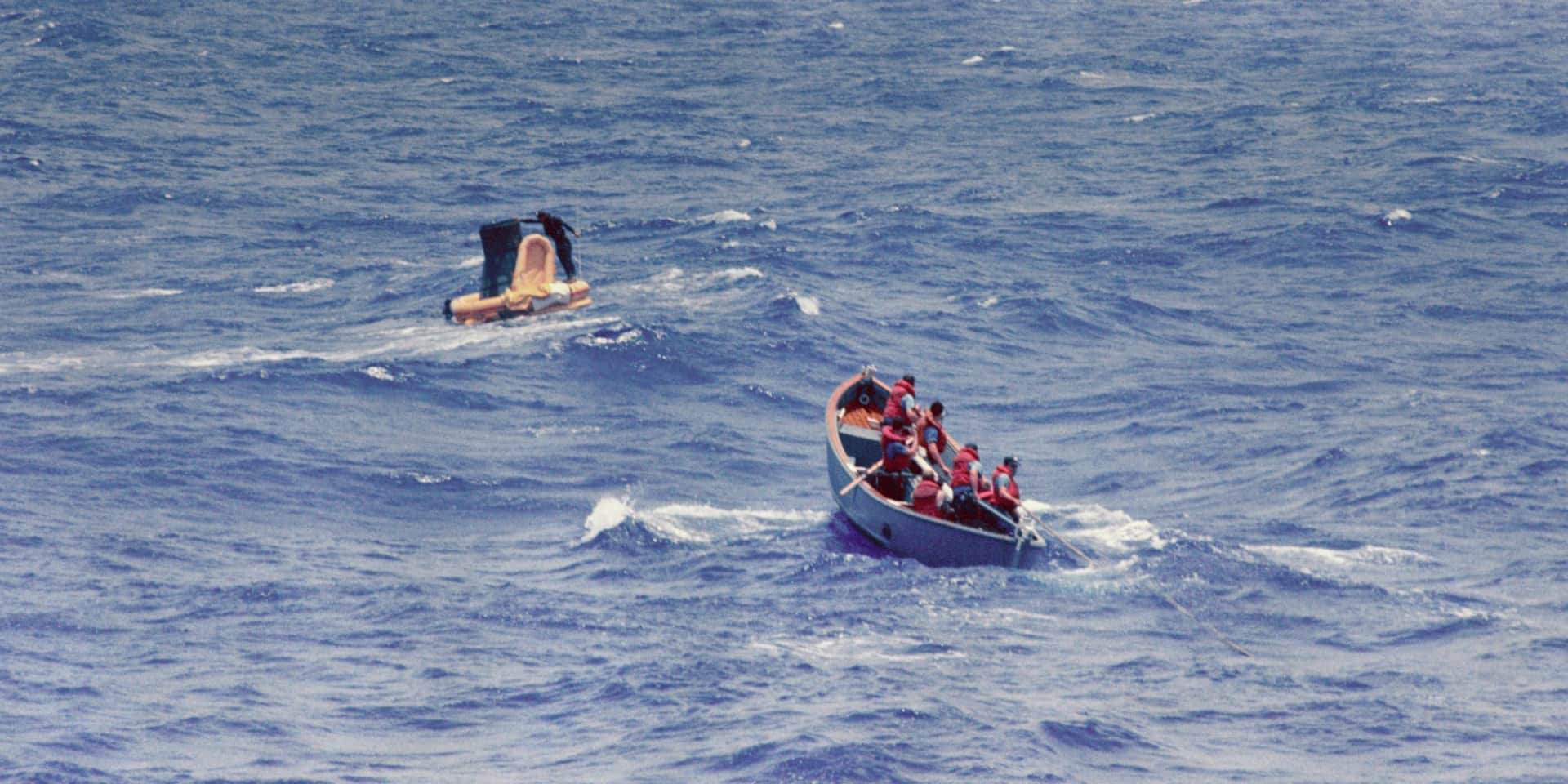
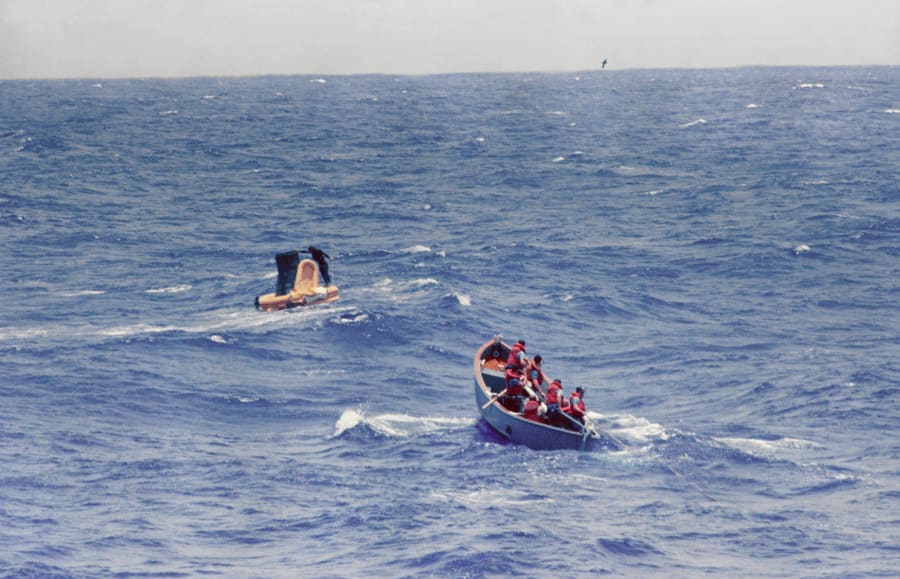
On 16 May 1963, a small black capsule hung under its parachute over the Pacific, south-east of Midway Island, in full view of the sailors on the aircraft carrier USS Kearsarge. Inside was Gordon Cooper, finishing the longest American spaceflight yet. He had brought it down by hand, after the system meant to do the job had gone dead.
The viral post about that flight says every guidance system on his capsule failed, that he drew lines on his window, aimed with the stars, timed reentry with his wristwatch and landed four miles from the carrier. Most of that is right. Two parts are overstated. Not everything failed: Cooper still had his manual controls, his radio and his retrorockets. And he did not time the burn alone. John Glenn, on a tracking ship near Japan, counted him down to the second.
Thirty hours of an almost perfect flight
Faith 7 lifted off from Cape Canaveral at 8:04 a.m. Eastern time on 15 May 1963, on the last flight of Project Mercury. The plan was 22 orbits, about a day and a half, far longer than any American had flown. For most of it the flight went to plan. Cooper ran his experiments, photographed the Himalayas and Tibet, slept in snatches, and sent back the first television pictures from an American spacecraft.
Mercury capsules were built to fly themselves. An automatic stabilization and control system, run by gyroscopes and a horizon scanner, held the spacecraft steady and was meant to point it correctly for the retrorocket burn that brings it home. The pilot could take over, but the default was the machine.
"Things are beginning to stack up"
The trouble began on the 19th orbit. A small green light came on telling Cooper the spacecraft had started to decelerate into reentry. It had not; he was still weightless. NASA's postflight analysis found the false signal had latched the automatic control system into its reentry mode. On the next orbit Cooper lost his attitude readings.
Then, on the 21st orbit, a short circuit knocked out the main inverter that supplied alternating current to the control system, and the standby inverter failed to take over. That killed the automatic control system, including its reentry mode, and the gyro-driven instruments that showed which way the capsule was pointing. At the same time, carbon dioxide was building up in his suit and in the cabin. Cooper, who had taken a prescribed dextroamphetamine pill to stay alert, summed it up for Scott Carpenter, the capsule communicator at the Hawaii station.
Things are beginning to stack up a little.
— Gordon Cooper to Scott Carpenter, as the failures mounted
How Faith 7's last orbits unfolded
- 15 May 1963Faith 7 launches from Cape Canaveral at 8:04 a.m. Eastern time on Mercury's final flight.
- Orbit 19A false 0.05g light comes on; the automatic control system latches into reentry mode.
- Orbit 20Cooper loses his attitude readings.
- Orbit 21A short circuit takes out the main inverter and the standby fails. Automatic control is gone and CO2 is rising. Glenn helps rewrite the retrofire checklist.
- Final orbitCooper holds attitude by hand and fires the retrorockets manually on Glenn's countdown.
- 16 May 1963Splashdown about 4.5 miles from USS Kearsarge, 34 hours, 19 minutes and 49 seconds after launch.
What still worked
"Every guidance system failed" is the part of the post that goes too far. What died was the automatic system and the instruments that depended on it. Cooper still had his manual controls, which let him fire the attitude thrusters himself, and his radio, which kept him in touch with the ground. He could still fire the retrorockets by hand. NASA had trained the Mercury astronauts for exactly this, and Glenn and Carpenter had both flown parts of their missions manually after smaller failures.
What the post says
Every guidance system on his capsule failed in orbit.
What the record shows
The automatic control system and its gyro-driven attitude instruments lost power. His manual controls, radio and retrorockets still worked.
Window, stars and a wristwatch
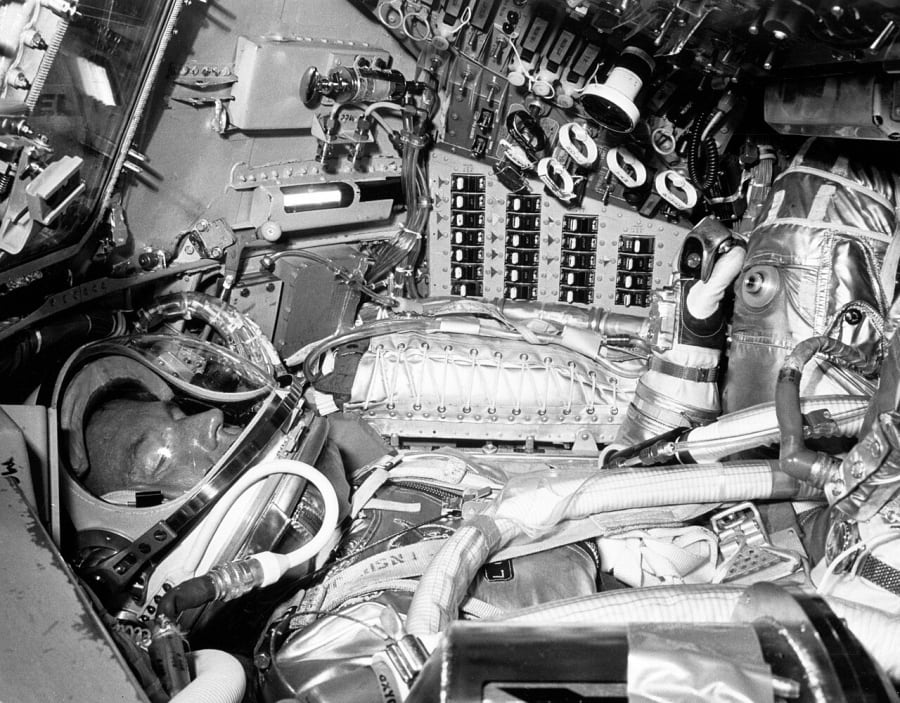
Without his attitude instruments, Cooper needed a picture of the outside world to fly by. The capsule had to be pointed with its blunt heat shield forward and tilted 34 degrees nose-down, with no sideways error, when the retrorockets fired. NASA's history of the program records that he held the 34-degree angle against the reticle on his window, a set of reference marks lined up with the horizon. Cooper later said he had lines drawn on the window and used the stars to keep the capsule straight, which matters because a sideways error is the hardest to see from the window.
Speaking in 2000, Cooper summed up the method as his wristwatch for timing and his own eyes, looking out of the window, for attitude. The watch is real, but the decisive count came over the radio. On the 21st orbit Glenn, aboard the tracking ship Coastal Sentry Quebec near Japan, worked through a revised retrofire checklist with him. On the final pass Glenn gave a ten-second countdown, and Cooper fired the retrorockets by hand on Glenn's "Mark!"
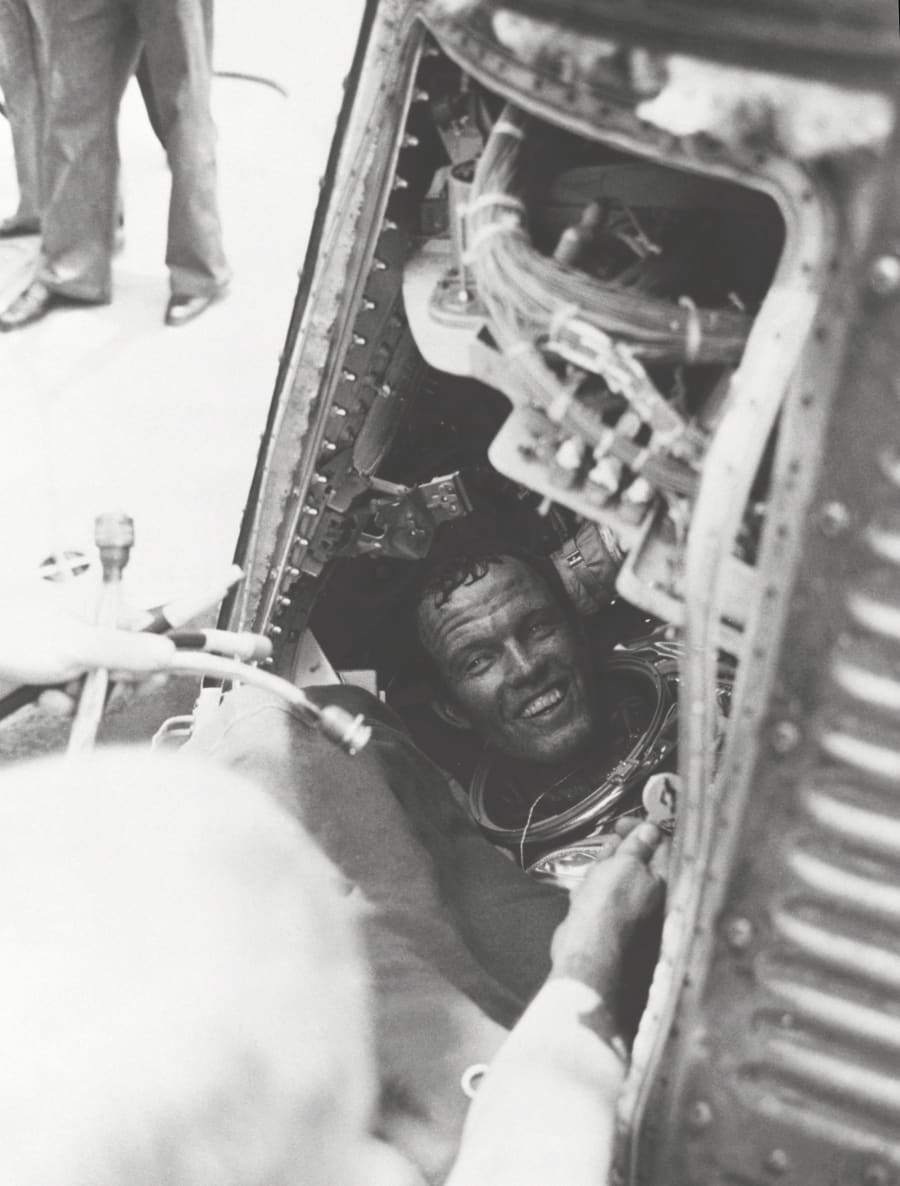
He then flew the reentry by hand as well. About 15 minutes later Faith 7 came down through light cloud and landed in the sea about four and a half miles from the Kearsarge. Cooper stayed inside while the capsule was hoisted aboard, then blew the hatch on deck. The photo of him grinning in the capsule that circulates with the viral post was taken there, after recovery.
As accurate as the autopilot
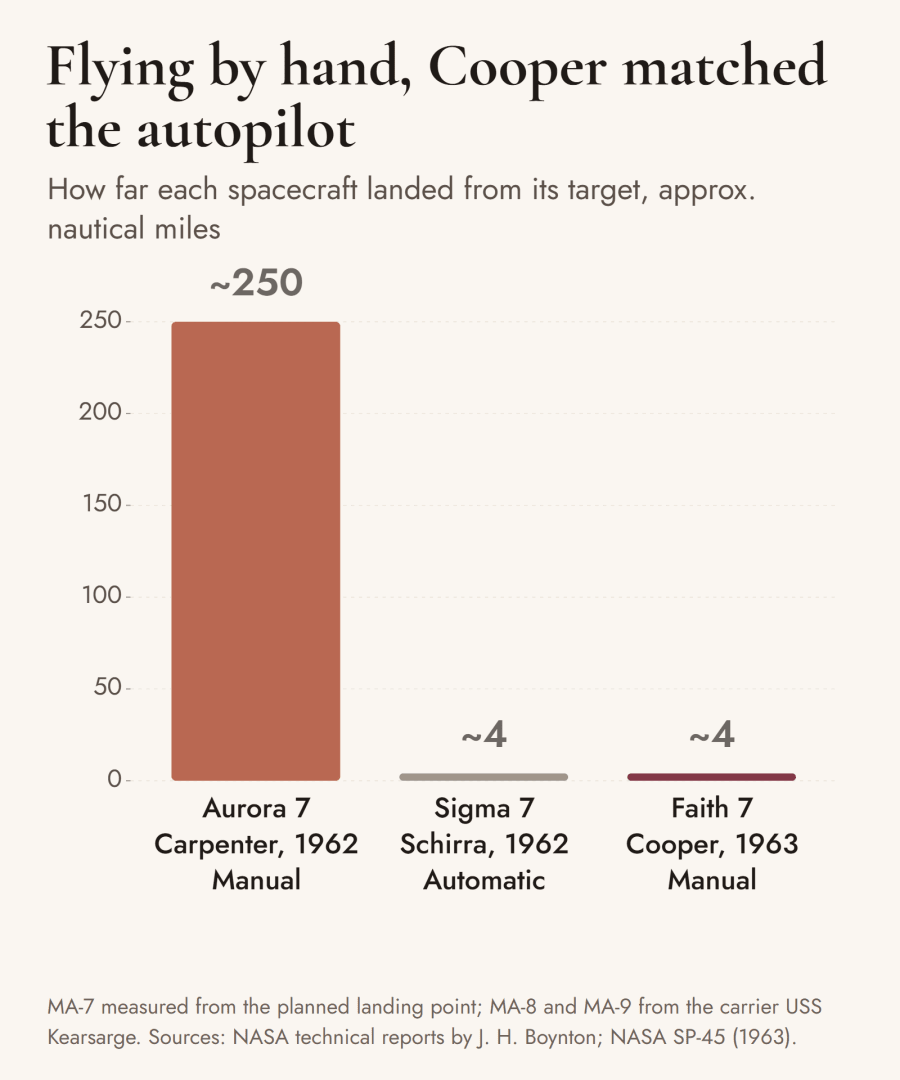
The four miles in the post is accurate, but it is not the whole point. Wally Schirra's flight the year before, Sigma 7, had also landed about four nautical miles from the Kearsarge, with the automatic system firing the retrorockets. Cooper matched that by hand. The comparison that shows what he pulled off is Scott Carpenter's flight in May 1962. A faulty horizon scanner forced Carpenter to fire his retrorockets manually too, but he fired about three seconds late with the capsule yawed roughly 25 degrees off line, and Aurora 7 came down about 250 nautical miles past its target. Carpenter waited about three hours to be picked up.
Faith 7 by the numbers
A NASA engineer, John Boynton, reviewed every Mercury failure in a 1964 paper and concluded that the program's successes depended heavily on the pilots' ability to take manual control. Faith 7 was one of his examples. Cooper flew again in 1965, commanding Gemini 5 with Pete Conrad for almost eight days.
Related: Why humans can never fly with wings · Nellie Bly's 72-day race around the world
Sources
- Swenson LS, Grimwood JM, Alexander CC. This New Ocean: A History of Project Mercury, NASA SP-4201 (1966), chapter 14 and appendix D.
- NASA. Mercury Project Summary, Including Results of the Fourth Manned Orbital Flight, May 15 and 16, 1963, NASA SP-45 (1963), including the project review and recovery operations chapters.
- Boynton JH. "The pilot's role during Mercury systems failures", AIAA paper 64-222 (1964).
- Boynton JH. Second United States manned three-pass orbital mission (Mercury-Atlas 7) and First U.S. manned six-pass orbital mission (Mercury-Atlas 8), NASA technical reports.
- NASA. Project Mercury: A Chronology, NASA SP-4001.
- Space.com, "Pioneering Astronaut Sees UFO Cover-up" (30 July 2000), reporting Cooper's account of his manual reentry, via an archived copy.
- Images: NASA, public domain, via Wikimedia Commons: Cooper and Faith 7 Recovery, S63-06129, Cooper Inside Faith 7 After Hatch is Blown. Chart, The Verified Post.