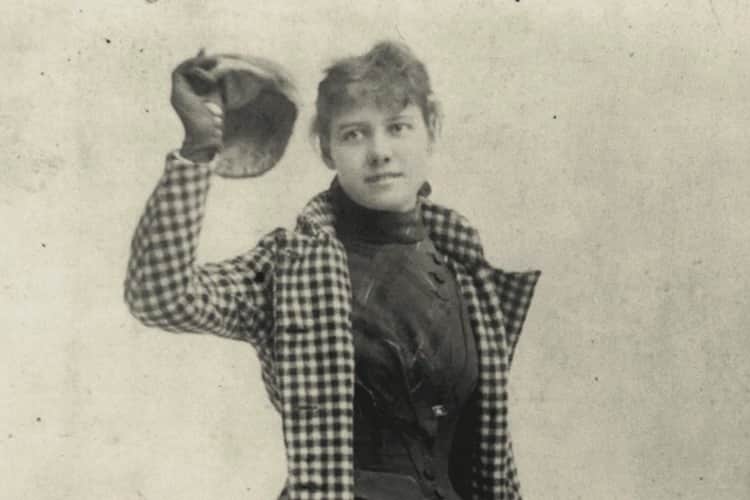
In 1889, a male reporter declared that no woman could travel around the world alone. A 25-year-old journalist from Pennsylvania had two words for him.
Watch me.
She packed one bag. A passport, a notebook, and two hundred pounds in English gold sewn into her coat. No companion. No chaperone. No permission from anyone.
Then she stepped onto a steamship in Hoboken, New Jersey, and vanished into the world.
Seventy-two days later, she came back. And nothing was the same.
I said I could beat Phileas Fogg's record. They laughed and said: 'Start.' So I did.
— Nellie Bly, 1889. She beat the fictional record by eight days.
More Than a Trip Around the Globe
Her name was Elizabeth Cochrane. The world knew her as Nellie Bly. And she was, without exaggeration, one of the most extraordinary human beings of the 19th century — in a century that refused to count women as full humans at all.
But the trip around the world wasn't even the most remarkable thing she did.
Not even close.
Before the World, There Was the Asylum
Two years before she circled the globe, Nellie Bly did something that took a different kind of courage entirely.
She faked insanity.
In 1887, at age 23, Bly was working for Joseph Pulitzer's New York World — one of the most powerful newspapers in America. Her editor wanted someone to get inside Blackwell's Island Asylum, the notorious women's mental institution in New York City. Rumors had been circulating for years about what happened behind its walls. But no one could confirm anything. No one could get in.
Bly volunteered.
She checked into a boarding house, began acting erratically, and was examined by multiple doctors — all of whom declared her insane. She was committed to Blackwell's Island. The door closed behind her. And for the next ten days, she lived as a patient.
What she found inside nearly destroyed her.
"The insane asylum on Blackwell's Island is a human rat-trap. It is easy to get in, but once there it is impossible to get out."
— Nellie Bly, "Ten Days in a Mad-House," 1887
Ten Days That Changed Mental Health Care in America
The conditions were beyond anything she had anticipated.
Patients were fed spoiled meat and rancid butter. They were forced to sit on hard benches for hours without moving. They were plunged into ice-cold baths. Women who protested were beaten. Women who cried were tied to beds. Women who had been committed for no medical reason at all — immigrants who didn't speak English, women whose husbands wanted them gone, women who were simply poor — were locked inside with the genuinely ill and given no treatment, no kindness, and no way out.
Bly memorized everything. She couldn't take notes — that would have given her away. So she stored every detail, every name, every horror, in her head.
After ten days, the newspaper sent a lawyer to get her released.
And then she wrote it all down.
Her exposé, "Ten Days in a Mad-House," was published as a series in the New York World and later as a book. It detonated across the country. The public was horrified. A grand jury launched an investigation into Blackwell's Island. The city allocated an additional $1 million — an enormous sum in 1887 — to the care of the mentally ill. Reforms were implemented. Conditions improved. Oversight increased.
A 23-year-old woman, armed with nothing but a notebook and the willingness to walk into hell, changed how America treated its most vulnerable people. And she did it by pretending to be one of them.
But Here Is the Part That Gets Overlooked
Before New York, before the asylum, before any of it — Nellie Bly became a journalist because a man made her angry.
In 1885, at age 21, she read a column in the Pittsburgh Dispatch titled "What Girls Are Good For." The column argued that a woman's place was in the home. That women who worked outside the house were "a monstrosity." That the best thing a girl could aspire to was domestic obedience.
Bly wrote a furious letter to the editor.
The letter was so good that the editor offered her a job.
She was 21 years old. She had no journalism training. She had no connections. She had a dead father, a mother who had survived a violent second marriage, and a fury that she had been carrying since childhood about what the world told women they were allowed to be.
She turned that fury into a career that reshaped American journalism.
Around the World in 72 Days
The trip that made her a global name started with a dare and ended with a parade.
In November 1889, Bly proposed to her editors at the New York World that she attempt to beat the record set by Phileas Fogg — the fictional hero of Jules Verne's "Around the World in Eighty Days." The editors initially said they'd send a man. Bly told them if they sent a man, she would do it for a competing newspaper and beat their man home.
They sent Bly.
Eastward, Alone, Against the Clock
She left Hoboken on November 14, carrying one small leather bag. She traveled east — across the Atlantic by steamship, through England, France (where she actually met Jules Verne, who wished her luck and doubted she would make it), through the Suez Canal, across the Indian Ocean to Ceylon, through Singapore, Hong Kong, and Japan, then back across the Pacific to San Francisco and by train across the United States to New York.
She did it in 72 days, 6 hours, 11 minutes, and 14 seconds.
She beat the fictional record by eight days.
Along the way, she filed dispatches from every stop. America followed her journey like a serial novel. Newspapers printed maps of her route. Board games were made in her honor. Songs were written about her. A rival newspaper, Cosmopolitan, sent a reporter named Elizabeth Bisland in the opposite direction to try to beat her. Bisland arrived four and a half days after Bly.
When Bly arrived back in New Jersey, cannons were fired, crowds cheered, and she was the most famous woman in America. She was twenty-five years old.
She Never Stopped
Most people know the trip. Some know the asylum. Almost nobody knows the rest.
From Newsroom to Boardroom
After her journalism career, Bly married millionaire industrialist Robert Seaman in 1895 — a man 40 years her senior. When he died in 1904, she took over his manufacturing company, the Iron Clad Manufacturing Company, and ran it herself. She patented new designs for steel barrels. She became one of the leading female industrialists in the United States.
When the company eventually went bankrupt due to employee embezzlement, she didn't retreat. She went back to journalism.
She covered the Eastern Front of World War I — from the trenches — becoming one of the first female war correspondents in American history.
She reported on the women's suffrage movement for the New York Evening Journal, writing passionately about a right she would technically live to see granted, though just barely.
She advocated for orphans, abandoned children, and families destroyed by poverty — using her column to match children with adoptive homes, personally coordinating placements.
She did all of this in an era where women could not vote, could not open their own bank accounts without a husband's permission, and were routinely told — in print, from pulpits, in legislatures — that their minds were not built for public life.
"Energy rightly applied and directed will accomplish anything."
— Nellie Bly
She Died at 57. The Obituary Got It Wrong.
Nellie Bly died on January 27, 1922, of pneumonia. She was 57 years old.
Her obituary in the New York Evening Journal called her "the best reporter in America."
That was too small.
She was the woman who walked into an asylum and came out carrying the truth. Who circled the planet with nothing but a bag and a deadline. Who covered a world war from the front lines. Who ran a factory. Who fought for children nobody wanted. Who turned a furious letter to the editor into one of the most consequential journalism careers of the 19th century.
She did it all while men wrote columns about what girls were good for.
She answered them. Not with words. With results.
The Point
A man said no woman could travel the world alone. She did it in 72 days. A system said women belonged in the home. She walked into an asylum, a war zone, a factory floor, and a newsroom — and changed each one. Nellie Bly didn't wait for the world to give her permission. She took a bag, a notebook, and a fury that had been building since childhood, and she made the world answer for what it told women they couldn't do. She was 25 when she circled the globe. She was 23 when she exposed the asylum. She was 21 when she wrote the letter that started everything. She never once asked for permission. And no one who came after her has had to, either.