The story has done the rounds for more than a century, and it always lands the same way. In 1876 a 14-year-old girl on a small Swedish island complained of toothache, went to bed, and did not get up again until April 1908. She was 46. She is said to have lived on two glasses of milk a day, never aged, and baffled every doctor who saw her.
Karolina Olsson was real, and the 32 years in bed are real too. What doesn't hold up is the word doing the heavy lifting in the viral version: asleep. The psychiatrist who travelled to her island in 1910 to investigate came away convinced she had been awake far more often than anyone admitted, and that she had help keeping it quiet.
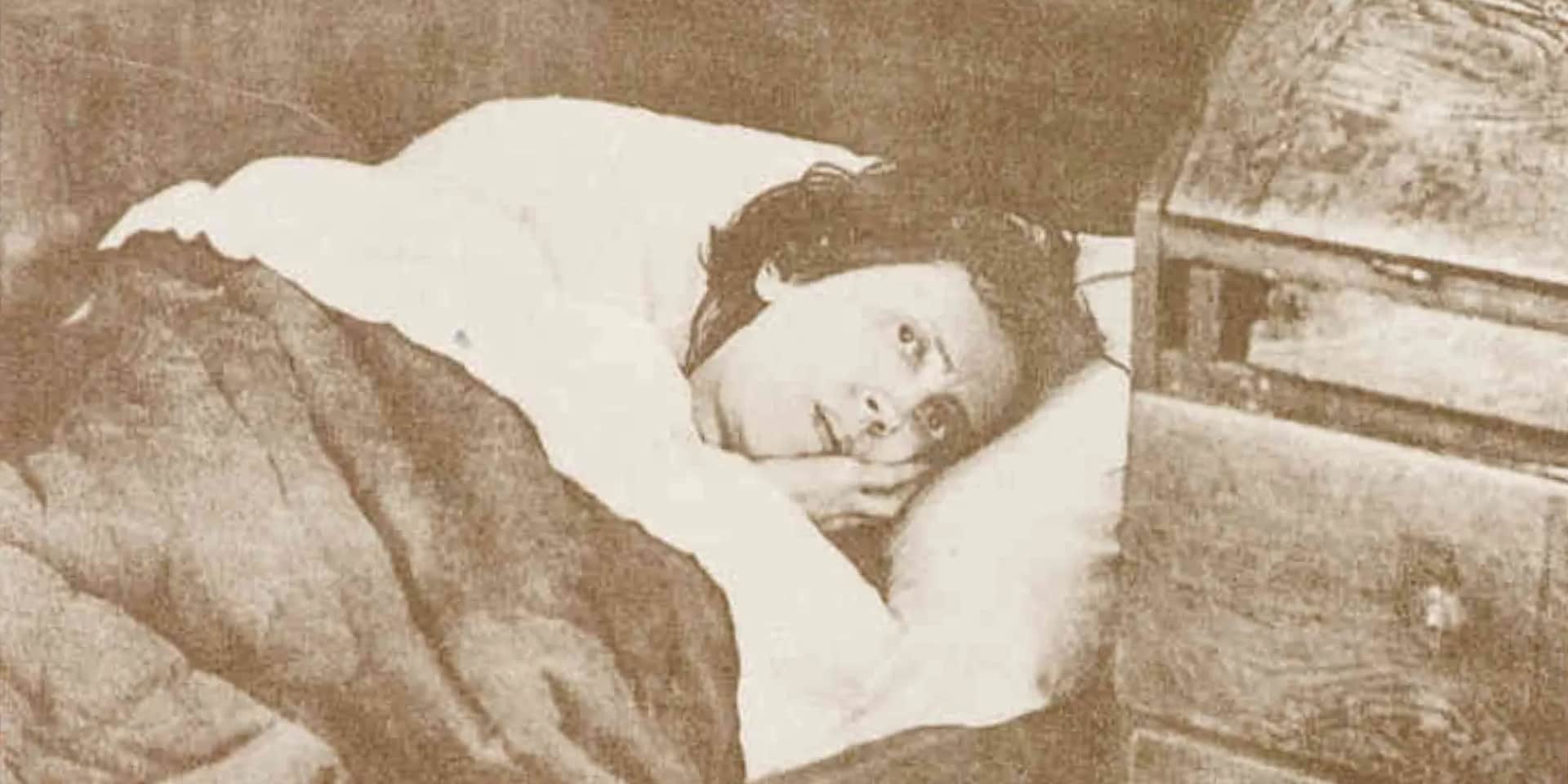
Even the photo in the post tells on the legend. The picture of Karolina lying in bed, colourised in the version now circulating, was taken after she woke up. Look closely and her eyes are open.
A girl from Oknö
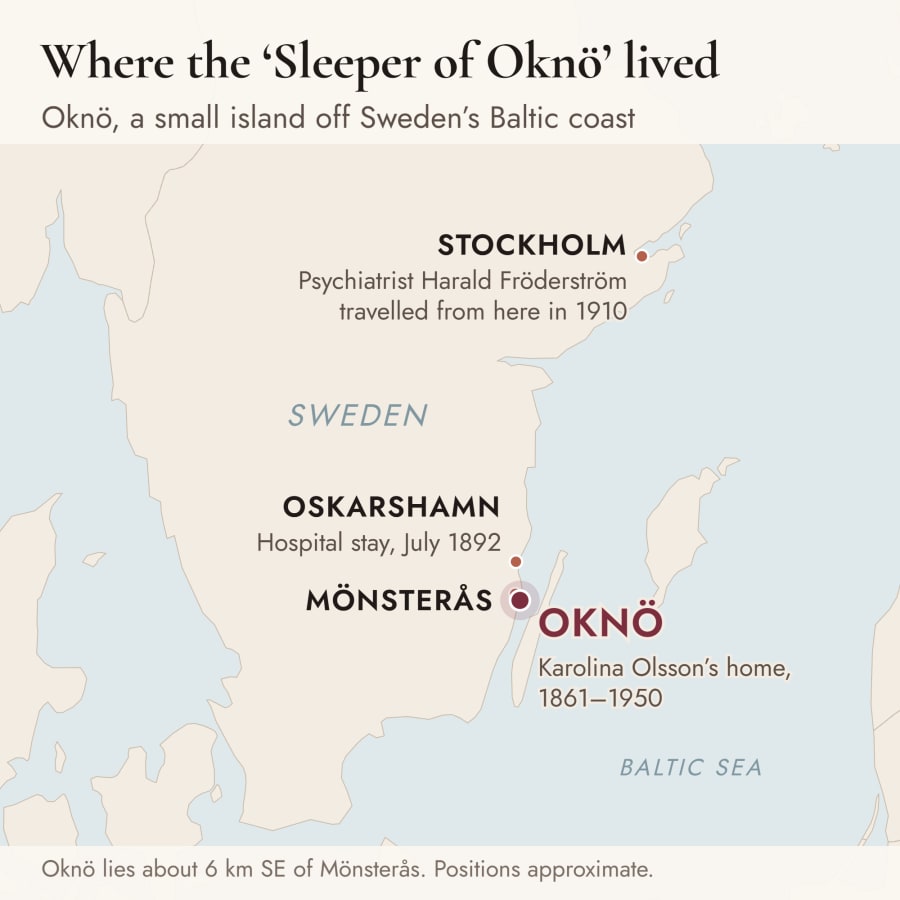
Karolina was born on 29 October 1861 on Oknö, a tiny island about six kilometres southeast of the market town of Mönsterås, on Sweden's Baltic coast. In the 1800s only around 20 people lived there. Her father was a fisherman and the family kept a small farm. She was the second of six children, and the only girl.
Her mother wanted her at home to help with the household, so she taught Karolina to read and write herself. Karolina only started school at 14, in the late autumn of 1875, and the walk there and back was about six kilometres each way, often in the dark and in winter weather.
About a month in, walking home over the ice with her brothers, she complained of toothache and feeling unwell. The family suspected witchcraft. Her mother sent her to bed.
The date that start is usually given is 22 February 1876, and that's where the famous "32 years and 42 days" comes from. But the psychiatrist who later interviewed the family placed the onset in late 1875. English-language retellings also often add a fall and a head injury; the Swedish medical-history account of the case, which draws on that psychiatrist's interviews, describes only the toothache.
Thirty-two years in one room
For the next three decades Karolina lay in the family's one-room cottage, and her mother looked after her almost entirely alone. The family said she ate nothing but two glasses of milk a day. Local doctors came several times over the years, and the general view was that this was a severe case of hysteria, the catch-all diagnosis of the era.
In July 1892 she was admitted to the small hospital in Oskarshamn, where the only physician was a surgeon with no psychiatric training. Staff tried electrical treatment, then the fashionable cure for almost everything. She stayed unresponsive, even to pinpricks. After a month she went home unchanged on 2 August, with a diagnosis of dementia paralytica, a condition linked to late-stage syphilis. Nothing in her case supported it. Researchers who later went through the hospital's records found that diagnosis turned up remarkably often in that period.
So when people say she "baffled doctors," that's only half right. Nobody cured her and nobody could prove what was going on. But the doctors who saw her mostly didn't think they were looking at a medical miracle. They thought they were looking at a psychological illness.
The cracks in the "sleep"
Here's the part most retellings skip. When psychiatrist Harald Fröderström interviewed the family, two of her brothers said they had never seen her leave the bed. Her father told a different story. He had seen her crawl across the floor on all fours a few times, and heard her speak on at least three occasions. Once she sat up and cried out, "Good Jesus, have mercy on me," then crawled back under the covers.
The detail that matters most is simple: Karolina and her mother were alone in the cottage all day while everyone else worked outside. Nobody else ever saw what she ate.
Her mother died in 1905, aged 76. (Some accounts give 1904.) Karolina cried for days, but stayed in bed. When her eldest brother drowned in 1907, she had another violent fit of weeping. The housekeeper hired after her mother's death later said that Karolina was always clean, her hair never dirty, her nails normal, and that she never found stains in the bed. Karolina wouldn't touch bread left beside her, but she liked caramels, as long as nobody watched her eat them. Sometimes objects in the room had moved while the housekeeper was outside.
Personally, I find that housekeeper's testimony the most telling thing in the whole file. A person in a true coma doesn't make sweets disappear.
The morning she got up
On 3 April 1908 the housekeeper walked in and found Karolina on the floor, crawling and crying. Told sharply to get back into bed, she asked, "Where is Mamma?" When her brothers came home, she said they couldn't be her brothers.
Those aren't my brothers, because they were so small.
Karolina Olsson on waking in April 1908, as recorded by psychiatrist Harald Fröderström (translated from Swedish)
She was emaciated and pale, like someone who had been starving, shied away from light, and moved with difficulty. But she ate with a good appetite. Three days later her old teacher visited and found she could still read fluently. Within weeks she was helping with the housework, and that July she went before the parish priest and acquitted herself well.
The news spread fast. Reporters arrived, and so did sightseers by horse and cart from Mönsterås, especially on Sundays. On or around 14 April a photographer sent by the Stockholm newspaper Dagens Nyheter took the bedside picture that still circulates today. The paper printed it on 22 April under a caption that translates as "Karolina Olsson after waking." That is the photo now shared, in colour, as if it shows her mid-sleep.
Key dates
- 29 Oct 1861Karolina Olsson is born on Oknö, near Mönsterås, the second of six children.
- Late 1875 / Feb 1876About a month after starting school, she complains of toothache and is sent to bed. Retellings usually say 22 February 1876.
- July 1892A month in Oskarshamn hospital. Electrical treatment fails; she is discharged on 2 August with an unsupported diagnosis of dementia paralytica.
- 1905Her mother, who cared for her alone, dies aged 76. A housekeeper is hired.
- 1907Her eldest brother drowns. She weeps violently but stays in bed.
- 3 Apr 1908She is found crawling on the floor, crying, and asks for her mother.
- 22 Apr 1908Dagens Nyheter publishes the bedside photo, captioned as taken after she woke.
- Oct 1910Psychiatrist Harald Fröderström visits Oknö to examine her and interview the family.
- 1912Fröderström publishes his study of the case in Nouvelle Iconographie de la Salpêtrière in Paris.
- 5 Apr 1950Karolina dies on Oknö, aged 88, of a brain haemorrhage.
What the psychiatrist concluded
Fröderström, then a 36-year-old physician at the Stockholm asylum, spent several days in Mönsterås in October 1910, sent by the newspaper Stockholms-Tidningen with his chief's blessing. He found Karolina busy with housework, friendly, a little flirtatious, and looking closer to 35 than 49. Physically she was normal apart from weak muscles. She was intelligent but knew very little: no Swedish history, couldn't find Stockholm on a map, struggled with sums. She remembered the winter walk home and the toothache. Of the years in bed, she said she remembered nothing, and the questions plainly made her uncomfortable.
He rejected any physical disease. In the newspaper he wrote that she had been governed by a "will to illness," the hallmark of hysteria as doctors then understood it. In his view a sensitive girl, put to bed and tenderly nursed by an overprotective mother, came to believe she was gravely ill. With her siblings around she lay still, eyes shut, refusing food. Survival on two glasses of milk, with no visible bodily functions, could only be explained one way: her mother had been quietly feeding and caring for her without the rest of the family knowing.
That also explains the ending. Once her mother died, Karolina lost her only ally. She would have had to fend for herself in secret, she grew thinner, and the arrangement became harder to keep up. Fröderström read her "waking" as a kind of surrender to the instinct for survival.
In his French paper of 1912 he leaned toward catatonic stupor instead, possibly influenced by his chief, Professor Bror Gadelius. When four Swedish physicians and researchers revisited the case in the 1990s, they argued against catatonia, which usually starts in adulthood, and concluded the likeliest explanation was conversion hysteria, or in modern terms a dissociative condition. They added, carefully, that other factors may have been "forgotten or left out for reasons of discretion." Nobody knows what those might have been.
What the viral post says
Karolina went to bed in 1876 and stayed asleep for 32 years, baffling doctors.
What the record shows
She was bedridden for about 32 years, but her father saw her crawl and heard her speak, a housekeeper noticed missing sweets and moved objects, and doctors at the time mostly diagnosed hysteria. The investigating psychiatrist concluded she was often awake and secretly cared for by her mother.
Why the legend still beats the truth
It's easy to see why the "Sleeping Beauty" version wins online. A girl who closes her eyes as a child and opens them as a middle-aged woman is a fairy tale with a date attached. The real story is harder and, I'd argue, more human: a poor, isolated family, a frightened teenager, a mother whose care slid into secrecy, and a medical system that had no real tools for what it was seeing.
It's worth remembering how she was treated, too. A parish record described her as a "half-idiot," and when she was sent home from hospital the parting words were reportedly "here's the spectacle again." Her great-niece, writing in Svenska Dagbladet in 2012, said Karolina seemed to meet doubt and mockery whenever the outside world paid attention.
She lived another 42 years after 1908, on the same island, in the same cottage. Bo Holmstedt, one of the researchers behind that 1990s study, met her as a six-year-old boy in 1924, when she killed an adder he had nearly stepped on and tossed it onto an anthill. Into old age she walked the few kilometres into Mönsterås to sell goods from the island or do the shopping. Whatever really happened in that room between 1875 and 1908, she never explained it.
Read next: Ellen Sadler, the English girl who "slept" for nine years · The 1962 laughter epidemic that closed 14 schools · When nostalgia was diagnosed as a deadly disease
Sources
- Bo Holmstedt, Lennart Ljungberg, Hans Moëll and Sven G. Sjöberg, “Soverskan på Oknö” (medical-history paper presented to the Swedish Society of Medicine, 1994, published 1995; archived copy, in Swedish). Primary source for the family interviews, hospital records and Fröderström’s findings.
- Harald Fröderström, “La Dormeuse d’Oknö: 21 ans de stupeur, guérison complète,” Nouvelle Iconographie de la Salpêtrière 25 (1912), and his three articles in Stockholms-Tidningen (1910), as summarised by Holmstedt et al.
- Marianne Nilsson, “Än i dag finns frågorna kvar,” Svenska Dagbladet (31 May 2012, in Swedish; written by a relative of Karolina Olsson).
- “Kvinnan på Oknö sov i 32 år: vad var hennes hemlighet?” Land / Minnenas Journal (2016, in Swedish).
- Karolina Olsson, Swedish Wikipedia and English Wikipedia (consulted for dates and for the commonly cited 22 February 1876 start date).
- Image: Karolina Olsson after waking, April 1908 (photographer for Dagens Nyheter, unnamed), reproduced as plate 37 in Nouvelle Iconographie de la Salpêtrière, vol. 25 (1912). Licence Ouverte 1.0, via Wikimedia Commons. Map: The Verified Post, using Natural Earth data via world-atlas.