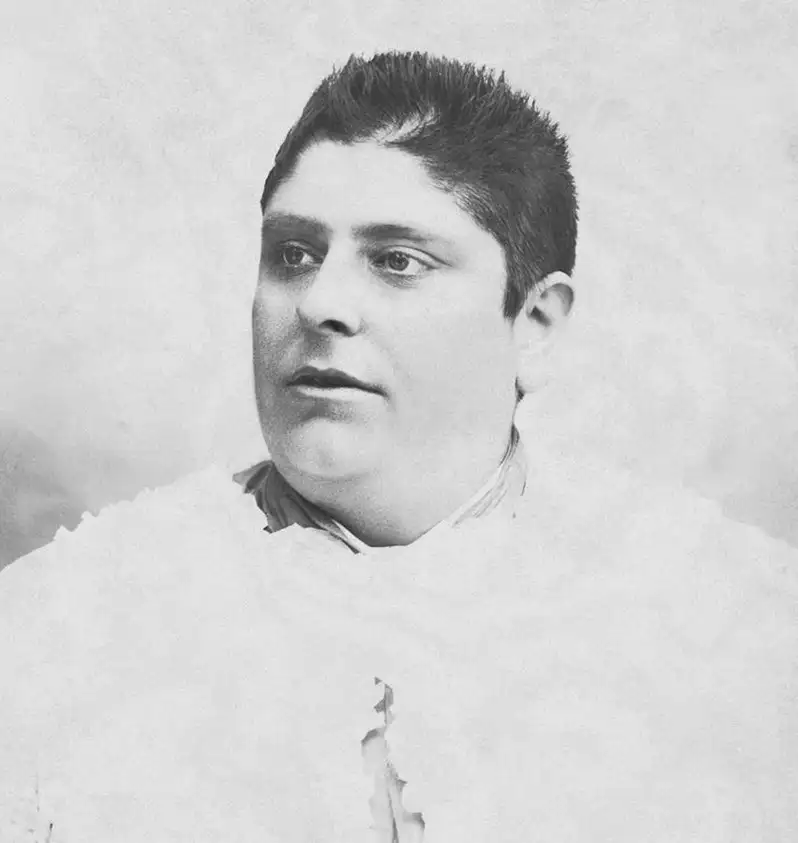
In April 1902, two engineers from a London record company carried a recording machine into the Vatican and set it up in a grand salon. Fred Gaisberg later remembered walls hung with Titians, Raphaels and Tintorettos, and their "grimy machine" planted in the middle of the floor. Over two days, members of the Sistine Chapel Choir sang into its horn. One of them was a 43-year-old soprano named Alessandro Moreschi.
Moreschi was a castrato. Those wax recordings, and a second batch made in 1904, are the only solo recordings of a castrato that exist. Nobody alive has heard Farinelli, or any of the eighteenth-century opera stars who were once the most celebrated singers in Europe. Moreschi is as close as we will ever get.
A post doing the rounds on X sums him up in one line: the last castrato, the final survivor of a brutal 500-year tradition, and the only one whose voice was ever recorded. Most of that holds up. A couple of details don't, and the gaps turn out to be more interesting than the slogan.
What the post gets right, and what it stretches
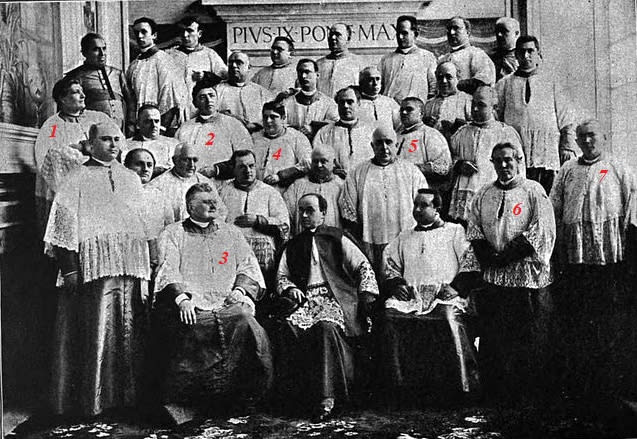
Start with "the last castrato." Moreschi joined the Sistine Chapel Choir in 1883, when several older castrati were still singing there. By the time he died in Rome on 21 April 1922, every one of those colleagues was dead. Domenico Salvatori died in 1909 and Vincenzo Sebastianelli in 1919. His biographer, the countertenor and Royal Academy of Music professor Nicholas Clapton, describes him as the last surviving castrato of the Vatican choir, and he is generally treated as the last of the line.
"Brutal" is fair. Boys were usually castrated between the ages of about seven and nine, according to the endocrinologist J.S. Jenkins, who has written about the castrati for The Lancet. A child that age could not meaningfully consent. Nobody kept count of how many died from the operation, and only a small fraction of those who survived ever became successful singers.
The "500-year" figure is where the post stretches. Castrati appear in Italian church music in the middle of the sixteenth century. Jenkins notes a castrato in a Roman church choir as early as 1553, and the papal chapel was hiring them by the 1580s. The last ones left the Sistine Chapel in 1913. That's roughly 360 years: a very long time, but well short of five centuries. Eunuch singers did exist much earlier in the Byzantine church, but that was a separate tradition. The Italian castrati who led to Moreschi grew out of sixteenth-century Rome.
The last claim, that he is "the only one whose voice was ever recorded", needs one small qualification. Moreschi is the only castrato who made solo records. But the 1902 and 1904 sessions also captured the Sistine choir singing together, and other castrati were still in that choir. Italian accounts of the sessions suggest another castrato, possibly Salvatori, can be heard among the altos on some of the group recordings. Nobody can pick that voice out with confidence, which is why Moreschi's solos remain the real evidence.
What the post says
Moreschi was the last castrato, the final survivor of a brutal 500-year tradition, and the only castrato whose voice was ever recorded.
What the record shows
He was the last surviving castrato of the papal choir and the only one to make solo recordings. The tradition lasted about 360 years, and other castrati probably sang on the same group recordings.
How a choirboy from the hills became the Angel of Rome
Moreschi was born in November 1858 in Monte Compatri, a small town in the hills southeast of Rome, then still part of the Papal States. How and when he was castrated is not known. One theory holds that he was born with an inguinal hernia, and castration was still sometimes treated as a cure for that in nineteenth-century Italy. It wasn't the only medical idea of those centuries that looks bizarre now: doctors once diagnosed homesickness as a disease that could kill. Another theory puts the operation around 1865, which would fit the old practice of castrating musically promising boys before puberty. Moreschi left no letters and no diary, and Clapton admits that most of his private life remains in shadow.
What is documented is the voice. As a boy he sang in the chapel of the Madonna del Castagno near his hometown, where a former Sistine singer, Nazareno Rosati, heard him and took him to Rome. There he studied at the Scuola di San Salvatore in Lauro under Gaetano Capocci, music director of the Basilica of St John Lateran. By about 15 he was first soprano in the Lateran choir.
His breakthrough came in 1883, when Capocci cast him as the Seraph in the first Italian performance of Beethoven's oratorio Christ on the Mount of Olives, a role full of high, ornamented runs. Romans started calling him l'Angelo di Roma, the Angel of Rome. Shortly afterwards he auditioned in front of the entire Sistine choir and was appointed first soprano, a post he would hold for about thirty years.
The choir needed him. Its director, Domenico Mustafà , was himself a castrato, and the castrati still on its books were ageing. None of them, by Clapton's account, could manage the punishing high line of Allegri's Miserere, sung every Holy Week. Moreschi could. He also seems to have enjoyed the attention: one contemporary account describes him parading through the crowd after a concert "like a peacock," trailing a long white scarf.
Why the Church needed castrati at all
The castrati existed because of a rule about women. Women were barred from singing in church, a ban rooted in Paul's instruction that women keep silent in churches, and in the Papal States they could not sing in public at all. Polyphonic church music still needed high voices. Boys could sing the parts, but their voices broke just as they became useful. Adult falsettists, many of them recruited from Spain, could reach the notes but were considered thin and weak by comparison.
Castrati solved the problem, and the Church found a way to live with it. Canon law forbade deliberate mutilation except to save a life, and Pope Sixtus V banned castration in the 1580s. In practice, as Jenkins puts it, the Church turned a blind eye to how and where the operations were done, because it wanted the voices. The first Italian castrati entered the Sistine Chapel in 1599. Opera arrived soon after, and by the eighteenth century castrati such as Farinelli were international stars.
You will often see a figure of 4,000 boys castrated in Italy every year at the peak. It comes from the Austrian scholar Franz Haböck, writing in 1927, and it is an estimate rather than a count drawn from surviving records. The honest answer is that we don't know how many boys went under the knife, how many died, or how many were left with nothing but the injury.
Personally, I think that last group is the part the romance of the castrati tends to skip. For every Farinelli there were boys who were operated on, trained for years, and then found their voices simply weren't good enough. They carried the physical consequences for life with no fame to show for it. Europe has a long habit of finding glamour in damaged bodies, from the castrati to the Victorian idea that tuberculosis made a woman beautiful, and the people who paid the price rarely got to tell the story.
What castration actually did to the voice
The science behind the sound is surprisingly simple. At puberty, testosterone makes a boy's larynx grow. According to the measurements Jenkins cites, the vocal folds lengthen from an average of about 17.4 mm before puberty to about 28.9 mm in adult men, while women's grow only to about 21.5 mm. Longer, heavier folds vibrate more slowly, which is why men's voices drop.
Remove the testes before puberty and that growth never happens. In the only recorded post-mortem examination of a castrato, the vocal folds were the length of a high soprano's. But the rest of the body kept growing. The chest, lungs, throat and mouth reached adult size, so the castrato had a child's pitch powered by an adult's breath and resonance. Without testosterone, the growth plates in the long bones also stayed open longer, and contemporaries remarked on how tall many castrati were.
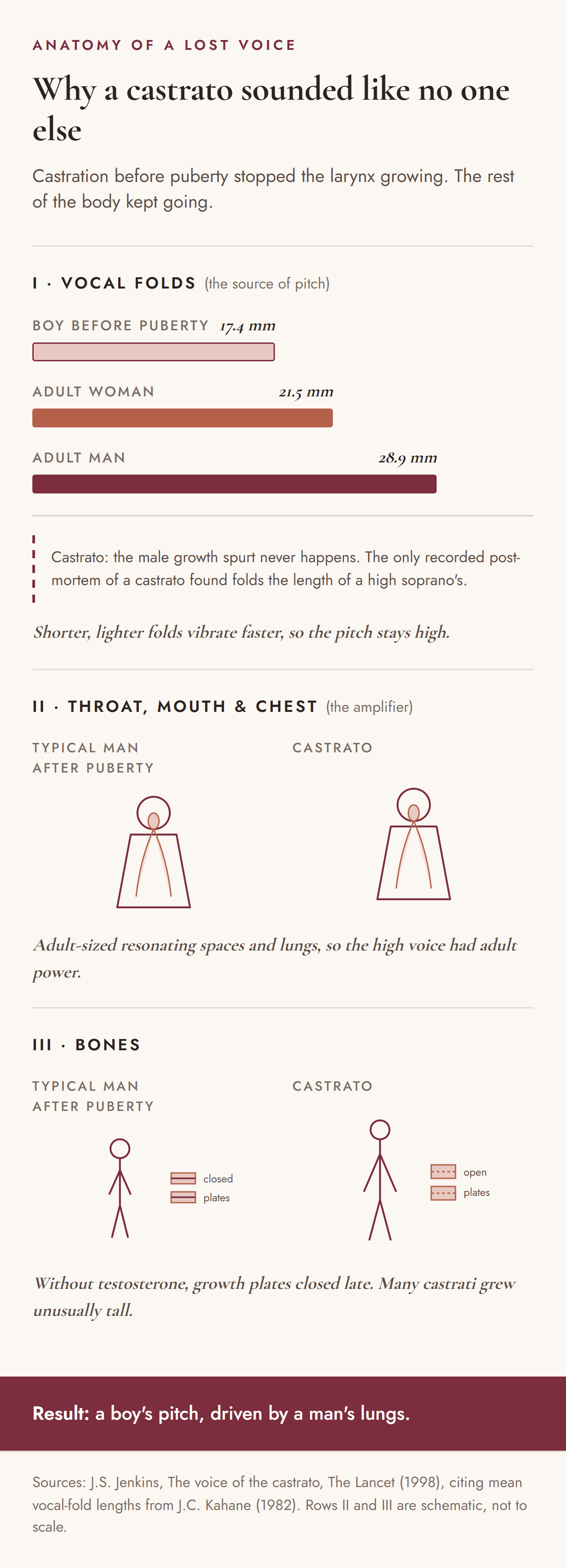
That combination is what made the sound so strange to listeners. One critic of the period, quoted by Jenkins, described it as being as clear and penetrating as a choirboy's but a great deal louder, with "something dry and sour about it" yet brilliant. Years of rigorous training did the rest. Conservatory-trained castrati were famous for breath control that let them spin out phrases far longer than ordinary singers could manage.
The week the Vatican met the gramophone
The Gramophone and Typewriter Company of London sent the brothers Will and Fred Gaisberg to Rome in the spring of 1902. On 3 and 5 April they recorded members of the Sistine choir and came away with eighteen usable sides, four of them solos by Moreschi. A second set of sessions followed in April 1904, directed by W. Sinkler Darby. Altogether, Moreschi appears on seventeen tracks.
The repertoire is mostly sacred music: Rossini's Crucifixus, Tosti's Ideale and Preghiera, the Bach-Gounod Ave Maria, and church pieces by composers from the Roman choirs he worked in. Restored transfers of the recordings are freely available on the Internet Archive, and they are worth hearing at least once.
The end of a tradition, by decree
By the time those recordings were made, the castrati were already a relic. Opera had moved on long before. The last castrato to sing on the operatic stage, Giovanni Battista Velluti, had retired about thirty years before Moreschi was born. Napoleon's rule in Italy brought pressure against the practice, and after the Kingdom of Italy took Rome in 1870, the supply of new castrati dried up.
The Sistine Chapel was the last refuge. Then Pope Leo XIII, who had protected the choir's traditions, died in 1903. His successor, Pius X, backed a reform movement that wanted church music returned to Gregorian chant and Renaissance polyphony. On 22 November 1903 he issued the motu proprio Tra le sollecitudini, which settled the question.
Whenever it is desirable to employ the high voices of sopranos and contraltos, these parts must be taken by boys, according to the most ancient usage of the Church.
— Pope Pius X, Tra le sollecitudini, 1903
The surviving castrati weren't dismissed. They were allowed to serve out their time, but no new ones were hired. Moreschi kept singing, increasingly in the Cappella Giulia, the choir of St Peter's Basilica, where castrati were still tolerated. He retired in 1913 after about thirty years in the Sistine choir.
In 1914 Franz Haböck, then researching his book on the castrati, met him and hoped to present him in concerts of eighteenth-century castrato arias. The plan went nowhere. Moreschi had spent his life singing church music rather than baroque opera, and by then his voice was in decline. A portrait he signed for Haböck that June survives.
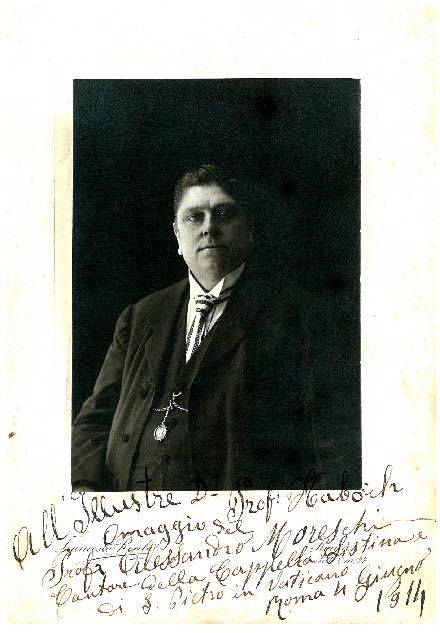
Moreschi spent his last years giving private singing lessons. He died in his apartment on Via Plinio, a few minutes from the Vatican, on 21 April 1922, aged 63, possibly of pneumonia. He is buried in Rome's Verano cemetery.
The rise and fall of the castrati
- 1553Earliest mention of a castrato in a Roman church choir.
- 1580sCastrati, mostly Spanish, are admitted to the papal chapel.
- 1599The first Italian castrati join the Sistine Chapel Choir.
- 1700sCastrati such as Farinelli dominate Italian opera across Europe.
- 1858Alessandro Moreschi is born in Monte Compatri, near Rome.
- 1870The Kingdom of Italy takes Rome; the supply of new castrati ends.
- 1883Moreschi becomes first soprano of the Sistine Chapel Choir.
- 1902 & 1904He makes the only solo recordings of a castrato.
- 1903Pius X rules that boys, not castrati, must sing the high parts.
- 1913Moreschi retires from the Sistine choir.
- 1922He dies in Rome on 21 April, the last of the papal castrati.
What the recordings can and can't tell us
Listen to Moreschi today and your first reaction may be confusion. The voice sobs and swoops between notes. Some high notes sound strained. Critics have not always been kind to these discs, and it's easy to hear why.
But there are good reasons not to treat them as a verdict on the castrati. Acoustic recording in 1902 had no microphones; singers projected into a horn that captured the upper range of a soprano voice badly. Moreschi was in his forties and no longer young. And his style belonged to late nineteenth-century Roman church music, not the virtuoso opera of the 1700s. As one reviewer of the reissued recordings put it, Moreschi was about as far from Farinelli as we are from Rossini.
What most people overlook is what the recordings do preserve: the timbre. However imperfect, they let us hear an adult male voice that never broke, carried by adult lungs. Nothing else in the historical record does that.
So the post is close. Moreschi was the last of the papal castrati, the practice that made him was cruel, and his are the only solo recordings of a castrato voice. The tradition was about 360 years old rather than 500, and the discs catch a tired, imperfect echo of something that had peaked two centuries earlier. That is still enough to make them extraordinary. Somewhere in the hiss is the last direct evidence of a practice Europe applauded for three and a half centuries and then spent a century trying to forget.
Sources
- J.S. Jenkins, "The voice of the castrato," The Lancet 351 (1998): 1877–80; and "The lost voice: a history of the castrato," Journal of Pediatric Endocrinology and Metabolism (2000).
- Nicholas Clapton, Moreschi and the Voice of the Castrato (Haus, 2008; first edition 2004).
- Richard Sherr, "Guglielmo Gonzaga and the Castrati," Renaissance Quarterly.
- V. Ginsburgh and others, "The Rise and Fall of Castrati," Université libre de Bruxelles working paper (2017).
- Discography of American Historical Recordings (UC Santa Barbara), Alessandro Moreschi recordings, 1902–1904.
- Pope Pius X, motu proprio Tra le sollecitudini, 22 November 1903.
- Encyclopaedia Britannica, "Castrato"; English and Italian Wikipedia entries on Alessandro Moreschi, for biographical details cross-checked against the above.