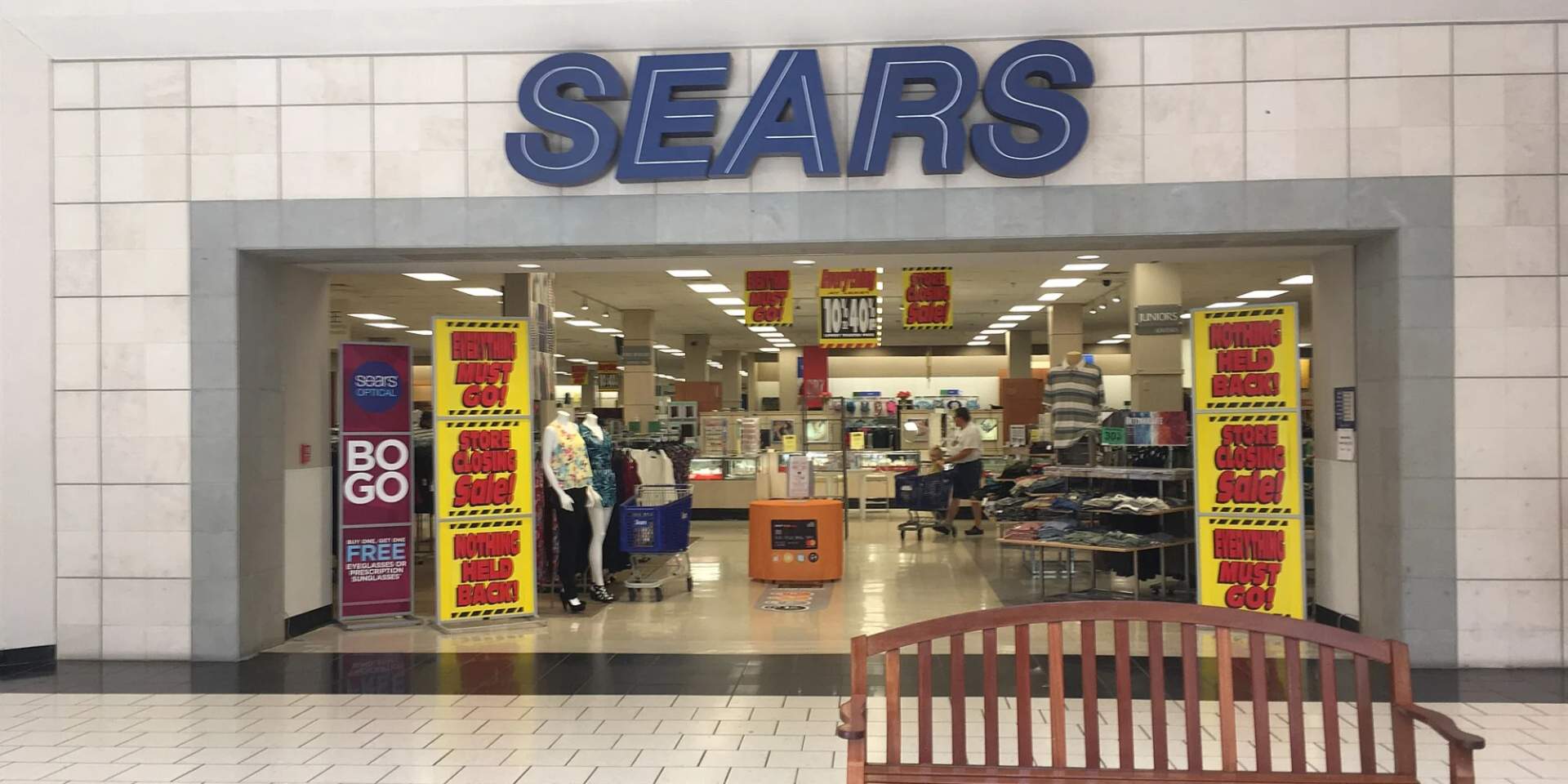
When Sears Holdings filed for bankruptcy on October 15, 2018, the easy explanation was already waiting: Amazon killed it. Court filings and the company's own numbers tell a different story, and it centres on one man. Eddie Lampert, a hedge fund manager from Greenwich, Connecticut, controlled Sears for 13 years, and in that time he was its chairman, its chief executive, its biggest shareholder, one of its largest lenders and, through a real estate trust he chaired, the landlord of hundreds of its stores.
The bankruptcy left 68,000 employees waiting to hear whether they still had jobs and a pension fund short by about $1.4 billion. Lampert ended up owning what was left. He bought the surviving stores out of bankruptcy in early 2019, and Forbes now puts his fortune at about $2.2 billion. Sears, a company that once sold everything from wristwatches to entire houses by mail, is down to five stores.
A retailer that was already slipping
It's worth being fair about the starting point. Sears was in trouble long before Lampert arrived. Walmart passed it as America's biggest retailer in 1990, and in January 1993 Sears killed its famous "Big Book" catalogue after 97 years, cutting 50,000 jobs and closing 113 stores in the same announcement. Big-box chains such as Walmart and Home Depot were taking its customers.
So the company Lampert took over was a wounded giant. What he did with it is the part people argue about.
The hedge fund manager in charge
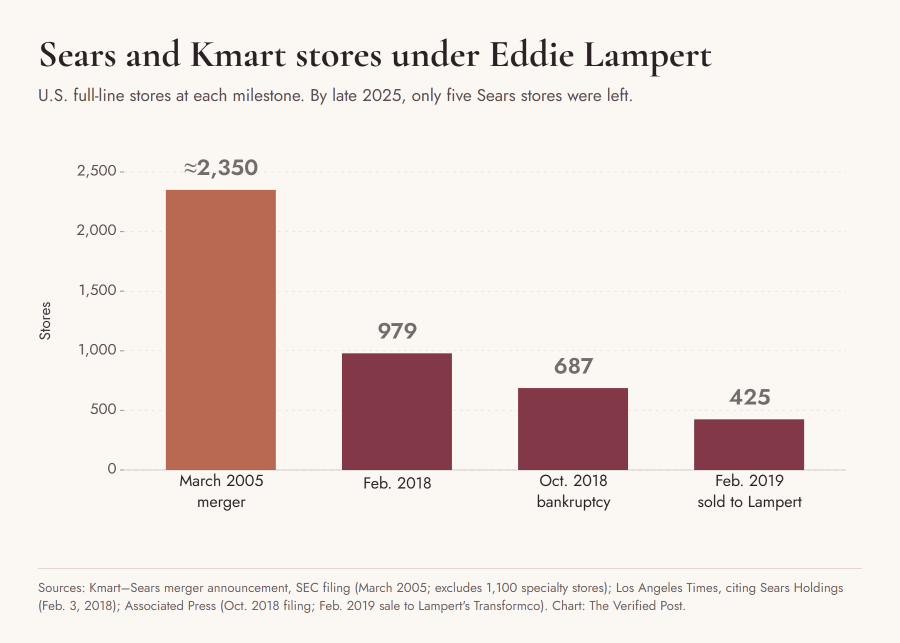
Lampert started on the risk arbitrage desk at Goldman Sachs, then launched his own fund, ESL Investments, in 1988 at the age of 25. ESL bought about $800 million of a bankrupt Kmart's debt, which gave Lampert control of the discount chain when it came out of bankruptcy in 2003. He already owned a large stake in Sears, Roebuck. In March 2005 the two companies merged into Sears Holdings, with Lampert as chairman.
Wall Street loved it at first. Business Week called him "the next Warren Buffett" in 2004. In early 2007 Sears Holdings was worth nearly $30 billion on the stock market, almost twice Amazon's value at the time, according to Institutional Investor.
Then came the choices that defined his tenure. Between 2005 and 2008, Sears spent about $5 billion buying back its own shares, well over double what it spent on its stores in the same period. Buybacks lift the share price and reward big shareholders (ESL owned about half the company at its peak). They don't fix a leaking roof or a tired fitting room. Mark Cohen, a Columbia Business School professor and former Sears Canada CEO, said Lampert took "an ax" to spending and looked like a genius for about 18 months because free cash flow jumped.
In 2013, with sales still falling, Lampert became chief executive too. Around the same time he moved to Florida, and he ran the Illinois company largely from there.
Eddie Lampert's roles at Sears
- Chairman of Sears Holdings from the 2005 Kmart merger until February 2019
- Chief executive from 2013 until the October 2018 bankruptcy filing
- Largest shareholder, through his hedge fund ESL Investments
- Major lender: ESL and his other entities held about $2.6 billion of Sears debt by late 2018
- Chairman of Seritage Growth Properties, the trust that bought 235 Sears and Kmart properties in 2015 and leased most of them back
Selling the stores, then renting them back
As cash ran short, Sears sold pieces of itself. It spun off most of Sears Canada in 2012, separated its Hometown and Outlet stores in 2012, spun off Lands' End in 2014 and sold the Craftsman tool brand to Stanley Black & Decker in 2017. Because ESL was the biggest shareholder, Lampert's fund received a large share of each spin-off; in the Lands' End deal alone, ESL and Lampert got nearly half the new company at no cost.
The deal that drew the most anger came in July 2015. Sears sold 235 of its properties, mostly Sears and Kmart stores, to a new real estate investment trust called Seritage Growth Properties for about $2.7 billion. Lampert became Seritage's chairman and put about $745 million into it. Sears then leased most of the stores back. By mid-2016, Sears was paying Seritage about $132 million a year in base rent, according to Seritage's own filing with the SEC, to stay in buildings it had owned a year earlier.
Defenders say the deal raised cash a dying company badly needed, and that's true. Critics say it moved the most valuable assets out of reach of the company's creditors. In a court filing, Sears' unsecured creditors argued that the properties went for "substantially less than fair value" while Sears was saddled with "unfavorable leases" on the same buildings.
Lampert's fund also lent Sears money, again and again, often secured against those remaining assets. Institutional Investor calculated that Lampert and ESL earned about $400 million in interest on those loans. Here's where I think the "conflict of interest" label fits: when the same person sets the strategy, owns the stock, holds the debt and collects the rent, every decision helps one of his positions while hurting another. Lampert always said he was trying to save the company. Even if you believe him, nobody could watch all those hats at once.
Bankruptcy, and who walked away with what
Sears Holdings filed for Chapter 11 on October 15, 2018, with 687 stores and about 68,000 employees. Lampert stepped down as chief executive that day but stayed on as chairman. The next day he spoke to staff at the headquarters in Hoffman Estates, Illinois.
There were mistakes along the way, for which I take responsibility.
— Eddie Lampert, speaking to Sears staff the day after the bankruptcy filing, October 16, 2018 (recording obtained by Institutional Investor)
Many creditors wanted the company liquidated. Instead, Lampert's ESL won the bankruptcy auction, and in February 2019 a judge approved the sale of about 425 stores to his new company, Transformco, saving roughly 45,000 jobs for the time being. Most of those stores have since closed.
Did he lose money? On paper, yes: ESL's Sears shares were close to worthless. But in December 2018 Institutional Investor added up the dividends, spin-offs, interest and the fees his hedge fund earned while Sears stock soared, and estimated that Lampert was about $1.4 billion ahead on Sears overall. That figure has never been confirmed by Lampert, and ESL's position in court was that its actions were "taken in good faith, on fair terms" and benefited all Sears stakeholders.
In April 2019 the Sears estate sued him anyway, alleging that he had moved about $2 billion of assets to himself and other shareholders through the Lands' End spin-off, the Seritage sale and other deals. The case never reached a verdict. In August 2022 the parties settled for $175 million: $125.6 million from insurers, $41.9 million from the defendants and $7.5 million from shareholding funds.
What happened to the pensions
Sears had two traditional pension plans, frozen since 2005, covering about 90,000 people. In January 2019 the Pension Benefit Guaranty Corporation, the federal agency that insures private pensions, moved to take them over. It said the plans were underfunded by about $1.4 billion, or only 64 percent funded.
That doesn't mean retirees got nothing. The PBGC said its guarantee would cover "the vast majority" of the benefits earned, and payments continued without a break. Retirees whose pensions are bigger than the federal limits can lose part of the difference, and that loss is real for them. The bill for the rest falls on the PBGC's insurance program, which is funded by premiums from other employers.
Key dates
- 1990Walmart passes Sears as the biggest retailer in the U.S.
- Jan 1993Sears ends its Big Book catalogue after 97 years and cuts 50,000 jobs.
- 2003Lampert's ESL takes control of a bankrupt Kmart.
- Mar 2005Kmart and Sears merge into Sears Holdings, with Lampert as chairman.
- 2013Lampert also becomes chief executive.
- Jul 2015Sears sells 235 properties to Seritage, chaired by Lampert, for $2.7 billion and leases most back.
- 15 Oct 2018Sears Holdings files for Chapter 11 with 687 stores and 68,000 employees.
- Feb 2019Judge approves the sale of about 425 stores to Lampert's Transformco; the PBGC takes over the pensions.
- Aug 2022Sears estate settles its lawsuit against Lampert and others for $175 million.
- Late 2025Five Sears stores are left in the U.S.
So was it Amazon?
Amazon didn't help, and neither did Walmart, Home Depot or the slow death of the American mall. But Sears was worth twice as much as Amazon as recently as 2007, it had a famous mail-order business decades before anyone shopped online, and it owned some of the best-known brands in the country: Kenmore, Craftsman, DieHard. A company with those assets had choices. The record shows that under Lampert, money went to buybacks, spin-offs and debt payments while the stores went without.
Personally, I don't think "Lampert killed Sears" and "the market killed Sears" are rival explanations. The market made Sears weak. Lampert decided how a weak company would spend its last billions, and the people who came out with something were mostly the ones holding its stock, its debt and its real estate. The workers and suppliers were at the back of the line.
Lampert, now 64, still runs ESL. He owns homes on Indian Creek Island near Miami, in Greenwich and in Aspen, and a 288-foot yacht named the Fountainhead, after Ayn Rand's novel.
Read next: the $539 inhaler, and who sets drug prices at the pharmacy counter · Olivia Dean vs. Ticketmaster and the resale price story · what happened after Bernie Sanders lost 99-1 on drug prices
Sources (14)
- Michelle Celarier, "Eddie Lampert Shattered Sears, Sullied His Reputation, and Lost Billions of Dollars. Or Did He?", Institutional Investor, December 3, 2018
- Pension Benefit Guaranty Corporation, "PBGC to Pay Pension Benefits for Employees and Retirees at Sears and Kmart", January 18, 2019
- Ben Unglesbee, "Sears Holdings reaches $175M settlement with Lampert and company", Retail Dive, August 11, 2022
- WTTW / Associated Press, "Sears Sues Former Chairman Eddie Lampert", April 19, 2019 (687 stores and 68,000 employees at filing)
- Seritage Growth Properties, Form 10-Q for the quarter ended June 30, 2016 (annual base rent paid by Sears Holdings)
- Bloomberg, "Sears Posts Second-Quarter Profit on Gain From Real Estate", August 20, 2015
- Kmart Holding Corporation and Sears, Roebuck and Co., merger completion announcement (SEC exhibit 99.1), March 24, 2005
- The New York Times, "Sears Eliminating Its Catalogues and 50,000 Jobs", January 26, 1993
- Los Angeles Times, "Sears files for Chap. 11, will further shrink operations", October 2018
- Los Angeles Times / Associated Press, "Bankruptcy judge OKs Lampert's Sears bid", February 2019
- Forbes, Edward Lampert profile (real-time net worth, checked November 27, 2026)
- Cleveland.com, "Here's where you can still shop at Sears", February 2026
- Wikipedia, Sears and Eddie Lampert (background, Walmart overtaking Sears in 1990, Lampert's age)
- Image credits: cover photo by Dough4872, Wikimedia Commons, CC BY-SA 3.0. Chart by The Verified Post.