Our video explainer on the 2026 midterms and what the new Congress can and can't do. Watch on YouTube
Some time on Sunday, August 7, 2022, deep into an all-night session of the U.S. Senate, Bernie Sanders walked outside and sat down on the steps of the Senate side of the Capitol. He was 80 years old and had been voting since before midnight. Los Angeles Times photographer Kent Nishimura caught him there, hunched forward with his forearms on his knees, alone against a wall of gray stone. Within hours the picture was all over the internet.
The defeat behind it was real. About 12 hours earlier, in the first amendment vote of the night, Sanders had asked the Senate to make Medicare pay no more for prescription drugs than the Department of Veterans Affairs does. He said that would cut Medicare's drug costs in half. It failed 99 to 1; the one vote in favor was his own. By the end of that Sunday, the bill he had tried to change had passed the Senate, and Sanders voted for it.
What Sanders wanted Medicare to pay
The bill on the floor was the Inflation Reduction Act, the climate, tax and health package Senate Majority Leader Chuck Schumer had worked out with Joe Manchin of West Virginia. Its drug provisions let Medicare negotiate prices with drugmakers for the first time. The catch, as Sanders saw it, was the pace: negotiated prices wouldn't arrive until 2026, and only for 10 drugs to start.
His amendment, numbered 5210, went much further. Its official description was "to establish a cap on costs for covered prescription drugs under Medicare parts B and D", and the cap was whatever the VA paid. Speaking on the floor, he made the case in about a minute. "The VA has been negotiating drug prices for 30 years and pays half, half, as much as Medicare pays," he said. Medicare, under his amendment, could not pay any more than the VA.
If we do that, we will cut the cost of Medicare prescription drugs in half and save $900 billion.
— Sen. Bernie Sanders on the Senate floor, August 2022
Sanders had said that week that he wanted to spend the money on lowering the Medicare eligibility age to 60 and on adding dental, vision and hearing coverage, according to The Hill. The $900 billion figure was his own estimate; we couldn't find an independent cost estimate of the amendment itself.
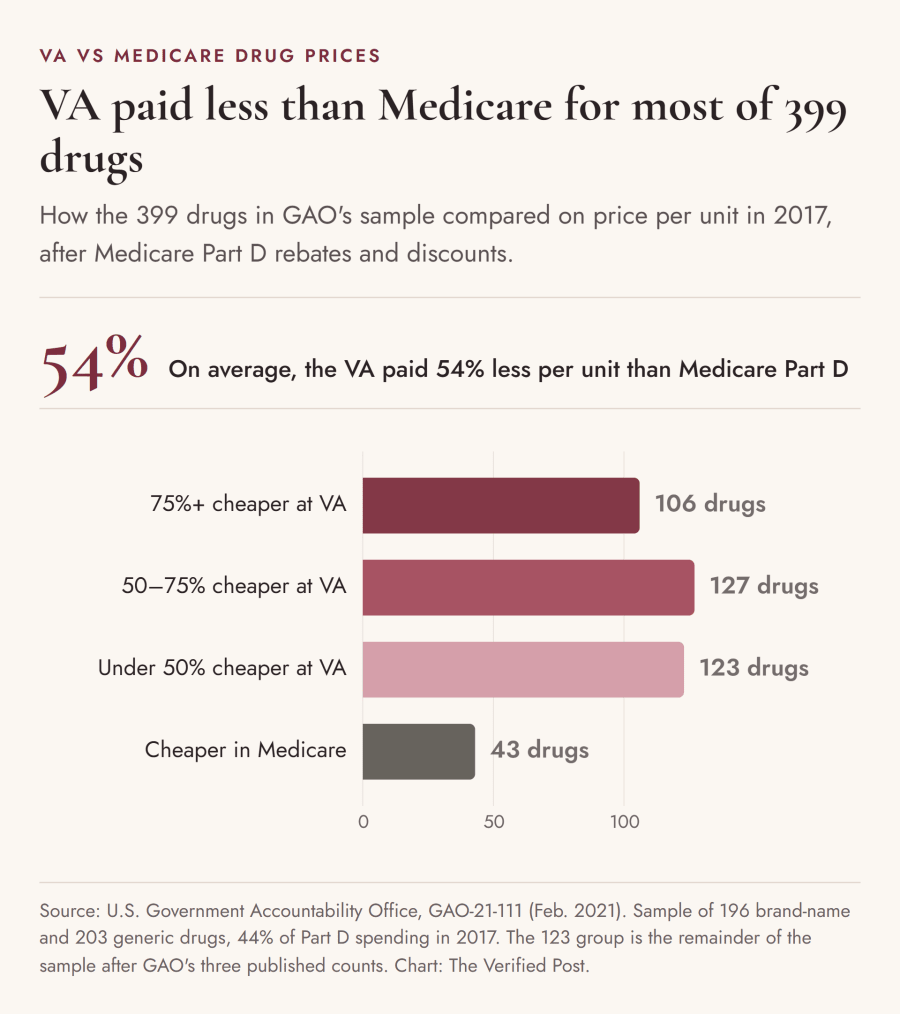
The "half" claim, though, has solid government data behind it. In February 2021, the Government Accountability Office compared what the two programs paid for 399 brand-name and generic drugs in 2017, which together made up 44% of Medicare Part D spending that year. Even after counting the rebates and discounts Part D plans get from drugmakers, the VA paid an average of 54% less per unit. For 233 of the 399 drugs, the VA's price was at least half Medicare's; for 106 it was at least 75% lower. Only 43 drugs were cheaper in Medicare.
The two programs buy medicine in very different ways, which goes a long way to explaining the gap. The VA purchases drugs directly from manufacturers as one health system with one national list of covered drugs. Medicare Part D pays private insurance plans, and those plans pay pharmacies and bargain with drugmakers separately. GAO pointed to the VA's single-system buying as one reason it can get lower prices. Whether Medicare could copy that overnight, for the tens of millions of people in Part D, is a fair question the amendment never got to test.
How a vote ends up 99 to 1
A 99-1 result sounds like the whole Senate decided cheaper drugs were a bad idea. The mechanics were more complicated than that.
Democrats were passing the Inflation Reduction Act through budget reconciliation, a process that lets a bill pass with a simple majority and avoids a Republican filibuster. The price of that shortcut is the vote-a-rama: an open-ended series of amendment votes that any senator can force. With the Senate split 50-50, Democrats needed every one of their members plus Vice President Kamala Harris to break the tie. Any amendment that passed could unsettle the deal with Manchin and Kyrsten Sinema of Arizona, so Democratic leaders spent the night voting down amendments, including those from their own side.
There was a procedural hurdle too. After Sanders spoke, a point of order was raised that his amendment broke section 313 of the Congressional Budget Act, the so-called Byrd rule that limits what can go into a reconciliation bill. Sanders moved to waive it. A waiver needs 60 votes. The Senate record lists the result as Roll Call Vote 288: yeas 1, nays 99. Every Republican and every other member of the Democratic caucus voted no.
Some of his allies said out loud why they were voting against things they supported. When Sanders later offered an amendment to bring back the expanded child tax credit, Michael Bennet of Colorado, one of the credit's biggest champions, opposed it on the floor: "This does not advance that cause because we could lose the underlying bill." Personally, I find that more revealing than the tally itself. For most of the Democrats among the 99, the real question on the board was whether to risk the bill.
Sanders' amendments that night
The dental, vision and hearing amendment picked up two extra votes, from the Georgia Democrats Raphael Warnock and Jon Ossoff. Everything else Sanders offered that night got his vote alone, or close to it, according to Roll Call's account of the session.
The picture on the steps
Nishimura posted the photo on Sunday with a note about "Big Vote-a-rama energy" as the Senate entered its 13th hour. People online immediately compared it to "I'm Just a Bill", the 1975 Schoolhouse Rock! cartoon in which a rolled-up bill sits on the Capitol steps waiting to become law; the New York photographer Clayton Cubitt was among the first to post the two side by side, Business Insider reported. Two days later NPR ran a short item noting that Sanders had been meme'd again. The first time was January 2021, when a photo of Sanders in a folding chair and big mittens at President Biden's inauguration became one of the most-shared images of the day.
The steps picture was taken during a break, roughly half a day after the drug vote. Sanders lost several more amendments in between, and he still had the final vote ahead of him. Whatever he was thinking out there, he didn't say.
Then he voted yes
The vote-a-rama ran close to 16 hours. When it finished on Sunday afternoon, the Senate passed the Inflation Reduction Act 51 to 50, and Sanders was one of the 51. He called it a step forward while complaining that "this legislation goes nowhere near far enough for working families." The House passed it 220 to 207 on August 12, and President Biden signed it on August 16.
What Sanders proposed
Medicare pays no more than the VA for covered Part B and Part D drugs. Sanders estimated $900 billion in savings over 10 years.
What became law
Medicare negotiates prices for a limited list of high-spending drugs: 10 at first, with new prices from 2026, plus a $35 monthly insulin cap and a yearly out-of-pocket cap for Part D.
The law also capped what people on Medicare pay for insulin at $35 a month and put a ceiling on yearly out-of-pocket drug spending in Part D: $2,000 in 2025, rising to $2,100 in 2026 as the cap is adjusted each year.
What negotiation has delivered so far
Sanders' complaint about timing turned out to be accurate. The first negotiated prices, for 10 drugs including the blood thinners Eliquis and Xarelto and the diabetes drug Jardiance, only took effect on January 1, 2026. When the Centers for Medicare & Medicaid Services announced them in August 2024, it estimated that Medicare would have saved about $6 billion, or roughly 22%, had those prices applied in 2023. The negotiated prices were 38% to 79% below list prices.
The second round went deeper. In November 2025, CMS announced prices for 15 more drugs, among them the semaglutide drugs Ozempic and Wegovy, and estimated a 44% saving, about $12 billion, against what Medicare actually paid in 2024 after rebates. Those prices start on January 1, 2027. A third round, the first to include drugs doctors administer under Medicare Part B, closed its negotiations on November 1 this year; CMS has to publish those prices by November 30, 2026, and they take effect in 2028.
Key dates
- Feb 2021GAO reports that the VA paid an average of 54% less per unit than Medicare Part D for 399 drugs in 2017.
- 6–7 Aug 2022Vote-a-rama on the Inflation Reduction Act. Sanders' VA-price amendment falls 1-99 in the first vote of the night.
- 7 Aug 2022Nishimura photographs Sanders on the Senate steps; that afternoon the bill passes 51-50 with Sanders voting yes.
- 16 Aug 2022President Biden signs the Inflation Reduction Act.
- Aug 2024CMS announces negotiated prices for the first 10 drugs, an estimated 22% saving.
- 1 Jan 2026The first negotiated prices take effect.
- 30 Nov 2026Deadline for CMS to publish third-round prices, the first to cover Part B drugs.
- 1 Jan 2027Prices for 15 more drugs take effect, an estimated 44% saving.
Those percentages and the VA's 54% are measured differently, over different drugs and different years, so they can't be lined up neatly. Still, the direction is plain enough. The program Sanders called too small has started cutting what Medicare pays, one batch of drugs at a time, and the batches are getting bigger: CMS can pick up to 20 drugs for the next round, with selections due by February 1, 2027.
The politics around it have moved as well. In the November 3, 2026 midterms, Democrats won control of both the House and the Senate, and the new Congress sits in January. Sanders, re-elected in 2024, will be part of it. What a Democratic Congress can and can't do with a Republican president in the White House is the subject of our video at the top of this article.
For now the next date on the calendar belongs to CMS. By November 30 it has to publish the third round of negotiated prices, for drugs that include Biktarvy, Trulicity and Xolair.
Read next: Midterms 2026 explained: what a Democratic Congress can change · Why Americans flew to China for a cancer drug the FDA had approved · Insulin's "Case VI": the girl in the 1922 before-and-after photos
Sources (11)
- Congressional Record, Senate, August 6–7, 2022: Sanders floor statement and Rollcall Vote No. 288 (yeas 1, nays 99)
- Congress.gov, H.R. 5376 all actions, including S.Amdt. 5210 and Senate passage, Record Vote 325
- U.S. Government Accountability Office, GAO-21-111: VA paid about half as much as Medicare Part D for selected drugs in 2017 (2021)
- The Hill, Senate Democrats kill off amendments as vote-a-rama goes all night and "Come on, Bernie": Democrats clash on Senate floor over Sanders proposal (Aug. 2022); Sanders rips Inflation Reduction Act
- Roll Call, Thune breaks through Democratic bloc on vote-a-rama amendments (Aug. 7, 2022)
- The New Republic, The Inflation Reduction Act passes after a long and exhausting weekend (Aug. 2022)
- Truthout, Nearly all senators vote against Sanders's amendments (Aug. 2022)
- Business Insider, Bernie Sanders Senate steps photo leads to Schoolhouse Rock comparisons; The Independent, Bernie Sanders sparks new memes for posing on Senate steps; NPR, Senator Bernie Sanders has been meme'd again (Aug. 9, 2022)
- CMS, Negotiating for lower drug prices works, saves billions (Aug. 2024); CMS delivers savings for seniors on 15 major drugs and fact sheet (Nov. 2025); final rule for 2029 and later (Nov. 2026)
- Alliance for Retired Americans, 2022 congressional voting record (insulin cap, out-of-pocket cap, House vote)
- Images: cover, Beethoven, via Wikimedia Commons, CC BY-SA 4.0; chart, The Verified Post from GAO data