Scott Thompson had left his boat in gear. Almost everything that happened to him next follows from that one small mistake. On Wednesday, January 26, 2022, the Ventura urchin diver slipped off the side of his 22-foot boat, the Miss Grace, in the Santa Barbara Channel and surfaced to watch it motor away without him. He had on shorts and a T-shirt, the sun was setting, and there would be no moon that night.
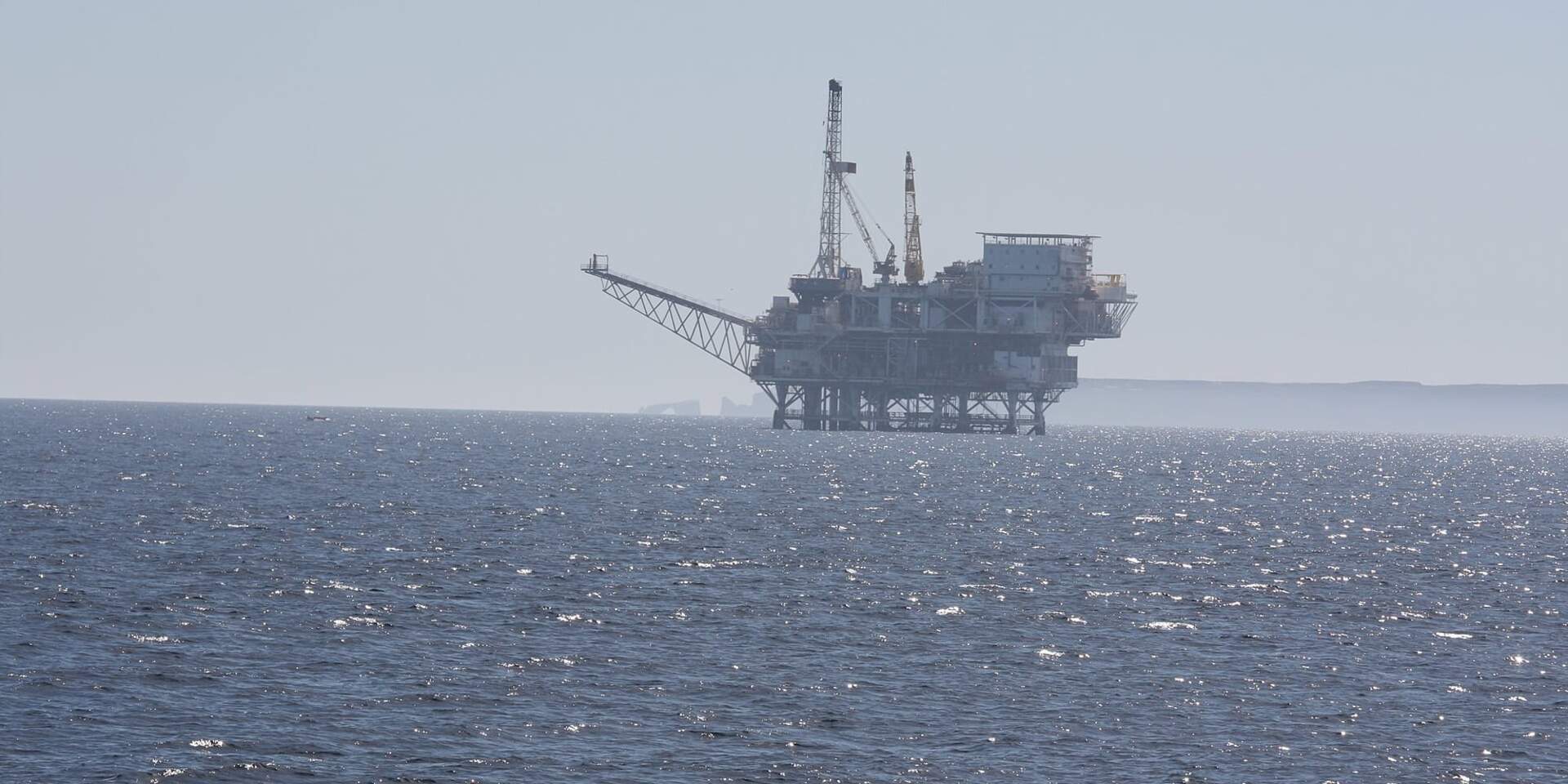
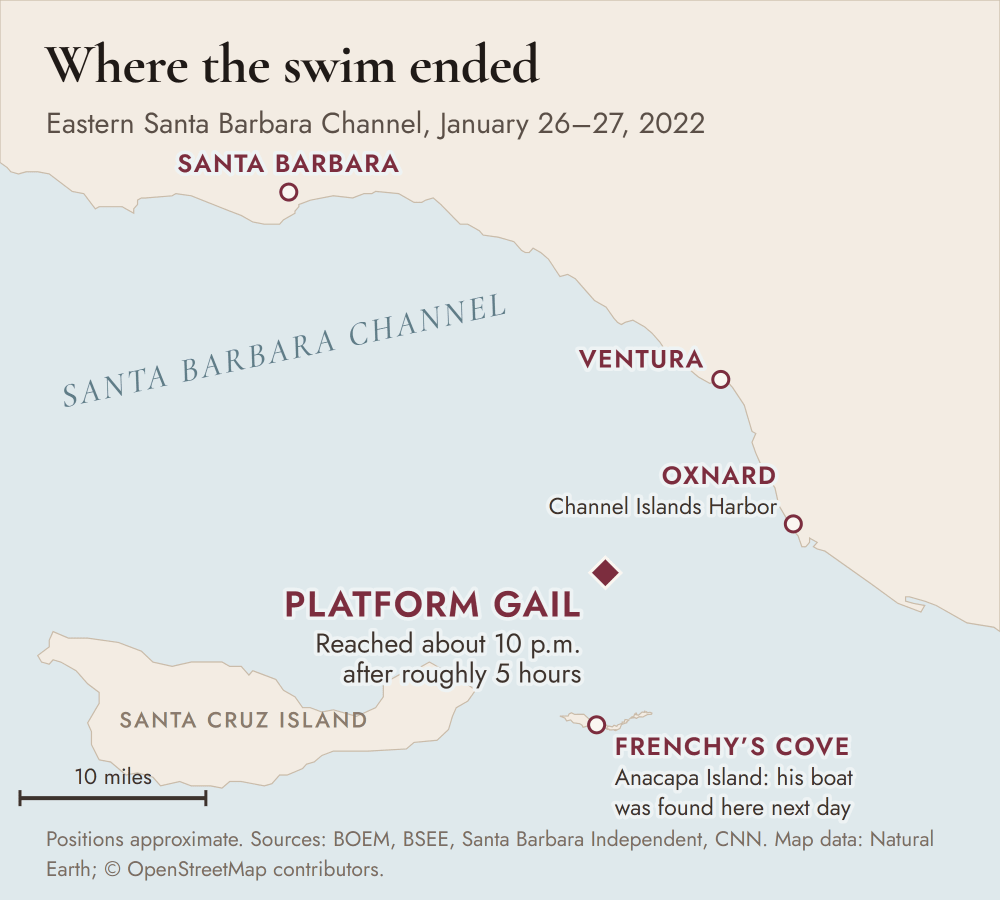
About five hours later he climbed onto Platform Gail, an oil platform roughly 10 miles off the Ventura County coast. Somewhere along the way a harbor seal turned up and stayed with him for part of the swim, and the seal is the detail people remember. His own description of it is smaller and stranger than the version where an animal escorts a man to safety, and I find it more convincing.
How he ended up in the water
Thompson dives commercially for sea urchins out of Ventura. This trip wasn't for work. A very good friend of his had just died of a heart attack at 38, leaving a wife and two young daughters close in age to Thompson's own girls, and he went out to Santa Cruz Island to surf and clear his head. He wrote about his mood later in a comment the Santa Barbara Independent quoted, and in a longer first-person account on writer Peter Maguire's newsletter, Sour Milk.
The wind had kicked up a nasty chop. He gave up and headed home. About halfway back, between Platform Gina and Platform Gail, he throttled back, phoned a friend, and stepped to the starboard side to relieve himself. A wave slapped the hull, his foot slid on something slick, and he went over.
When he reached up for the boat it wasn't there. The engine was still engaged, so the Miss Grace kept going, pointed toward the harbor. He swam after it as hard as he could. Within about a minute he could see the gap growing.
I thought to myself, great, this is how I'm going to die.
— Scott Thompson, to KABC-TV, February 2022
Swimming for the lights
What he did next is probably why he lived. Instead of fighting the water, he rolled onto his back and floated, falling back on his old fire-service training, and took stock. There were no boats in sight, and the beach was too far. The nearest thing he could hope to reach was a lit platform he took to be Gina; it turned out to be Gail. He checked which way the current was running, and by his own account it was running toward the platform.
He started with the crawl, lasted two or three minutes, and switched to breaststroke to save energy. Reports of the water temperature differ: the Independent said 57°F, and CBS Los Angeles said 52°F. Either figure is dangerous for someone with no wetsuit. The National Center for Cold Water Safety says most people experience maximum-intensity cold shock, including a complete loss of breathing control, in water between 50°F and 60°F, and it calls the familiar survival-time charts misleading because they make an unprotected swim look survivable for hours. Paul Amaral, the towboat captain who later recovered the Miss Grace, guessed that years of urchin diving in that same cold water had conditioned Thompson for it.
Nobody knows exactly how far he swam. CBS Los Angeles reported the platform was two to three miles away, and a BoatTEST headline said five. No one tracked his position, so there is no reliable figure.
The seal
The cold wasn't what got to him most. In his written account he says the hardest part, especially after dark, was feeling lonely and cut off, with nothing to look at except the platform lights. Then he heard a splash and, for a second, thought shark.
It was a young harbor seal. He started talking to it. In the comment the Independent quoted, he says it bobbed around checking him out, and that at one point “I even asked him for a lift.” In a TV interview with KABC he said it would dive and come back up to nudge him, “like a dog comes up and nudges your leg,” and he wondered aloud whether it somehow knew he was in trouble. In the longer account, he says the seal stuck with him until he got closer to the platform, bumped him when he stopped to tread water and get his bearings, and helped mostly by giving his tired mind something else to focus on.
The word “angel” attached to the story comes from KABC's report, which said the splash felt like one to him. The quotes Thompson himself gave were about company and a nudge.
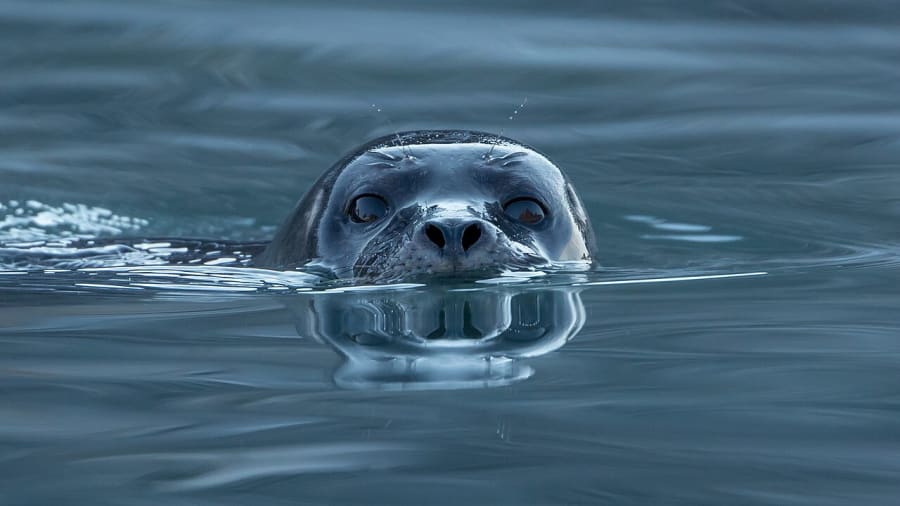
That curiosity is normal harbor seal behavior. The National Park Service's guide to harbor seals at Point Reyes describes them as curious in the water; they often lift their heads to look around, and they sometimes follow kayakers from as close as 50 feet. A seal investigating a lone person splashing through the channel at night fits that pattern. Whether it understood anything about his situation is unknowable, and Thompson never claimed it did. Personally, I think his version is the better story: a frightened, exhausted man found something alive out there to talk to, and it kept him swimming.
The ladder
He knew he was close when he heard the hum of a diesel engine. Seagulls were swarming around the platform. Thompson grabbed one of its legs and held on, getting cut up by barnacles, and shouted for help, but nobody could hear him over the machinery and the swell. The nearest ladder was about 50 feet away. Then a surge picked him up and carried him toward it. He wrote that it “felt like the hand of God picked me up” and set him on the ladder.
He crawled up the stairs on his hands and knees and lay on a metal landing while the cold and the shock caught up with him. Then he went looking for a phone or an alarm and pounded on a lit window, startling the worker inside. The platform's medic gave him hot coffee and a warm shower and wrapped him in towels. The crew called the Coast Guard, which took him ashore to St. John's hospital in Oxnard. He was treated for hypothermia, and he was dehydrated and nauseous from the seawater he'd swallowed.
Amaral, of TowBoatUS Ventura, said he couldn't imagine making that swim at night in shorts and a T-shirt: “There was no moon, I mean it was pitch black.” His colleague Carson Shevitz told CNN that the company has dealt with other cases where people “just don't, and we never find them.”
Key dates
- Jan. 26, 2022, around sunsetThompson falls overboard between Platforms Gina and Gail. The Miss Grace, still in gear, keeps going.
- Jan. 26, about 10 p.m.After roughly five hours in the water he reaches Platform Gail. The crew calls the Coast Guard.
- That nightThe Coast Guard takes him ashore; he is treated for hypothermia at St. John's in Oxnard.
- Jan. 27Using the boat's tracking system, TowBoatUS Ventura finds the Miss Grace at Frenchy's Cove, Anacapa Island, and tows it to Channel Islands Harbor.
- Feb. 22A GoFundMe for the boat's repairs has raised nearly $15,000.
The boat, the platform and a life jacket
The Miss Grace survived too. Thompson had recently installed a vessel monitoring system, and when the Coast Guard asked about the boat, that tracker led the TowBoatUS crew to it the next day, aground at Frenchy's Cove on Anacapa Island. The drive had been sheared off and the fiberglass was damaged, but it came back to Channel Islands Harbor in one piece. Thompson rode along on the recovery.
Platform Gail had a crew aboard that night, but it was no longer pumping oil. It was installed in 1987 in about 739 feet of water, and production there has ended. Chevron is responsible for plugging its wells and removing the well conductors on Gail and its neighbor Grace, according to the Bureau of Ocean Energy Management, and the Bureau of Safety and Environmental Enforcement now lists all 28 of Gail's wells as abandoned and its 28 conductors removed. Under BOEM's plan, the deck and the steel jacket below it stay in place until regulators approve a separate application to remove the platform itself.
Thompson spent the first hours afterward angry with himself for a preventable accident. He called himself a computer game nerd who'd been handed an extra life and “made it to the bonus round.” What helped most, he wrote, came a little later: his old fire captain pulled up at his house, got out of the car and handed him a life jacket. The two of them laughed, then hugged for a long time.
Read next: why some male orcas never leave their mothers · the whooping cranes that learned to migrate by following costumed pilots · the true story of Stoffel the honey badger
Sources (13)
- Jean Yamamura, “Urchin Diver Scott Thompson Survives Five-Hour Swim in Santa Barbara Channel”, Santa Barbara Independent, Feb. 2, 2022 (date of the trip, water temperature, Thompson's Instagram comment, recovery at Frenchy's Cove).
- Peter Maguire, “Row Jimmy”, Sour Milk (Thompson's first-person account of the fall and the swim).
- Leo Stallworth, “Boater who fell into the Santa Barbara Channel helped by nudging seal, swims to oil rig safely”, KABC-TV / ABC7 Los Angeles, Feb. 2022; and follow-up on the boat's recovery.
- “Man survived freezing waters after falling off his boat. He swam for five hours to safety”, CNN, Feb. 19, 2022 (arrival about 10 p.m., Coast Guard, TowBoatUS comments).
- “Knocked Overboard, Boater Swims 5 Miles to Safety”, BoatTEST, 2022 (excerpts of Thompson's written account, hospital, boat damage, GoFundMe total).
- CBS Los Angeles, “Man Swims Five Hours To Safety After Being Thrown Overboard”, Feb. 21, 2022 (52°F water, distance estimate).
- “‘Today is the day I'm going to die’: California fisherman swims five hours after falling overboard”, National Fisherman, Feb. 22, 2022.
- Bureau of Ocean Energy Management, Santa Clara Unit Well Conductor Removal (Platforms Gail and Grace, Chevron's responsibilities, location offshore Ventura County).
- Bureau of Safety and Environmental Enforcement, Pacific Region Federal OCS Decommissioning (Platform Gail well and conductor status).
- Bull, A.S. and Love, M.S., “Worldwide oil and gas platform decommissioning: A review of practices and reefing options”, Ocean & Coastal Management, 2019 (Gail's installation year, water depth and distance from shore).
- National Park Service, Point Reyes National Seashore, Harbor Seals site bulletin (curiosity in the water).
- National Center for Cold Water Safety, “Cold Water Survival Charts Are Misleading”.
- Images: Platform Gail, Ken Lund, Wikimedia Commons, CC BY-SA 2.0. Harbor seal, AWeith, Wikimedia Commons, CC BY-SA 4.0. Map by The Verified Post using Natural Earth data and © OpenStreetMap contributors (ODbL).