"Weightism" is a concept that many countries in Asia are familiar with. It's common in China, where a larger body is often linked to laziness and a lack of discipline. A 2025 review of 53 studies, covering more than 83,000 Chinese adults, found that people there tend to judge obesity by appearance more than health, and that stigma makes living with it a lonely experience.
Despite much of the world adopting a more accepting attitude towards bodies of all shapes and sizes, aka the "Body Positivity" movement, many people in China still don't look kindly on a larger frame. If a person is overweight, it is often blamed on a poor mindset, attitude, and personal lifestyle choices. In a 2022 national survey, three in four Chinese adults living with obesity said losing weight was entirely their own responsibility.
In such a climate, gaining weight on purpose is a serious social misstep. But Lu Zikuan wasn't fazed by society's standards. At the tender age of 10, he was fiercely adamant about his goals:
"Save dad first, lose weight later."
Lu Yanheng & Lu Zikuan
In 2012, Lu Yanheng, from Huixian in China's Henan province, was diagnosed with myelodysplastic syndrome, which Chinese media described as an early stage of leukemia. Myelodysplastic syndrome, or MDS, is basically a group of bone marrow disorders. Blood disorders like this tend to reorganise a whole family around one patient, as the story of Keanu Reeves and his sister Kim's leukemia also shows.
Lu Yanheng's marrow was unable to produce healthy blood cells. So he spent years relying on drug therapy to treat the symptoms. His doctor suggested a transplant. But because of the high cost, Yanheng refused.
Six years later, his condition worsened. By mid-2018, a transplant was no longer optional; it was urgent. And despite his best efforts, Yanheng could no longer hide the truth from his three children.
In early 2019, tests showed that Lu Zikuan, his eldest, was a match. If he could donate bone marrow, he could save his father's life. Yanheng refused at first and kept saying he would rather give up treatment than put his son through it. Doctors repeatedly reassured him that the donation would not cause the boy lasting harm, and he finally agreed.
Zikuan later told reporters that with his father bedridden and unable to work, he had decided to step up. "Since my father can't support the family, I should be a 'little man' and take responsibility until he recovers," he told China Daily.
In Zikuan's case, this meant saving his father.
But there was a catch.
Lu Zikuan's Decision
Zikuan weighed just 30kg, or 66 pounds, when the match was confirmed. The doctors informed the family that they could only proceed with the operation if the donor weighed considerably more. Reports put the minimum at 45 to 50kg.
Reports vary on the exact goal weight given to Zikuan, but, essentially, the child needed to gain anywhere between 15kg and 20kg (or 33 to 44 pounds) if he wanted to save his father.
Zikuan didn't back down. He took matters into his own hands and started eating five meals a day.
Now, this might seem simple enough for a child to do. It wasn't. His family, who rarely ate much meat, started buying braised pork for him every day. Breakfast was three eggs, a carton of milk, a large steamed bun and a bowl of porridge. Main meals were a bowl of braised pork over rice, and before bed he ate a bowl of instant noodles with more milk. His mother told the Beijing Youth Daily that he was often painfully full but kept forcing food into his mouth anyway. His father later said the irregular diet had given him stomach problems, and that he had tried to tell his son to stop.
He started in March. Within a month he was 5kg heavier, and by July he weighed in at 48kg.
But gaining weight was not Zikuan's only sacrifice.
A Son's Love for His Father
While willingly packing on more than 15kg for his father is admirable in its own right, Lu Zikuan was fully aware that the process didn't stop there. He was told up front what donating bone marrow would entail: several injections and multiple blood draws that would surely take a physical toll on his body.
And yet, Lu Zikuan didn't hesitate.
I have a lot of blood. Draw mine.
— Lu Zikuan, to China Daily, 2019
Why Weight Matters
When it comes to medical transplants, weight requirements are basically safety nets for the donor.
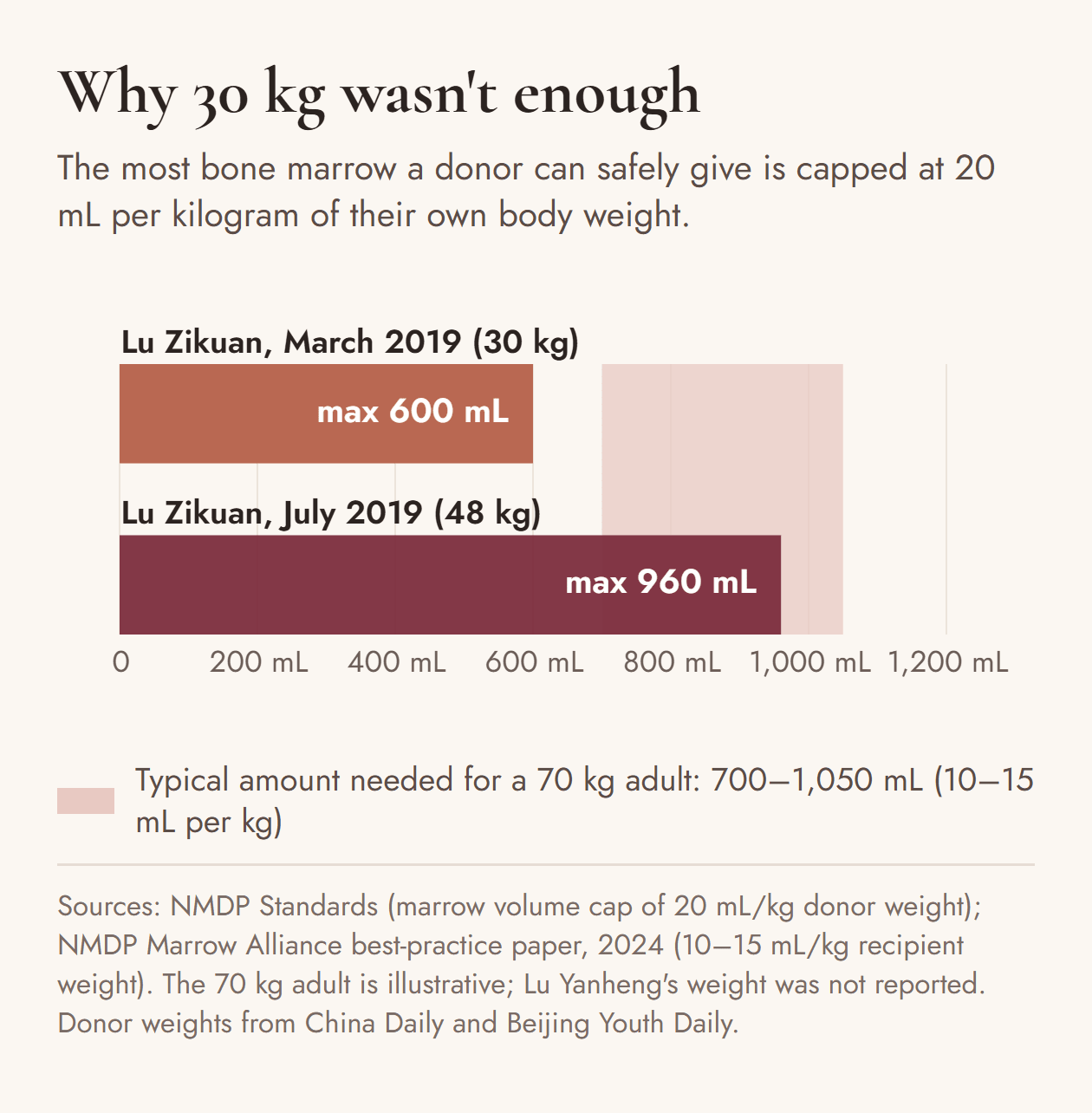
Donor centers cap the volume of marrow collected, and the cap is tied to the donor's body weight. The National Marrow Donor Program (NMDP), as well as many collection centers, limits collection to 20 mL per kilogram of donor weight. Anything more than that can pose serious risk to the donor.
The amount of marrow the recipient needs is tied to their weight as well. Current guidance puts it at 10mL to 15mL per kilogram of the recipient's weight.
The data is a little unforgiving, truth be told. An adult weighing 70kg would need about 700 to 1,050mL. A child donor weighing 30kg can only safely give 600mL. That's at least 100mL short of the target.
Because of this cap, successful collections are more likely to happen when the donor outweighs the recipient. A 2024 review of more than 1,300 marrow harvests at the largest collection center in the United States found that when the donor weighed less than 60 percent of the recipient, the minimum cell dose for a transplant to take was reached only about half the time. Only when the donor was heavier than the recipient could it be met with roughly 90 percent certainty.
Weight requirements aside, the very act of donating can be hard on a child as well. Marrow harvests are usually done under general anesthesia, which carries its own risks, and donors who give a large share of their blood volume can become anemic enough to need a transfusion afterward.
Lu Zikuan's extraction was done under local anesthesia. "It didn't hurt much. I was given a local anesthetic, I just felt a bit dizzy," he told the Beijing Youth Daily. Even at 48kg, the margin was tight. On the first day, doctors could not collect enough marrow, so the boy spent two more days, five hours and then four, having stem cells filtered from his blood through a line of more than 20cm inserted in his thigh. He cried only once: when he learned it meant he still could not go upstairs to see his dad. On the day of the harvest, his father posted a short video telling people: "Zikuan didn't cry. He was very brave."
The Cost of Bulking Up
Lu Zikuan's weight gain wasn't easy. After he packed on the pounds, even minor exercise exhausted him. Zikuan reported that his inner thighs often became red and swollen when he walked due to chafing and exhaustion. A scan before the donation also showed mild fatty liver, which his mother blamed on the rapid weight gain.
Pediatric health guidelines judge weight by body mass index measured against children of the same age and sex. Under CDC definitions, a healthy weight falls between the 5th and 85th percentiles, overweight between the 85th and 95th, and obesity at or above the 95th.
Reports don't give Zikuan's height, so there's no telling where he landed. However, there's a good chance that he reached clinically overweight or obese levels due to the drastic weight gain. The CDC warns that obesity puts children at risk for poor health outcomes in childhood, adolescence, and adulthood, and research on what children eat early in life shows how long diet's effects can last.
It doesn't help that children with obesity are also more likely to be bullied, in China as everywhere else.
Given how much personal and social cost came with Lu Zikuan's decision, the question was raised: did the 10-year-old truly understand what he was signing up for?
Looking at it through a purely scientific lens, there's a good chance he at least got the moral side of it. Psychologist Lawrence Kohlberg stated that children younger than about 8 or 9 mostly make moral decisions to avoid punishment and earn praise.
As a child grows, moral reasoning then shifts toward understanding the impact on others. At later ages, children's empathy is consistently linked to prosocial behavior.
But understanding sacrifice in principle is not the same as understanding surgery. And it's very clear that Zikuan wasn't doing this to avoid punishment or garner praise. He knew his father needed help, and he knew he was the only one who could help him.
That gap is why medical standards for minor donors exist. In the United States, the American Academy of Pediatrics calls for parental permission, the child's assent where appropriate, and an independent donor advocate to look out for the child's interests; if a child objects, a child mental health professional may be brought in. Donating is not something to be taken lightly, and no child should donate simply because they've been told to.
For Lu Zikuan, no expert publicly assessed his state of mind. The records simply show a 10-year-old boy whose father was dying. He was told about the needles and the blood draws, and he chose to go ahead with the procedure regardless.
The Hopeful Ending
September 9, 2019, was Lu Yanheng's birthday. It was also the day the donation began at a branch of Peking University People's Hospital in Beijing. From the sterile ward, Yanheng posted on WeChat: "On my birthday, my son gave me a priceless gift, his bone marrow. This is a seed that rekindles my life."
Zikuan went home from hospital on September 12. He had lost about 4kg by early October, and his new goal weight was to climb back down to a healthy 30kg. The doctors cleared him to return to school not long after. According to his father, he stayed among the top five performers of his grade and kept his position as class monitor.
His father's recovery was slower. Yanheng left the sterile ward at the end of September, but strong reactions to his medication sent him to the emergency room almost every day of the October national holiday. When complications flared at the end of October, Zikuan took the train back to Beijing and gave blood for his father's transfusion. By January 2020, Yanheng was still living near the hospital for check-ups twice a week, and his blood type had changed to O, the same as his son's. In May 2020, when Zikuan was named one of Henan province's "Good Youth of the New Era", reports said his father was gradually recovering. We could find no public update after that.
From diagnosis to donation
- 2012Lu Yanheng is diagnosed with myelodysplastic syndrome and manages it with medication.
- Mid-2018His condition worsens and a transplant becomes urgent.
- Early 2019His son Lu Zikuan, 10, is confirmed as a match but weighs only 30 kg.
- March 2019Zikuan starts eating five meals a day.
- July 2019He reaches 48 kg and the family travels to Beijing.
- Sept 9–11, 2019Marrow is harvested, then stem cells are collected over two more days.
- Late Sept 2019Lu Yanheng leaves the sterile ward; Zikuan returns to school in October.
- Nov 2019Zikuan travels back to Beijing to give blood for his father's transfusion.
- May 2020Reports say Lu Yanheng is gradually recovering.
Through all of it, Lu Yanheng had one simple message to live up to, from his strong, brave, 10-year-old son:
"My task is complete, so it's now up to you."
Sources
- China Daily, "To save ailing father, boy gains weight to donate bone marrow" (September 10, 2019), "Boy gains weight to save ailing father" (September 27, 2019) and "Boy who gained weight to save father returns to class" (October 9, 2019).
- Beijing Youth Daily, interview with Lu Zikuan and his mother after his discharge (September 15–16, 2019); Shangguan News (September 12, 2019); The Paper / Red Star News (September 2019).
- Southern Metropolis Daily, follow-up on the family's Spring Festival (January 22, 2020); Xinxiang Daily on the Henan "Good Youth of the New Era" award (June 1, 2020).
- South China Morning Post (September 19, 2019); Global Times (September 23, 2019).
- NMDP Standards (marrow volume limit of 20 mL/kg donor weight); NMDP Marrow Alliance, "Bone Marrow Harvest: A White Paper of Best Practices" (2024); W. Rennert, "Optimizing total nucleated cell yield in bone marrow harvests," Annals of Blood (2024).
- American Academy of Pediatrics Committee on Bioethics, "Children as Hematopoietic Stem Cell Donors" (2010).
- Systematic review of Chinese adults' perceptions of overweight and obesity, Monash University (2025); ACTION-China survey, Diabetes, Obesity and Metabolism (2024).
- US Centers for Disease Control and Prevention, child and teen BMI categories and childhood obesity guidance.