Updated October 8, 2026: we added sources and tightened our description of the Lynn study, which found a clear effect only for fire with sound, and noted the study’s limitations.
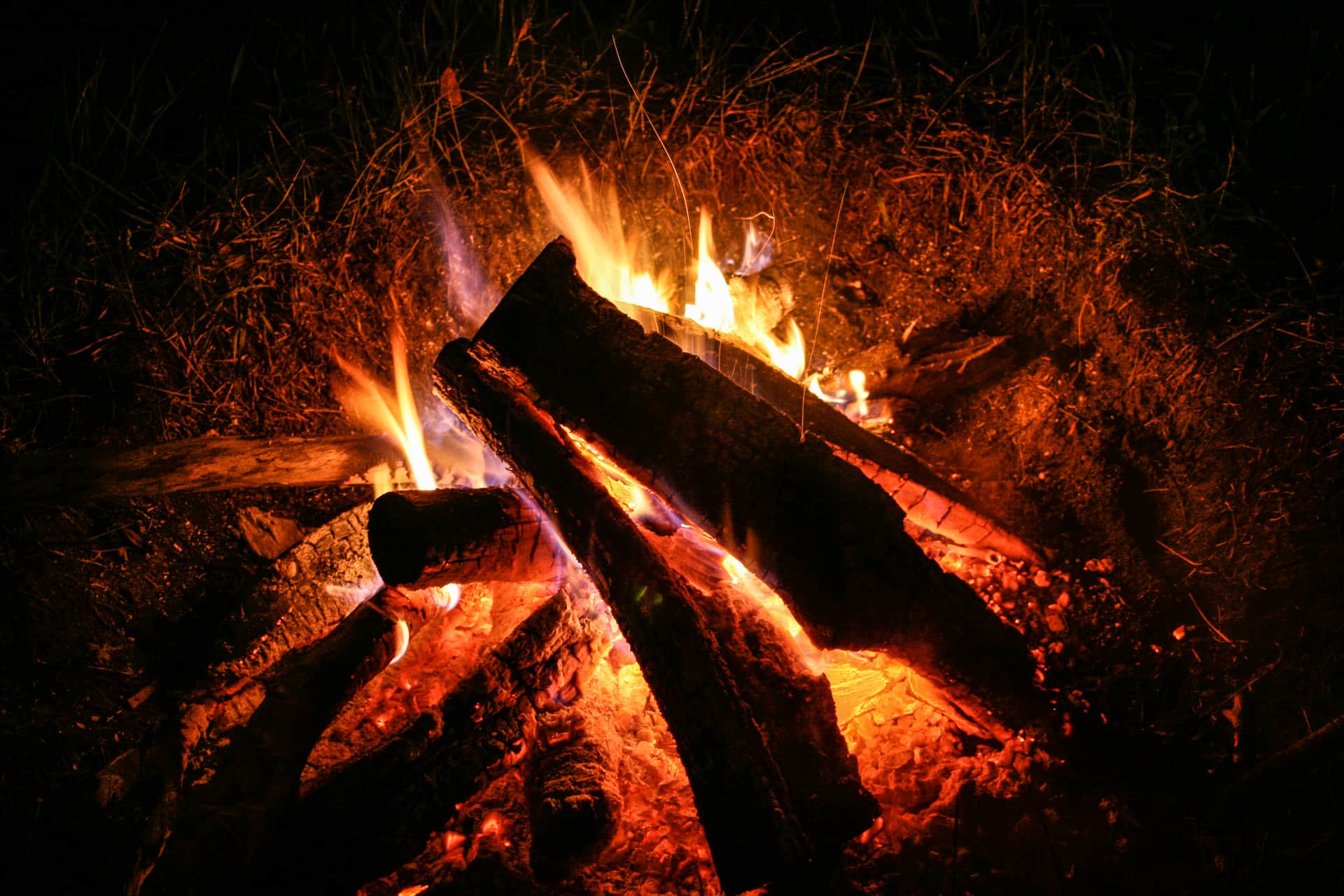
You already know the feeling. You sit down in front of a fire and, within a few minutes, something in you unclenches. Your shoulders drop. The talk gets slower and, somehow, deeper. You lose track of time watching flames do absolutely nothing useful.
That feeling isn’t just in your head — or rather, it’s very precisely in your head, and researchers have actually measured it.
But the version of this going around online oversells one part and completely misses the best part. Let me untangle what’s actually true, because the real science is better than the myth.
What Actually Happens When You Watch a Fire
Start with the cleanest piece of evidence, because it’s genuinely striking.
In 2014, anthropologist Christopher Lynn ran a study, published in Evolutionary Psychology, on what watching a fire does to your body. He had 226 adults watch a video of a fireplace and measured their blood pressure before and after. The people who watched the fire with its crackling sound showed a drop in blood pressure (in the longest version of the experiment, systolic pressure fell by about 6 points, roughly five percent), and here’s the key detail: the longer they watched, the more relaxed they got.
The control conditions are what make it convincing. People who watched the fire on mute, or watched an upside-down image of a fire, didn’t get the same benefit; in the longest version of the experiment, their blood pressure actually went up slightly. So it wasn’t just “sitting still and watching a screen” doing the work. It was specifically the fire, moving and crackling the way a fire does, that produced the calm.
One more finding worth holding onto: the effect was strongest in people who scored higher on prosocial traits like empathy. The more social you are, in other words, the more a fire seems to settle you. Sit with that — we’ll come back to why it matters.
The Part the Viral Version Gets Wrong
Now let me be the annoying fact-checker for a second, because it’s the reason to trust the rest.
The popular telling of this goes big on neuroscience: fire is “completely random,” it has “no predictive element,” so your brain is forced to give up trying to guess what comes next, which drops you into a special “highly responsive state” and rewires you through neuroplasticity. It sounds amazing. It also isn’t something the research actually shows.
Here’s the honest version. Yes, your brain is, at every waking moment, a prediction machine — constantly guessing what’s about to happen and updating when it’s wrong. That part is solid, mainstream neuroscience. And yes, flames are chaotic in a way you genuinely can’t predict frame to frame. But the leap from “flames are unpredictable” to “therefore fire drives neuroplasticity and forces your brain open” is a hypothesis someone made sound like a finding. No study I can point you to has measured “fire-induced neuroplasticity” or a special “responsive state.”
So why bother telling you the real science instead of the sexier version? Because the real science still backs up the thing you actually care about — that fires calm you down and that the best conversations happen around them. It just gets there through mechanisms that are proven, not invented. And honestly, wouldn’t you rather know which parts are real?
Soft Fascination — Why Fire Holds You Without Draining You
Here’s a mechanism that is well-established, and it explains the trance better than the “randomness” story.
Psychologists talk about a concept called soft fascination — part of a broader idea called Attention Restoration Theory. The gist: some things grab your attention so gently that they hold you without demanding effort. A fire. Waves on a beach. Clouds. Rain on a window. Your attention rests on them, drifting, and — crucially — while it’s resting there, the part of your mind responsible for hard, effortful focus gets to recover.
That’s the opposite of your phone, which is hard fascination — it seizes your attention and wrings it out. A fire asks nothing of you. It gives your overworked attention somewhere soft to land. What most people mistake for “fire hypnotizing me” is really your directed-attention system finally getting to clock off for a while.
And notice how neatly this fits the blood-pressure result. A stimulus that quietly holds you, demands nothing, and lets your mind idle is exactly the kind of thing that would relax your body. You’re not being forced into anything. You’re being let off the hook.
Why the Deepest Conversations Happen at the Fire
This is the part the viral post skips, and it’s the best part — because it’s not a hypothesis, it’s data.
Anthropologist Polly Wiessner spent decades among the Ju/’hoansi people of the Kalahari, and in 2014 she published something remarkable in PNAS. She compared what people talked about during the day versus at night, around the fire — 174 conversations in all.
The difference was stark. Daytime talk was practical and often sharp-edged: economic matters, planning, complaints, gossip, the social policing of who did what. Useful, necessary, a little tense. Firelight talk, after dark, was a different creature entirely. It was dominated by storytelling — by imagination, by talk of people far away, by myth and memory. It healed the frictions of the day. It carried the culture’s values from one generation to the next. It was where a community did its dreaming.
Same people. Same day. But the fire changed the kind of conversation that was possible. Read that again, because it’s the whole thing: the campfire didn’t just relax bodies; it opened a nightly window for exactly the kind of imaginative, bonding, story-driven talk that ordinary daylight doesn’t make room for.
Day talk is for surviving the day. Fire talk is for making sense of each other.
The Oldest Social Technology We Have
Step back and the pieces snap together into something genuinely moving.
Our ancestors have had some control of fire for hundreds of thousands of years — regular use goes back at least 400,000. For nearly all of that time, the fire was the one place everyone gathered after dark. It extended the day. It pushed back predators and cold. And it created something new in human life: a warm, safe circle where people sat, faces lit, with nothing pressing to do and nowhere else to be.
Lynn’s blood-pressure study and Wiessner’s firelight-talk study are really describing two halves of the same ancient machine. The fire relaxes the body — more so in the people who are most social — and in that relaxed, unhurried circle, a different, deeper kind of talk becomes possible. It’s not a stretch to think we were, in part, shaped by those evenings. The hearth may be the original social technology, and we may still be running on its software.
Which is why sitting by a fire with someone feels like it unlocks a conversation you couldn’t have had at a desk. Because, for a few hundred thousand years, it did exactly that.
How to Actually Use This
So what do you do with it? A few things, and here’s where I’ll editorialize.
Use a real fire if you can, with sound. The study is clear that the crackle matters — muted fire did far less. (One honest caveat: Lynn’s fire-with-sound groups also started out with higher blood pressure, and a later study in his lab using an electric fireplace didn’t find a clear effect, so treat this as promising rather than settled.) A fireplace, a fire pit, a campfire. If you’re stuck indoors, a fire video with audio is a real (if weaker) substitute; the silent one is basically useless.
Put the phone away — completely. This is the big one. The entire benefit is your attention getting to rest on something soft. A phone is hard fascination; it drags your mind straight back into the effortful, predicting, defensive mode the fire was pulling you out of. You cannot get the fire’s effect with a screen in your other hand. Pick one.
Related: the study that took away people’s phone internet for two weeks.
Let it be boring. The trance, the calm, the openness — none of it arrives in the first ninety seconds. Lynn’s people got more relaxed the longer they watched. Our culture treats “staring at nothing” as wasted time. This is the rare case where staring at nothing is the entire point.
And if you want the real conversation — have it there. If there’s something you’ve been meaning to say to someone, or something you want to actually hear from them, don’t do it over coffee across a table. Do it around a fire, after dark, phones gone. The research quietly suggests you’ll both be calmer, more imaginative, and more open than you’d be anywhere else.
The Bottom Line
The viral version wasn’t entirely wrong — it just reached for flashy neuroscience it couldn’t cash. The truth is sturdier and, I think, more beautiful. Watching a fire genuinely relaxes your body, in a way scientists have measured. It gives your exhausted attention a soft place to rest. And gathered around one, humans reliably slip into a warmer, more imaginative, more honest kind of talk — the kind our species has been having by firelight for longer than we’ve had writing, farming, or cities.
You don’t need to believe it rewires your brain. You just need to light one, put the phone down, and notice who you become in front of it.
Because the fire has been doing this to us the entire time. We just forgot to ask why.
Read next: Why staying home can trap your brain in a loop.
Sources
- Christopher Dana Lynn, “Hearth and Campfire Influences on Arterial Blood Pressure: Defraying the Costs of the Social Brain through Fireside Relaxation,” Evolutionary Psychology 12, no. 5 (2014)
- Polly W. Wiessner, “Embers of society: Firelight talk among the Ju/’hoansi Bushmen,” PNAS 111, no. 39 (2014)
- Rachel Kaplan and Stephen Kaplan, The Experience of Nature: A Psychological Perspective (Cambridge University Press, 1989), on attention restoration and soft fascination.
- Wil Roebroeks and Paola Villa, “On the earliest evidence for habitual use of fire in Europe,” PNAS 108, no. 13 (2011)
- Christopher D. Lynn lab, “Fireside Relaxation Study”