At 7 a.m. on May 18, 1980, a geologist named David Johnston radioed in a set of laser measurements from his observation post on a ridge overlooking Mount St. Helens in Washington State. Nothing had changed. The mountain was trembling, as it had been trembling for two months, but the readings were consistent with everything that had come before.
Ninety-two minutes later, Johnston's last transmission crackled across the radio frequency: "Vancouver! Vancouver! This is it!"
Then silence. The pyroclastic flow reached him before he could say anything else.
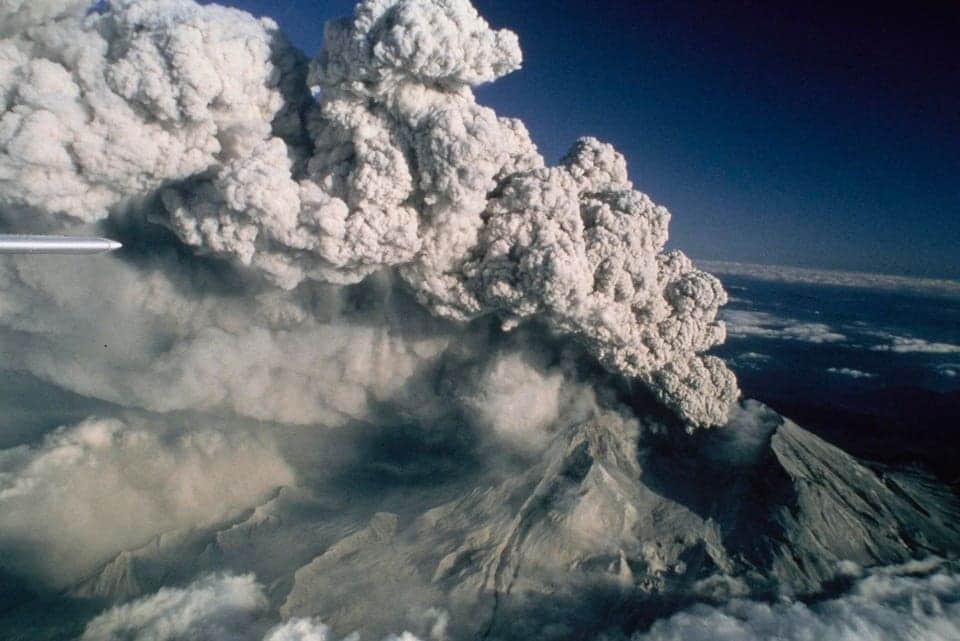
The eruption of Mount St. Helens on May 18, 1980 at 8:32 a.m. is the most powerful volcanic event in the contiguous United States in recorded history. It released more energy than Hurricane Katrina. It sent 540 million tons of ash into the atmosphere. It killed 57 people. It removed the top 300 metres of the mountain in less than a minute and left a crater a mile wide where a perfectly symmetrical snow-capped peak had stood for centuries.
And it had been coming for 123 years.
The science of why volcanoes don't erupt immediately — why they build, accumulate, tremble, swell, and then one day simply give way — is one of the most precise and well-documented processes in the natural world. And it turns out to be an almost perfect physical description of the mechanics of any pressure that has been held too long.
What Is Actually Happening Underground
Deep beneath the Earth's surface — typically between one and ten kilometres down — magma collects in chambers carved out of the surrounding rock. Magma is molten rock, and it is less dense than the solid rock around it. That density difference creates a constant upward pressure — the magma is always, in a physical sense, trying to rise. It is always looking for a way out.
What keeps it contained is the strength of the surrounding rock. The walls of the magma chamber and the rock above it push back against the magma's upward pressure. As long as the rock is strong enough to resist the pressure below, nothing happens on the surface. The mountain sits still. It may look dormant. It may look peaceful. But underneath, the balance is always being tested.
The chemistry of magma matters enormously. Magma contains dissolved gases — primarily water vapour, carbon dioxide, and sulphur dioxide. When magma is deep underground, the pressure is high enough to keep those gases dissolved within the liquid rock, the way carbonation stays dissolved in a sealed bottle of soda. As long as the lid stays on, the bubbles don't form. But as magma rises toward the surface and pressure decreases, those gases begin to come out of solution and form bubbles — exactly as a soda bottle fizzes when you remove the cap.
If the magma is thin and runny — low viscosity — those gas bubbles can escape relatively easily. The pressure releases gradually. The eruption, when it comes, tends to be effusive rather than explosive: lava flows out rather than exploding upward. The volcanoes of Hawaii behave this way. Their eruptions are dramatic but navigable — the lava moves slowly enough that people can outrun it.
But if the magma is thick and sticky — high viscosity — the gas bubbles cannot escape. They are trapped within the magma as pressure builds and builds. The gases have nowhere to go. The rock above holds firm. The system accumulates energy. And then, when something finally gives — when the rock cracks, or an earthquake shifts the structure, or the pressure exceeds what the mountain can contain — everything that has been held is released at once.
This is the difference between a volcano that sighs and a volcano that screams. The screaming ones are the ones that held too long.
If the magma is thick and sticky, gases cannot escape easily. Pressure builds up until the gases escape violently and explode.
— U.S. Geological Survey, on the mechanics of explosive volcanic eruptions
Two Months of Warnings Before One Minute of Catastrophe
Mount St. Helens had last erupted in 1857. For 123 years it sat quiet in the Cascade Mountain Range of Washington State — snow-capped, symmetrical, beautiful. Geologists began warning in 1979 that it would almost certainly erupt again before the end of the twentieth century. Studies published in 1975 and 1978 had identified the warning signs already accumulating in the mountain's geology. Outside of scientific circles, almost nobody was listening.
On March 16, 1980, the first sign came: a series of small earthquakes beneath the volcano's north flank. Four days later, on March 20, a magnitude 4.2 earthquake flagged what geologists recognised as the end of the mountain's 123-year dormancy. On March 27, magma heating groundwater caused an explosion of steam that blasted a crater 200 feet wide through the summit ice cap. Within a week the crater had grown to 1,300 feet across. Two giant crack systems crossed the entire summit area.
Over the following weeks, the volcano's north face began to swell outward — a phenomenon geologists called a cryptodome, a bulge caused by rising magma pushing against the mountain from within. The bulge grew at a rate of up to five feet per day. By May 17, the north flank had deformed outward by at least 450 feet. More than 10,000 earthquakes had been recorded beneath the volcano since mid-March. The heat from the rising magma was melting the mountain's ice in streams. Groundwater was boiling away in some places.
The signs were not subtle. They were continuous, measurable, and documented. Geologists knew something was coming. What they could not know was exactly when — or how large.
At 8:32 a.m. on May 18, a magnitude 5.1 earthquake one mile below the mountain caused the unstable bulge to collapse. Within fifteen to twenty seconds, the entire northern face of the volcano slid away in the largest subaerial landslide in recorded history. The removal of that mass instantly depressurised the magma system beneath — like removing your thumb from the top of a shaken soda bottle. The gas-charged, partially molten rock that had been trapped under the cryptodome exploded laterally through the gap at speeds approaching 680 miles per hour. Temperatures in the pyroclastic flow exceeded 400 degrees Celsius. The blast devastated an area of 230 square miles. David Johnston's observation post — on a ridge 6 miles from the volcano — was directly in the path.
Within fifteen minutes of the eruption's start, an ash column had risen to more than fifteen miles above the surface. The Plinian eruption — named after the Roman scholar Pliny the Younger, who first described this eruption type when documenting the destruction of Pompeii in 79 CE — continued for nine hours.
Vesuvius and the City That Didn't Listen
Mount St. Helens was not the first volcano to give extensive warning before its most catastrophic eruption. Nearly two thousand years earlier, on August 24, 79 CE, Mount Vesuvius on the Bay of Naples erupted in an event that buried the cities of Pompeii and Herculaneum under metres of ash and volcanic material. The remains of approximately 2,000 people were discovered preserved in the ash — a number that likely represents only a fraction of those who died.
What is less often discussed is what had come before. Vesuvius had not been silent. In 62 CE — seventeen years before the catastrophic eruption — a major earthquake had shaken the mountain and the surrounding region, causing widespread damage to Pompeii and Herculaneum. The magma chamber beneath Vesuvius had been building pressure. The 62 CE earthquake was not the eruption. It was the mountain announcing, in geological terms, that the system was under stress.
In the days immediately before the 79 CE eruption, there were additional earthquakes. Pliny the Younger — who observed the event from across the bay at Misenum and later wrote the only surviving eyewitness account — described how the sea seemed to be pulled back from the shore before the eruption, and how the mountain began to emit dark clouds of ash and gas. His uncle, Pliny the Elder, sailed toward the eruption to attempt a rescue and to observe the phenomenon more closely. He died on the shore, overcome by volcanic gases.
The cities of Pompeii and Herculaneum had been warning signs around them for decades. The mountain itself had been communicating through earthquakes for seventeen years. The pressure had been building far longer than that. When it finally gave way on that August afternoon in 79 CE, the eruption column rose to an estimated 33 kilometres into the atmosphere. The ash fell for eighteen hours. Pompeii was buried under fourteen to seventeen feet of volcanic material. Herculaneum under more than sixty feet of mud and debris.
Two thousand years later, Pompeii remains one of the most visited archaeological sites on earth — a precise, terrible record of what happens when accumulated pressure meets its limit all at once.
The mountain does not erupt without warning. It trembles first. It swells. It cracks at the surface and boils the groundwater and shakes the earth thousands of times before the moment it gives way. The warnings are real and measurable. What is hard is knowing when the last one has arrived.
Why the Most Explosive Eruptions Are Always the Quietest Before They Blow
There is a direct relationship in volcanology between how long a system holds its pressure and how catastrophically it releases it. The geology is not complicated. A volcano that releases pressure gradually — through small eruptions, through lava flows, through regular venting — never accumulates the conditions necessary for a catastrophic explosion. The system is self-regulating. The pressure finds outlets before it becomes unmanageable.
A volcano that holds — whose rock walls are strong enough, whose magma is viscous enough, whose vents are blocked enough — accumulates energy over years, decades, sometimes centuries. The pressure doesn't disappear because it isn't being expressed. It deepens. The dissolved gases become more saturated. The magma chamber becomes more pressurised. The mountain swells almost imperceptibly, year after year, until the point of instability is reached and the entire system fails simultaneously.
The USGS describes it with characteristic precision: when the pressure inside the magma chamber exceeds the strength of the surrounding rock, an eruption occurs. That statement contains everything essential. The eruption is not a malfunction. It is not a catastrophic accident. It is the system working exactly as physics demands it must. The pressure was always going to find a way out. The only variable was time.
Stromboli, the volcanic island off the coast of Sicily, has been erupting almost continuously for two thousand years — small, regular explosions of gas and lava, several times per hour. It has never produced a catastrophic eruption. The system releases constantly. There is no accumulation.
Yellowstone, by contrast, sits above one of the largest magma chambers on Earth. Its last full eruption occurred approximately 640,000 years ago and covered much of North America in ash. The USGS describes a worst-case scenario eruption producing ash columns that exceed ten miles and covering much of the United States in some ash. Yellowstone is not doing nothing in the meantime. It is the most seismically active region in North America. Its geysers and hot springs and ground deformations are the mountain trembling — the continuous, measurable signal of a system under pressure that has no current outlet significant enough to release it.
Nobody knows when Yellowstone will erupt again. The geological record suggests the intervals between its major eruptions run to hundreds of thousands of years. But the science is unambiguous about one thing: the pressure is real, it is accumulating, and it will eventually exceed the capacity of the surrounding rock to contain it. This is not a prediction. It is physics.
What the Mountain Teaches
After the eruption of May 18, 1980, the area around Mount St. Helens was the most biologically devastated landscape in Washington State. Fifty-seven people were dead. Six hundred square kilometres of forest were destroyed. Spirit Lake was buried under avalanche debris. The mountain itself was unrecognisable.
Within a year, something unexpected was happening. Animals that had hibernated underground — frogs, insects, small mammals — emerged into the devastated landscape to find that most of their predators had been killed. Population explosions followed. Plants began to reclaim the ash. Elk moved into the newly open terrain. Scientists who returned to the area over the following decades found not a dead zone but a landscape in rapid, remarkable regeneration. Today, the area around Mount St. Helens is the most biologically diverse region in Washington State.
The eruption that seemed like pure destruction had also cleared the ground. Everything that had been holding was gone. And in the space the release created, something new could grow.
That is perhaps the most complete thing the geology has to say. Pressure does not accumulate indefinitely without consequence. The longer it builds, the less choice the system has about how it finally releases. The warnings are real — the trembling, the swelling, the small surface eruptions that signal something larger is happening underneath. And when it finally goes, the scale of the release is directly proportional to the length of the silence that preceded it.
The mountain does not choose to explode. The mountain simply reaches the point where holding is no longer physically possible. And then — inevitably, precisely, and with the full force of everything that was never allowed to escape — it does what the physics always required it to do.
The Point
Mount St. Helens shook 10,000 times before it exploded. Vesuvius sent earthquakes for seventeen years before it buried Pompeii. Yellowstone last erupted 640,000 years ago and has been trembling ever since. The science is consistent and unambiguous: pressure that cannot escape gradually does not disappear. It deepens. It accumulates. It waits. The most explosive eruptions in geological history are always preceded by the longest silences — and the warnings, when they come, are real and measurable. The mountain does not explode without reason. It explodes because holding became physically impossible. That is not a metaphor. That is geology. What you do with it is up to you.
Read next: Why humans would need wings the size of a bus, and the science of staring into a fire.
Sources
- U.S. Geological Survey — How Do Volcanoes Erupt? — usgs.gov
- U.S. Geological Survey — 1980 Cataclysmic Eruption of Mount St. Helens — usgs.gov
- U.S. Geological Survey — Mount St. Helens: From the 1980 Eruption to 2000 — pubs.usgs.gov
- Wikipedia — 1980 eruption of Mount St. Helens — en.wikipedia.org
- Wikipedia — Magma chamber — en.wikipedia.org
- National Geographic — Mistakes Led to Needless Deaths From Worst Volcanic Blast — nationalgeographic.com
- National Park Service — Volcanic Eruptions — nps.gov
- Sciencing — Were There Any Warning Signs Before The 1980 Eruption of Mount Saint Helens? — sciencing.com
- Royal Society Publishing — Formation and dynamics of magma reservoirs — royalsocietypublishing.org
- Pliny the Younger — Letters VI.16 and VI.20, eyewitness account of the 79 CE eruption of Vesuvius