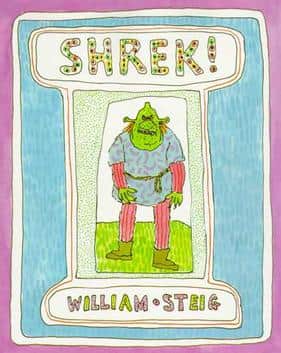
Shrek has grossed over $1 billion across its film franchise, spawned four movies, a spin-off series, a Broadway musical, and one of the most recognizable characters in animation history.
Almost none of that exists in the book it's based on.
In 1990, author and illustrator William Steig published a picture book called Shrek! — a slim, strange, darkly funny story that DreamWorks would eventually option, reshape, and turn into a global franchise. The character survived. Almost everything else about him did not.
This is the story of where Shrek actually came from — and how little of the original made it to the screen.
“Did you ever see anybody so disgusting: said lightning to thunder, "never," growled thunder, "let's give him the works.” ~ William Steig, Shrek!
The Man Behind the Monster — Who Was William Steig?
Before Shrek became a beloved movie character, he was brought to life by an 83-year-old cartoonist who had dedicated most of his career to drawing for The New Yorker.
William Steig, born in New York City in 1907, came from a family deeply rooted in the arts. In 1968, he took a bold step and published his first children's book, Roland the Minstrel Pig, marking a fresh start in his career at a time when most would be winding down.
By the time Shrek! hit the shelves in 1990, Steig had already made a name for himself as one of the most celebrated figures in American children's literature, boasting both the Caldecott Medal and the Newbery Medal—two of the most prestigious awards a children's author and illustrator can achieve.
A Career Built on Strange, Wonderful Characters
Steig's books had a unique charm that really distinguished them from the typical children's literature of his time. His tales revolved around characters who were quirky, a bit scary, or just plain unconventional compared to the usual fairy-tale heroes — yet they still found their place in the world.
For instance, in Sylvester and the Magic Pebble, we meet a donkey who accidentally turns to stone. Then there's Doctor De Soto, featuring a mouse dentist who bravely treats animals that are much bigger and more intimidating than he is. While there’s always a hint of darkness in his stories, there's also a comforting warmth that shines through. Shrek! fits right into this mold, even if its main character doesn’t exactly resemble the typical hero you’d expect in a story about finding belonging.
Why Steig Matters to the Shrek Story
Understanding who Steig was is crucial because it sheds light on what Shrek! truly represents. This wasn’t just a cynical attempt to kick off a franchise; it was a picture book crafted by an 83-year-old literary giant who had been penning these quirky, humorous, and darkly human tales for kids for two decades. Released on October 17, 1990, by Farrar, Straus and Giroux, the book is a mere 30 pages long—a delightful picture book rather than a hefty novel.
Upon its release, it received a warm welcome from critics, who lauded the illustrations, the originality of the concept, and the writing itself. However, at that time, it wasn’t seen as a franchise. That shift happened eleven years later, transforming almost everything except for the core idea.
The Legacy Steig Left Behind
William Steig passed away in 2003, two years after the release of the DreamWorks film that would make his creation globally famous. He lived long enough to see Shrek become a cultural phenomenon — but the version that became one is almost unrecognizable from the one he drew and wrote by hand in his eighties.
That gap is where the real story begins.
What the Original Shrek Story Actually Is
If you strip away all the movie magic and the familiar elements of the original Shrek, you'll find that the true story is actually a fairy tale told in reverse, flipping every traditional value on its head.
The book centers around a grotesque monster who ventures out into the world and ultimately ends up marrying an unattractive princess. That's the whole story right there—just thirty pages long, one quest, and one wedding. Forget about the swamp kingdom, the fairy-tale realm, Lord Farquaad, and the catchy soundtrack.
Meet the Real Shrek
From the very first pages, Shrek is painted as incredibly ugly—so much so that he’s described as being uglier than both of his already unattractive parents put together. He can spit fire nearly a hundred yards and puff out smoke from his ears, but instead of being disgusted by these traits, Shrek takes great joy in his own hideousness.
The story flips traditional morals on their head, as Shrek truly believes that what’s considered bad is actually good, and vice versa. This means that, by the standards of his own kind, he’s acting quite nobly throughout the tale. He’s not some hidden hero waiting to be revealed; he’s exactly who he appears to be, and he’s perfectly okay with that.
Kicked Out and Loving It
At the beginning of the story, Shrek's parents make the decision to send him out into the world to fend for himself — and he embraces it wholeheartedly, taking delight in watching flowers droop and trees bend away as he strolls by. There’s no hesitation or nostalgia for home. Shrek steps out the door and instantly starts reveling in his freedom.
This is one of the book's standout features — the complete lack of the typical "outsider yearning to belong" storyline that so many fairy tales, including the movie adaptation, rely on. Book Shrek isn’t looking for acceptance from the world. Instead, he’s eager to venture out and scare it, and that’s exactly what he does.
The Quest, the Witch, and the Prophecy
As Shrek makes his journey, he crosses paths with a witch who shares tales of a rather unattractive princess and gives him directions from a chatty donkey. This witch plays the role of a classic fairy-tale guide, but instead of offering typical advice, she’s more about boiling bats in turpentine and mixing in some turtle juice.
In a twist on the usual fairy-tale narrative, Shrek isn’t just a victim of circumstance; he’s actively searching for a bride who actually wants to be with him—someone as monstrous as he is, both looking for the same thing. It’s a love story, just not your typical one.
The Princess — And the Ending
In the story, the princess that Shrek eventually encounters is portrayed as the most astonishingly ugly princess you could ever imagine. When they finally come face to face, both are instantly thrilled by each other's hideousness — it’s a Love at First Sight moment that’s all about mutual repulsion instead of the usual kind of attraction.
On the surface, it follows the classic fairy tale formula — there’s a quest, a witch, a dragon, a princess, and a marriage. But what Steig really turned on its head is the underlying value system. Here, beauty isn’t the ultimate goal, and ugliness isn’t a barrier. The tale wraps up happily because both characters embrace who they truly are, and that’s more than enough.
The Powers, the Donkey, and the Details the Movie Left Behind
If you come to the original Shrek! book expecting to find the foundations of the franchise you grew up with, you will find some of them. The donkey is there. The quest structure is there. The ugly princess is there. What you will not find is almost anything else.
Book Shrek vs Movie Shrek — The Powers
This is where the differences between the two versions really stand out. In the book, Shrek has some wild abilities that never made it to the big screen — like swallowing lightning, shooting laser beams from his eyes, and even breathing fire! There’s a moment in the story where Shrek faces off against a gigantic dragon and takes it down using the electrical power he absorbed after gulping down thunder and lightning earlier in his adventure.
The DreamWorks version of Shrek is tough, headstrong, and can be quite unpredictable in a fight — but he definitely doesn’t have laser vision. The book version, on the other hand, is way more supernatural and a lot more dangerous.
The Donkey — Same Character, Very Different Role
In the book, the donkey has a unique alliterative way of speaking, and unlike his movie counterpart, he's big enough for Shrek to actually ride. He serves as a guide, a talking animal in a world where all the other animals act like regular creatures, rather than the chatty comedic sidekick that Eddie Murphy brought to life in the films.
The donkey in the book is there to help Shrek find the princess and keep the story moving along. In contrast, the film version, voiced by Eddie Murphy, blossomed into one of the standout roles of his career — a character so richly developed that he eventually earned his own spin-off specials, a wife (the Dragon from the first movie), and a whole bunch of kids named Debbie, Coco, Bananas, Peanut, Parfait, and Eclair. None of this backstory is found in the book.
The Language and the Style
One of the most noticeable differences between the book and the films lies in the style rather than the storyline. In Shrek!, every character has a knack for speaking in rhyme or alliteration, creating a playful verbal rhythm that flows throughout the text. This gives the book a delightful read-aloud quality that the film simply can't capture in the same way.
The book is brimming with tongue-twisting poems and clever lines that truly shine when read aloud. It’s packed with absurd yet intentionally funny moments that are sure to elicit giggles from kids and knowing chuckles from the adults reading along with them.
What the Movie Kept and What It Didn't
To be completely honest, the movie really only kept a few key elements. We’ve got the name Shrek, the basic idea of an ugly ogre going on a journey with an ugly bride, and of course, a talking donkey. Plus, there’s that core message about how a character deemed hideous by society can still find happiness in the end.
Everything else? That’s all DreamWorks' original creation. The swamp, Far Far Away, Lord Farquaad, Princess Fiona's curse, the fairy-tale characters, and the pop culture references — they were all crafted by the writers at DreamWorks. TV Tropes even points out that while Shrek! inspired the 2001 film and the franchise that followed, it did so "only very loosely," and honestly, that might be putting it mildly.
From 30-Page Picture Book to Billion-Dollar Franchise — How It Happened
The journey from William Steig's 30-page picture book to one of the most successful animated franchises in history is not a straight line. It involves a studio, a team of screenwriters, and a series of creative decisions that moved progressively further from the source material with each step.
DreamWorks and the Adaptation
The book hit the shelves in 1990, and then the DreamWorks Animation film made its debut eleven years later in 2001, kicking off a franchise that would eventually rake in billions worldwide. The character of Shrek was brought to life on screen by a talented writing team that included Ted Elliott, Terry Rossio, Joe Stillman, and Roger S. H. Schulman. These four writers took a 30-page picture book and expanded it in every direction imaginable.
While the film shares its main character and basic concept with Steig's original book, the universe it creates and the story it unfolds are largely fresh and original.
What the Films Added
The changes are so significant that they really create a whole new narrative. We see the swamp as Shrek's cozy home, the enchanting kingdom of Far Far Away filled with its human characters, and Lord Farquaad stepping in as the villain. Then there's Princess Fiona, who deals with her shapeshifting curse, which adds a lovely romantic twist to the story. Plus, we can't forget the quirky fairy-tale creature sidekicks like the Gingerbread Man, Pinocchio, and Puss in Boots. The franchise is also known for its unique pop-culture humor and catchy soundtrack.
As the series progressed, Shrek ended up marrying Princess Fiona, becoming a dad to three kids—Fergus, Farkle, and Felicia—and even taking on the role of a temporary ruler in Far Far Away. None of this is found in Steig's original book, which wraps up right at the wedding. The films, however, expanded this universe into something much larger and richer.
The Franchise by the Numbers
It's hard to truly grasp the magnitude of what DreamWorks created from just 30 pages of Steig's work. The first Shrek movie raked in over $480 million worldwide, all from a production budget of around $60 million. Then came Shrek 2 in 2004, which soared to over $920 million globally. When you look at the entire franchise—spanning four films, spin-offs, a Broadway musical, merchandise, and even theme park attractions—it’s clear that it has brought in well over $1 billion in total revenue.
Now, there's exciting news: a fifth Shrek film is in the works at DreamWorks! Fans can look forward to seeing familiar faces, as both Mike Myers and Eddie Murphy have been confirmed to return—more than twenty years after it all started with a simple 30-page picture book about an ogre who had a soft spot for wilting flowers.
What Steig Thought of It
Steig didn't say much publicly about the DreamWorks adaptation, but his comments were generally positive. He seemed to really enjoy the film and appreciated that it captured the essence of his original idea—that beauty shouldn't be the measure of worth—even though it changed almost everything else. Whether he ever imagined that his 30 pages would evolve into such a grand production is another story.
He passed away in October 2003, just two years after the first film hit theaters, having witnessed his creation transform into one of the most iconic characters in the world of modern animation.
Why the Original Book Still Resonates — And What It Gets Right That the Movies Don't
Given how little of Steig's original book made it into the franchise, it would be reasonable to assume the book had been forgotten. It has not been. If anything, the viral comparisons between source material and adaptation have given it a second life — introducing it to audiences who had no idea it existed.
The Core Message That Both Versions Share
No matter how different the tone, plot, powers, or supporting characters may be, the thread that ties Steig's book to the DreamWorks films is the same core idea that has always made the Shrek story resonate: it’s about someone who’s been told by the world that they don’t fit in, yet they discover happiness—not by changing who they are, but by finding someone who loves them just as they are.
At its heart, the book conveys a powerful message about acceptance—both of oneself and of others. It encourages readers to push back against societal pressures that dictate what beauty should look like and to embrace the uniqueness of individuality. Remarkably, this message has remained intact through the adaptation. In fact, it might just be the only element that truly did.
What the Book Does That the Movie Cannot
The book's short length is, interestingly, one of its biggest advantages. At just 30 pages, Steig doesn't have to delve into the details of Shrek's world, explain his backstory, or create a deep emotional journey. The artwork, though a bit grotesque, perfectly matches the tone, blending image and text in a way that feels more humorous than scary.
In the book, Shrek's frightening presence is kept in check — characters might scream or faint when he shows up, but nothing too extreme happens. This keeps the mood light enough for little ones while still offering plenty of enjoyment for adults reading aloud. The playful rhymes and alliterative phrases make it a joy to read out loud, enhancing those shared reading moments.
The film, on the other hand, had a much tougher job — it had to create a whole world, fill it with characters, and maintain that over two hours and eventually four films. That kind of storytelling comes with compromises that the book simply didn’t have to face.
The Ending That the Book Gets Right
The book wraps up in a straightforward way. Shrek discovers his not-so-pretty princess, and they’re overjoyed to be together. They tie the knot, and that’s that.
There’s no last-minute plot twist, no villain to vanquish, and no moral lesson spelled out in dialogue. The joy of both characters comes from finding someone who mirrors them perfectly — and Steig has faith in the reader to appreciate that without needing it to be emphasized.
While the films reached a wider audience, the book delivered a more satisfying conclusion.