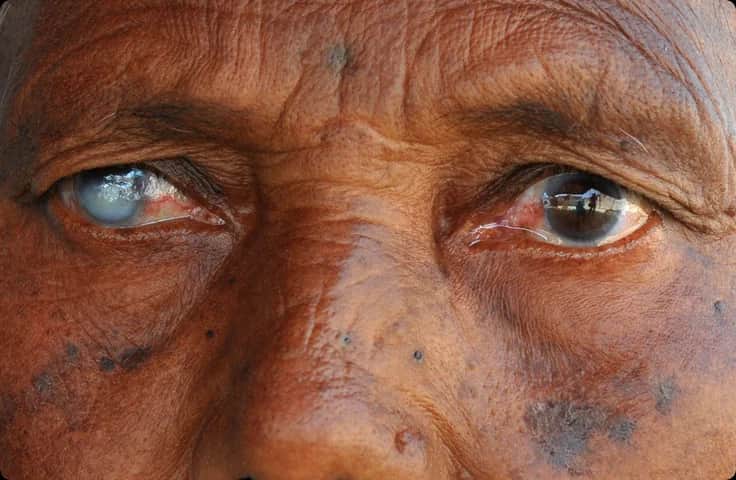
Every philosopher had an opinion. It took 315 years and five surgeries to get the actual answer. Nobody was ready for it.

In 1688, an Irish scientist named William Molyneux wrote a letter to the philosopher John Locke.

Inside was a riddle.

It sounded simple.

It was not.

"

Suppose a man born blind has learned to distinguish a cube from a sphere by touch. If his sight is restored, could he tell them apart just by looking — without touching them?

— William Molyneux, in a letter to John Locke, 1688

Think about it before you read on.

A person blind from birth knows what a sphere feels like. Smooth, curved, continuous. They know what a cube feels like. Flat planes, sharp edges, corners. They can tell them apart instantly by touch.

Now give them sight. Put both objects on a table. No touching. Just looking.

Could they tell which is which?

Most people say yes. Of course. You already know the shapes. You just have a new way of seeing them. The knowledge should transfer. It seems obvious.

Three Centuries of Argument

It was not obvious to the people who thought about it carefully.

Locke said no. Touch and sight are separate languages, he argued. Knowing a shape by hand doesn't mean you'll recognize it by eye. The brain would need to learn the connection from scratch.

Leibniz — one of the greatest minds of the era — said yes. Geometry is geometry. A sphere is round whether you feel it or see it. The mind would make the connection through reason alone.

The argument became one of the most famous unsolved problems in philosophy. It sat at the intersection of perception, consciousness, and the relationship between body and brain.

For over three hundred years, nobody could settle it. Because to answer it, you needed something philosophy couldn't provide — someone born blind who could suddenly see.

Then Five People Opened Their Eyes for the First Time

Dr. Pawan Sinha, a neuroscientist at MIT, led Project Prakash — a humanitarian initiative providing sight-restoring surgeries to people in India who had been blind from birth, primarily due to dense cataracts.

The project gave them the gift of sight. It also gave science the answer to a 315-year-old riddle.

Within 48 hours of gaining functional vision for the first time, five patients were tested. They were shown objects they already knew by touch — spheres, cubes, simple shapes they could identify in an instant with their hands.

Then they were asked to identify them by sight alone.

They could not.

Molyneux was right. Locke was right. After three centuries, the answer was no.

315 Years
From the day the riddle was posed to the day it was answered by experiment
48 Hours
After gaining sight, patients could not match what they felt to what they saw
No
The answer — touch and vision do not automatically share knowledge

But Here Is the Part That Changes Everything

The patients weren't confused. Their brains were working perfectly.

The problem was deeper.

When they opened their eyes for the first time, they did not see the world the way you see it. They saw light, color, shapes — but they could not assemble those inputs into meaning. A cube didn't look like a cube. It looked like a flat pattern of light and shadow that their visual cortex had no experience interpreting.

Their hands knew a cube intimately. Their eyes had never met one.

Sight, it turns out, is not a camera that switches on. It is a skill — a vast system of pattern recognition the brain builds from scratch through years of matching what the eyes receive to what the hands feel, what the body moves through, what the world does when you interact with it. Without that experience, visual input is just noise. Beautiful, overwhelming, meaningless noise.

"The subjects could see. But they could not yet understand what they were seeing. Vision without experience is perception without meaning."

— Dr. Pawan Sinha, MIT, on the results of Project Prakash

If that idea hooks you — brains that receive the world but cannot yet read it — Oliver Sacks’s The Man Who Mistook His Wife for a Hat is the book people still reach for: real patients, broken and beautiful perceptual worlds, told with compassion instead of jargon. Check price on Amazon.

The Brain Caught Up. Fast.

Here is where the story turns.

Within days — not months, not years — the patients began to learn. Their brains started building the connections that sighted people spend infancy constructing. They started matching what they saw to what they felt. The visual cortex, starved of input for decades, began wiring itself at a speed that stunned the researchers.

Within a week, most could begin to cross-reference touch and vision. The sphere started to look like a sphere. The cube started to make sense.

The brain was not broken. It was behind. And it was catching up fast.

This was almost as significant as the original answer. It meant that neuroplasticity — the brain's ability to rewire itself — was far more powerful in adults than many scientists had assumed. The answer to Molyneux's riddle was no. But the follow-up — can the brain learn to do it? — was a resounding yes.

What This Tells You About Your Own Eyes

You think you see the world as it is.

You don't.

You see the world as your brain has learned to construct it — through decades of matching visual input to touch, to movement, to sound, to every other sensory stream your body provides. What you experience as "seeing a cube" is not your eyes detecting a cube. It is your brain assembling a lifetime of cross-referenced data and presenting you with a finished product so seamlessly you never notice the construction.

The Project Prakash patients proved it by showing what happens when the construction hasn't been done yet. Working eyes. Working brain. But without the years of wiring, the visual world was meaningless.

You are not seeing reality. You are seeing your brain's best guess — built from every experience you have ever had. And the guess is so fast, so seamless, that you will never notice it is a guess at all.

The Riddle Started With a Man Watching His Wife Go Blind

Molyneux didn't ask the question as an academic exercise.

His wife was going blind. He watched the woman he loved lose her sight and wondered what it would mean if she ever got it back. Would she recognize him? Would she see the world she remembered?

She never regained her sight. She died in 1691.

But the question born from that grief outlived them both by centuries. It passed through the hands of Locke, Leibniz, Berkeley, Diderot, and William James. It became one of philosophy's most elegant unsolvable puzzles.

And then, in a clinic in India, five people who had never seen a sphere were asked to look at one.

They couldn't tell what it was.

A question that started with a husband watching his wife go blind was finally, quietly, answered.

The Point

In 1688, a man watching his wife go blind asked whether sight and touch speak the same language. Philosophers argued for three hundred years. Then five people opened their eyes for the first time, looked at a sphere they had held a thousand times, and did not recognize it. Seeing is not believing. Seeing is something your brain spent a lifetime learning to do. Without that learning, the world is light without meaning. You are not seeing the world. You are building it — one experience at a time. And the construction is so perfect you will never know it is happening.

We may earn a commission from Amazon when you buy through links on this page.

Sources

1. Molyneux, W. (1688). Letter to John Locke. Reproduced in Locke, J. "An Essay Concerning Human Understanding," Book II, Ch. IX.
2. Held, R., Ostrovsky, Y., de Gelder, B., Gandhi, T., Ganesh, S., Mathur, U., Sinha, P. (2011). "The Newly Sighted Fail to Match Seen with Felt." Nature Neuroscience, 14(5), 551–553.
3. Sinha, P. (2013). "Once Blind and Now They See." Scientific American, 309(1), 48–55.
4. Project Prakash, MIT Department of Brain and Cognitive Sciences. web.mit.edu/bcs/sinha.
5. Locke, J. (1689). "An Essay Concerning Human Understanding." Book II, Ch. IX, Sec. 8.
6. Leibniz, G.W. (1704). "New Essays on Human Understanding." Response to Molyneux's Problem.
7. Sacks, O. (1985). The Man Who Mistook His Wife for a Hat and Other Clinical Tales. Summit Books / subsequent editions.