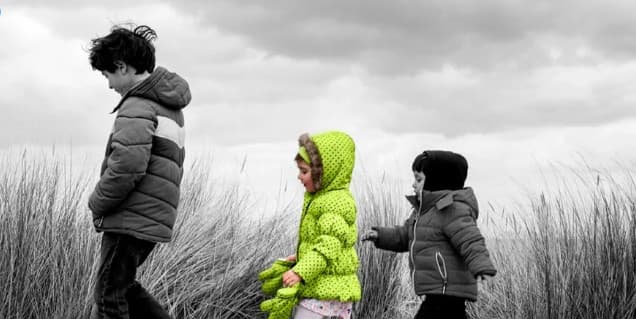
There is something almost poetic about this.
The middle child — the sibling most famous for being forgotten, overlooked, and pushed to the side — is disappearing from existence. And the world has barely noticed.
If you told a middle child their entire demographic was going extinct, they would probably shrug and say "yeah, that sounds about right."
But the data is real. And the story behind it is more interesting than the punchline.
What's Actually Happening
In the 1970s, the most common American family had four children or more. The house was full, the dinner table was loud, and middle children were statistically inevitable — sandwiched siblings everywhere you looked.
Today, nearly two-thirds of women with children only have one or two. As the median family size continues to shrink, middle children are increasingly becoming a rare breed — and the trend is accelerating.
The US birth rate dropped to 1.6 children per woman in 2024, the lowest ever recorded. You cannot mathematically produce a middle child with 1.6 kids. You cannot even produce a middle child with 2. You need at least three — and three is increasingly the exception rather than the rule.
The demographic formerly known as the Middle Child is being quietly phased out by the same forces that produce only children and two-sibling households: housing costs, childcare costs, career demands, the sheer exhaustion of modern parenting, and the growing cultural acceptance of smaller families as a valid choice rather than a failure.
Once again: overlooked by forces completely outside their control. Classic middle child behavior.
My mother never had time for me. When you're the middle child in a family of five million, you don't get any attention.
— Homer Simpson, middle child energy personified
The Science of Being Stuck in the Middle
Birth order theory has been around since the 1920s, when Austrian psychologist Alfred Adler first argued that the order in which children are born significantly shapes their personalities. His take on middle children was not exactly flattering: even-tempered but perpetually struggling to fit in, sandwiched between a firstborn who gets all the responsibility and a youngest who gets away with everything.
Modern research has complicated that picture considerably. A 2021 study found that middle children were more likely than their older siblings to exhibit prosocial traits like kindness and collaboration. Research from 2024 found that middleborns scored high on honesty, humility, and agreeableness. In studies, 85% of middle children showed openness to new experiences, compared to just 50% of firstborns.
The American Psychological Association, for its part, notes that birth order is not a reliable predictor of any specific psychological outcomes. Which is exactly the kind of lukewarm institutional assessment a middle child would receive.
What the Middle Child Actually Produces
Here is where the story gets genuinely interesting — and slightly infuriating for every oldest and youngest child reading this.
Warren Buffett, Bill Gates, and Mark Zuckerberg are all middle children. All three belong to the $100 billion club, which has just 14 members globally. Nelson Mandela was a middle child. Martin Luther King Jr. was a middle child. Susan B. Anthony — who was arrested at 52 for the crime of voting — was the second of seven children. Walt Disney, Madonna, Michael Jordan, Jennifer Lopez, Anne Hathaway, and Abraham Lincoln were all middle children.
The pattern, according to researchers who study birth order, is not accidental. Middle children develop specific skills precisely because of their position: they are natural negotiators, because they have to be. They learn to see multiple sides of an argument. They are empathetic, adaptable, and practiced at compromise. They build strong friendships because they cannot rely on their family position to give them automatic status.
They become excellent at fairness and justice — because they spend their entire childhoods watching the oldest get privileges and the youngest get pampered, and feeling the gap between those two things personally.
Psychology Today puts it plainly: middles are justice seekers. They side with the underdog. They practice what they preach. And they are skilled enough at negotiation that when they get to a boardroom or a political office, they tend to be very, very good at it.
Middle children are used to not getting their own way — so they become savvy, skillful negotiators. They can see all sides of a question and are empathetic and judge reactions well. They are more willing to compromise. They have lower self-esteem than other birth orders — but this can actually be a positive, as they don't have huge egos. — Psychology Today
What Most People Don't Know About This
There is actually a National Middle Child Day. It was created in the 1980s by a woman named Elizabeth Walker, who felt that middle children were "left out" and deserved their own official recognition.
It is celebrated on August 12th. You probably didn't know that. Neither did most people. Because it is the middle day of August — not the first, not the last — and it gets almost no coverage. This is either a cosmic accident or the universe has a sense of humor.
What most people also don't know: while middle children are declining in number, the desire for larger families is quietly ticking back up. Roughly 41% of US adults now say families of three or more children are ideal — the highest that number has been since 1997. That does not mean families are actually getting bigger, but it is the first meaningful shift in that preference in decades.
There is also a California winery called Middle Sister that makes wine with names like Rebel Red, Sweet and Sassy Moscato, and Goodie Two Shoes Pinot Grigio. This exists. It is extremely on-brand. The middle child turned their personality archetype into a wine brand before anyone else could — because that is exactly the kind of scrappy, independent, overlooked-but-quietly-thriving move that middle children make.
Research has also found something quietly alarming that tends not to make the headlines: while middle children are far less likely to attempt suicide than other birth orders, when they do, they are eight times more likely to need medical intervention. The takeaway from researchers is not to panic — it is to pay attention. Middle children rarely cry wolf. When they signal distress, it tends to be real.
Once again: they ask for less. They need it more quietly. They cope alone by default. The patterns hold.
The Point
The middle child is statistically disappearing, and the world has barely paused to acknowledge it. Which is objectively the most middle child outcome possible. But here is what the data actually shows: the traits that made middle children feel invisible in their families — the negotiating, the empathizing, the seeing-all-sides, the stubborn self-reliance, the quiet drive for fairness — produced an outsized share of the world's most consequential people. Nelson Mandela. Martin Luther King Jr. Bill Gates. Warren Buffett. Susan B. Anthony. They were all stuck in the middle. And they changed everything. The middle child is going extinct. But the things they build don't die with their birth order.
Sources
- Pew Research Center — Middle children have become rarer, but a growing share of Americans now say three or more kids are 'ideal' — pewresearch.org
- NPR — With American Families Shrinking In Size, The Middle Child May 'Go Extinct' — npr.org
- OPB / NPR — People are having fewer kids. Their choice is transforming the world's economy — opb.org (Oct 2025)
- Healthline — Is Middle Child Syndrome Real? Here's What You Need to Know — healthline.com
- Psychology Today — The Secret Powers of Middle Children — psychologytoday.com
- Entrepreneur — Billionaires Warren Buffett, Bill Gates and Mark Zuckerberg Are All Middle Children — entrepreneur.com (Oct 2024)
- NC Medical Society — Today is National Middle Child Day — ncmedsoc.org
- WebMD — Middle-Child Syndrome: The Effects of Birth Order on Character Traits — webmd.com