She used to be beautiful.
That is the part of the story that most people don't know — or can't quite believe — when they first see the photograph. The wide brow. The protruding jaw. The features that seem to have been rearranged by something catastrophic. But before all of that, Mary Ann Bevan was a tall, poised London nurse with a husband, four children, and an ordinary life that she loved.
Then a disease took everything. And she decided — with a clarity that is almost impossible to fully comprehend — that the only way left to protect her children was to let the entire world laugh at her face.
She did it. For years. And it worked.
Before
Mary Ann Webster was born on December 20, 1874, in Plaistow, East London, one of eight children in a working-class family. She became a nurse and in 1902 married Thomas Bevan, a farmer from Kent, with whom she had four children.
It was not a glamorous life. It was not a dramatic life. It was the life of a woman doing everything right — working, building a family, making a home — and finding it sufficient. She was described as attractive. She was healthy. She had steady hands and a steady income and a husband who loved her.
Then, sometime in her early thirties, her body began to betray her.
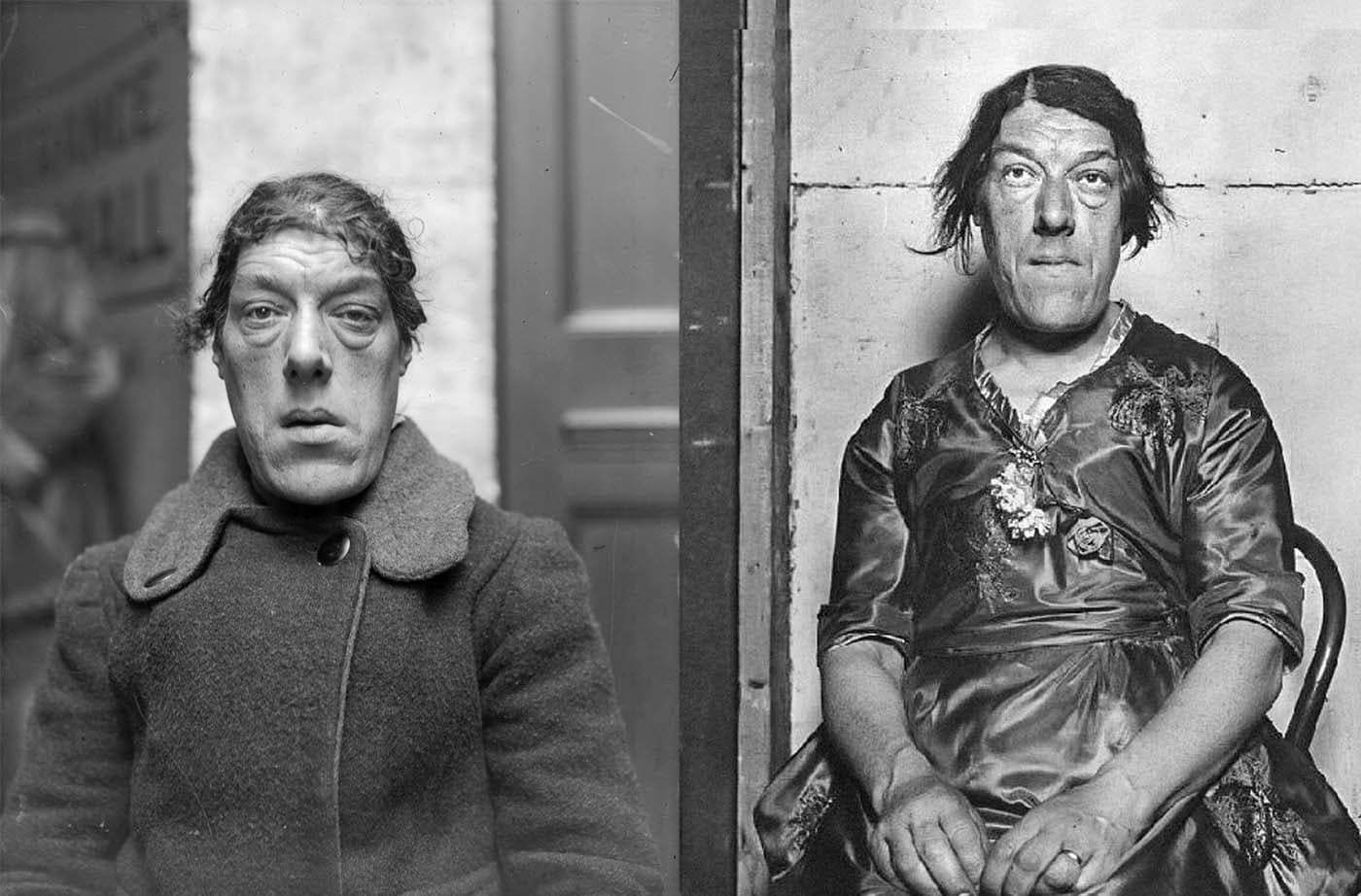
She began to suffer from abnormal growth and facial distortion, along with severe headaches and fading eyesight. Her hands and feet grew. Her brow protruded. Her nose expanded. Her jaw pushed forward. The face in the mirror became less recognizable with every passing month — and there was nothing she could do to stop it.
Acromegaly is a disorder in which the pituitary gland overproduces growth hormones, causing adults to suddenly begin growing again. Today it can be treated if detected early enough. Under the limitations of early 20th-century medicine, Bevan had no way of treating or preventing the condition.
In 1914, Thomas died suddenly. He had stood by her through the illness. Now he was gone. She was alone with four children, a disfiguring disease, and a world that had very limited patience for either.
This unfortunate woman who sits in the sideshow of Ringling Brothers 'between Fat Lady and Armless Wonder' has a story which is far from mirth-provoking. She, previously a vigorous and good-looking young woman, has become the victim of a disease known as acromegaly. Being a physician, I do not like to feel that Time can be frivolous over the tragedies of disease.
— Dr. Harvey Cushing, Neurosurgeon, in a letter to TIME Magazine, 1927
The Decision
There is a moment in every desperate life where the options run out. Mary Ann Bevan reached that moment as a widow with four hungry children and a face the world had decided to use as a punchline.
Faced with mounting bills and few prospects, she entered a local "Ugliest Woman" contest, triumphing over 250 other contestants. She did not do it for attention. She did not do it for fame. She did it because it was the only door left open.
Then she saw a newspaper advertisement: "Wanted: Ugliest woman. Nothing repulsive, maimed or disfigured. Good pay guaranteed, and long engagement for successful applicant. Send recent photograph." It had been placed by Claude Bartram, the European agent for the American circus Barnum and Bailey, who had just returned from Europe after a fruitless mission to find "new season freaks."
She sent her photograph. She got the job.
Her doctor confirmed that her condition would only worsen. The circus had a long-term interest in keeping her employed. The grotesque logic of her situation had accidentally produced something like job security.
The Work
In 1920, she was hired by American showman Samuel W. Gumpertz to appear at Coney Island's Dreamland sideshow. She was paraded alongside Lionel the Lion-Faced Man, Zip the "Pinhead," and Jean Carroll the Tattooed Lady. Dreamland visitors were invited to gawk at the 154 pounds she carried on her 5'7" frame, her size 11 feet, and her size 25 hands.
People came to stare. To point. To laugh. She sat there and let them.
"Smiling mechanically, she offered picture postcards of herself for sale," contemporary accounts noted, securing money for herself and for her children's education. She resented being pitied. She was pleasant to talk to. She did not complain publicly. She simply sat, and smiled, and sold the postcards, and endured.
She also found an unexpected friendship with a giraffe keeper named Andrew. She agreed to a makeover at a New York salon — manicure, massage, hair treatment, rouge. Upon seeing her reflection afterwards, she simply said, "I guess I'll be getting back to work."
She went back to work.
What Most People Don't Know About This
Mary Ann Bevan was not a passive victim of her circumstances. She was a strategist.
She negotiated. She secured not just a flat wage but a share of ticket sales and royalties from the postcards sold in her image. She got a piece of the ticket sales and other types of royalties — each time a stamp was sold, she made the equivalent of $12 in today's money. She understood what the circus wanted from her — reliable, escalating spectacle — and she used that leverage to build a financial cushion for her children's futures.
She put her four children in boarding school. Although she missed them terribly, she wrote to them regularly, and knowing that their futures were secure helped her endure the humiliation.
What most people also don't know: more than seventy years after her death, her image was used without permission on a Hallmark birthday card sold across the United Kingdom — a card making jokes about blindness and ugly dates. A Dutch endocrinologist, Dr. Wouter de Herder, recognized her face while on holiday in England and filed a formal complaint. Hallmark initially defended the card but reversed course once they learned that the woman was disfigured by disease. They withdrew the card from distribution.
She was still being used as a punchline seven decades after her death. She couldn't stop it in life. A doctor stopped it for her after she was gone.
Her physician in life — the celebrated neurosurgeon Harvey Cushing — had tried to defend her dignity too. In 1927 he wrote a letter to Time magazine to protest their mockery of his patient: "Being a physician, I do not like to feel that Time can be frivolous over the tragedies of disease."
Nobody at the circus was asking those questions. Nobody in the crowd was asking them. But the doctors who knew her actual story — who knew what she had been before the disease, what she was choosing every day she sat in that chair — saw something different from what the audience saw.
"She went on to draw huge crowds, overshadowing bearded ladies, conjoined twins, little people, giants and people with physical disabilities." She bore the humiliating treatment calmly. She knew exactly what she was doing. She was paying her children's school fees, one postcard at a time.
The End
Mary Ann Bevan continued working in sideshows until her health declined due to the complications of acromegaly, which caused increasing pain and blindness. She died on December 26, 1933, at the age of 59. She was interred at Brockley and Ladywell Cemeteries in London.
Her children were educated. Her children were grown. Her children had what she set out to give them — stability, opportunity, a future that did not look like hers. She had done the thing she came to do.
The crowds had come to see a freak. What they were actually looking at was a woman who had made a calculation — cold, clear, and completely unselfish — about what her life was worth and what she would spend it on.
She spent it on her children.
Every single day.
The Point
Mary Ann Bevan was a London nurse who developed an incurable disease, lost her husband, and found herself in a world with no use for her except as a spectacle. She looked at that world, understood it completely, and decided to use it. She did not ask for sympathy. She did not wait for rescue. She sat in the sideshow chair — through the laughter, the pointing, the cruel jokes, the postcards sold of her own disfigured face — and she earned enough to give her children boarding school, education, and futures. The crowd thought they were watching a freak show. They were watching an act of love so total and so costly that most of us will never come close to understanding it.
Sources
- Wikipedia — Mary Ann Bevan — en.wikipedia.org
- Rare Historical Photos — Mary Ann Bevan: The Tragic Story of the 'Ugliest Woman in the World' — rarehistoricalphotos.com
- All That's Interesting — Meet Mary Ann Bevan, The 'Ugliest Woman In The World' Who Supported Her Family By Joining A Sideshow — allthatsinteresting.com
- Commonplace Fun Facts — Mary Ann Bevan: The Unlikely Heroine Behind the Cruel Title — commonplacefacts.com
- MedBound Times — Mary Ann Bevan: The Tragic Story of a Nurse Labeled 'The Ugliest Woman in the World' — medboundtimes.com
- Sinister Isles — 'The World's Ugliest Woman' Mary Ann Bevan made freak show sacrifice for her kids — sinisterisles.com
- PMC / BMJ — Doctor protests at greeting card manufacturer making fun of woman with acromegaly — pmc.ncbi.nlm.nih.gov (2006)
- Yahoo / Creators — She Was Mocked As the Ugliest Woman in the World — creators.yahoo.com