Anthony Omari had every reason to flee, but he chose to stay put.
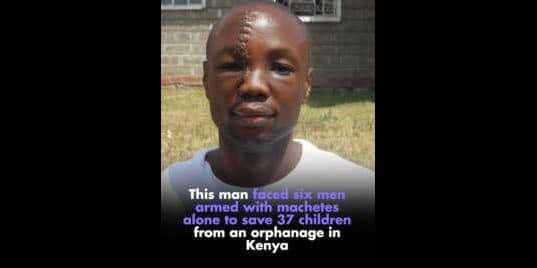
In January 2012, the Faraja Children's Home in Ngong, Kenya — an orphanage that looked after 37 abandoned and orphaned kids — was broken into for the fourth time that month. Omari, who was just 24 at the time, grabbed a hammer from under his bed and bravely chased the armed intruders out of the building.
You’d think that would be the end of it. But it wasn’t.
As he turned back to reassure the frightened children, one of the attackers swung a machete and struck him across the face. Even with the painful wound, Omari managed to lock the front door before he collapsed.
This is the story behind the scar that brought him recognition — and the choice that often goes unnoticed: just two days later, he left the hospital and headed straight back to the orphanage.
I'm trying to tell them go back, but they were not listening, so I turned and was rushing to close the door, close them in. That's when I think one of them got me with that double-edged sword, he got me in the face. So it was painful for a few seconds.
anthony omari, AFRICAN HISTORY GROUP, 2012
The Home Anthony Omari Was Protecting
To understand what Anthony Omari did on the night of January 23, 2012, you first have to understand what Faraja Children's Home actually was — and how much was at stake inside its walls.
From a One-Room Shack to a Home for 37 Children
The Faraja Children's Home began its journey in 2006, starting from a tiny one-room shack in Kibera, Nairobi's largest slum. It all started when Anthony's mother's youngest son brought home two friends who just never left. As the years went by, that humble tin-roofed shack transformed into a spacious facility in Ngong, just outside of Nairobi, welcoming 37 boys and girls who had been abandoned or orphaned from the streets.
A Mother Who Refused to Turn Children Away
The home was managed by Anthony's mother, Martha Bosire, who depended on donations to cover rent, school fees, medical expenses, and to provide meals for the children she looked after. In Kenya, some parents, struggling with extreme financial difficulties, felt they had no choice but to abandon their newborns because they couldn't afford to feed them. Bosire's home turned into a safe haven for many of these children, as well as for others who had lost their parents altogether.
Anthony's Role at the Orphanage
Anthony Omari called the Faraja Children's Home his home, where he took on the important job of keeping the kids safe, making sure they had their meals, helping them with school, and looking after their health needs. He wasn’t just some far-off administrator; he lived right there with the children he cared for, in the same building, facing the same challenges every day.
A Target Because It Had So Little
It’s a heartbreaking twist that, despite looking after so many vulnerable children, the orphanage found itself under constant threat from armed thieves coming from a nearby slum. The irony is hard to miss throughout the whole story. The home didn’t possess much in terms of material wealth. What it truly had were the children, and even that wasn’t enough to deter the attacks.
The Fourth Break-In — What Happened That Night
By January 2012, the attacks on Faraja Children's Home had become a pattern. What happened on the night of January 23 was the moment that pattern finally broke — at a devastating cost.
A Home Already Under Siege
This wasn’t the first time the orphanage had faced an attack. In fact, it had already been targeted three times that month by thieves thought to be from a nearby tin-shack slum. Each time, Omari had bravely defended the place all on his own. Just days before the last assault, a machete had been hurled at him, barely missing and embedding itself in the wall instead, which forced him to make a quick escape.
The Night the Attackers Broke Into His Room
On the night of January 23, 2012, a group of thieves broke into the room where Anthony was sleeping and made off with his belongings. When Omari woke up to find armed intruders in his room, he quickly grabbed a hammer he had stashed under his bed and bravely charged at them, forcing the intruders to flee.
The Moment Everything Changed
As Omari turned around to reassure the terrified, screaming children, one of the assailants swung a machete and struck him hard across the face. The blow opened a deep gash, drenching his clothes in blood, all while the young, traumatized orphans looked on in horror.
He Locked the Door Before He Collapsed
Even with a terrible wound, Omari somehow managed to secure the front door before he fell to the ground. He later recounted the frantic moment when he tried to guide the children back to their room: "I was telling them to go back, but they just wouldn’t listen. So, I turned and hurried to shut the door, to keep them safe inside. That’s when..." — the machete hit.
The Aftermath — Stitches, Recovery, and Going Straight Back
What happened after the attack reveals as much about Anthony Omari's character as the attack itself — perhaps more.
Eleven Stitches and a Permanent Scar
Omari now sports an 11-stitch scar that stretches from his forehead down to his upper lip — a permanent reminder of the night he bravely stood up to a group of machete-wielding thugs to protect the orphanage. The wound was so serious that he had to be rushed to the hospital right after he collapsed at the front door.
Refusing to Stay Away
Just two days after being discharged from the hospital, Omari was back at the orphanage, determined not to leave the kids unprotected any longer. There was no lengthy recovery time, no chance to reflect on what he had been through. He stepped right back into the same building, surrounded by the same children, facing the same dangers — almost instantly.
The Psychological Toll He Later Described
Years later, Omari opened up about how that night still lingers in his mind. He shared, "I can tell you: it's not over yet. Even my body has adjusted. I find myself waking up at night just to check on my kids. It really hit me hard. I think I became way too overprotective with them." He also mentioned that he prefers not to be reminded of what happened on January 23.
A Story That Almost Went Untold
Even though Omari's achievements were truly remarkable, his story might have remained under the radar if not for a serendipitous meeting that brought his name to the forefront. It was a post on Reddit by Ben Hardwick, a 21-year-old intern from Penn State who happened to be in Kenya at the time, that helped spread the word and connect his story with a much larger audience.
How the World Found Out — and Responded
Anthony Omari's act of courage could easily have remained a private tragedy known only to the people of Ngong. Instead, it became a story that moved people across the world to act.
A Reddit Post That Changed Everything
The story took off like wildfire after a Reddit post reached out for help on Omari's behalf, capturing the hearts of people well beyond Kenya. The initial request was for a modest $2,000 in donations to aid Omari and the Faraja Children's Home.
An Outpouring Far Beyond What Anyone Expected
In an incredible show of generosity, over 3,600 donors from all 50 states and 46 countries came together to raise more than $80,000—well beyond the initial modest goal. Even major news outlets like the Associated Press took notice, reaching out to Omari for an interview about the attack and its aftermath.
What the Money Actually Changed
The money we raised went towards putting up a new security fence, hiring guards, and purchasing proper beds—since the kids had been sleeping on the floor before. We also covered other vital needs for the home. For an orphanage that had experienced four break-ins in just one month, these security improvements were far from a luxury. They represented a crucial step towards moving from a state of constant vulnerability to achieving a sense of real safety.
A New Home, A New Chapter
By 2015, the orphanage had moved to a larger new location in Loodarak, Kajiado county — a significant upgrade from the original property in Ngong, made possible in part by the support that followed Omari's story going public.
Where Anthony Omari Is Today
More than a decade after the attack that left him scarred, Anthony Omari's story did not end with the headlines. What he built afterward is, in many ways, just as remarkable as what he survived.
From Orphanage Custodian to Civil Engineer
By 2015, Omari had completed his college journey, earning a degree in civil and structural engineering. Fast forward to today, and Anthony Omari is not just a proud civil engineer; he’s also the owner of his own construction company. It’s quite a remarkable journey, transforming from a young boy who helped manage an orphanage to a dedicated professional carving out his own career and future.
Starting His Own Family
Omari has left the orphanage behind and has begun a new chapter in his life, now as a father of two. This is the same man who once bravely shielded 37 children from armed intruders, even though they weren’t his own. He’s taken that same fierce protective instinct into his own home, ready to nurture and defend his family.
He Never Really Left
Even though Omari has carved out his own life and career, he makes it a point to visit the kids at Faraja almost every weekend. To this day, he remains a steady presence, offering his support to the children at Faraja Children's Home. The scar on his face serves as a lasting reminder of a dark night, but his ongoing dedication to the orphanage symbolizes something much brighter — a promise that has never faltered, even after he could have walked away.
A Legacy Bigger Than One Night
Omari has openly shared how that experience transformed him for good — he’s become more protective, more watchful, and he’ll always carry the weight of that January night with him. Yet, the orphanage he once fought to defend with nothing but a hammer is still there, still nurturing children, now in a bigger and safer place than the one he risked everything to protect. In the end, that’s what his story truly created, even more than the scar he bears.
Sources
https://www.badassoftheweek.com/omari
https://icantbelieveitsnonfiction.com/2020/07/28/anthony-omari/