There's a naming convention in war that almost nobody talks about.
The Vietnam War. The Iraq War. The Afghanistan War. The Korean War. The Libyan intervention. The Syrian campaign. The Somali operation.
Notice the pattern. The country in the name is almost always the country being attacked.
The country doing the attacking rarely gets its name on the label. That would make things much less comfortable — and much more accurate.
Because if wars were named after the initiating power, the history books of the last 250 years would consist almost entirely of one title, repeated on loop.
The Numbers First
This is not opinion. This is dataset.
According to the Military Intervention Project (MIP) at Tufts University's Fletcher School of Law and Diplomacy — the most comprehensive dataset ever compiled on the subject — the United States has conducted nearly 400 military interventions since 1776. That's roughly one every seven months for 250 years
Wikipedia's more expansive accounting, which includes colonial operations and smaller engagements, puts the number closer to 500 military interventions between 1776 and 2026, with half of these operations occurring since 1950 and over 25% occurring in the post-Cold War period.
The Cold War is over. The Soviet threat — the stated justification for decades of intervention — collapsed in 1991. The rate of U.S. military intervention then accelerated.
The Tufts researchers themselves note that their post-9/11 count is "an undercount." Their analysis excludes purely economic warfare through sanctions and diplomatic coercion — which would add many more countries to the list.
None of the countries the US has invaded or attacked previously initiated hostilities against it.
— IBON Foundation analysis of US military interventions since 1945
How It Started
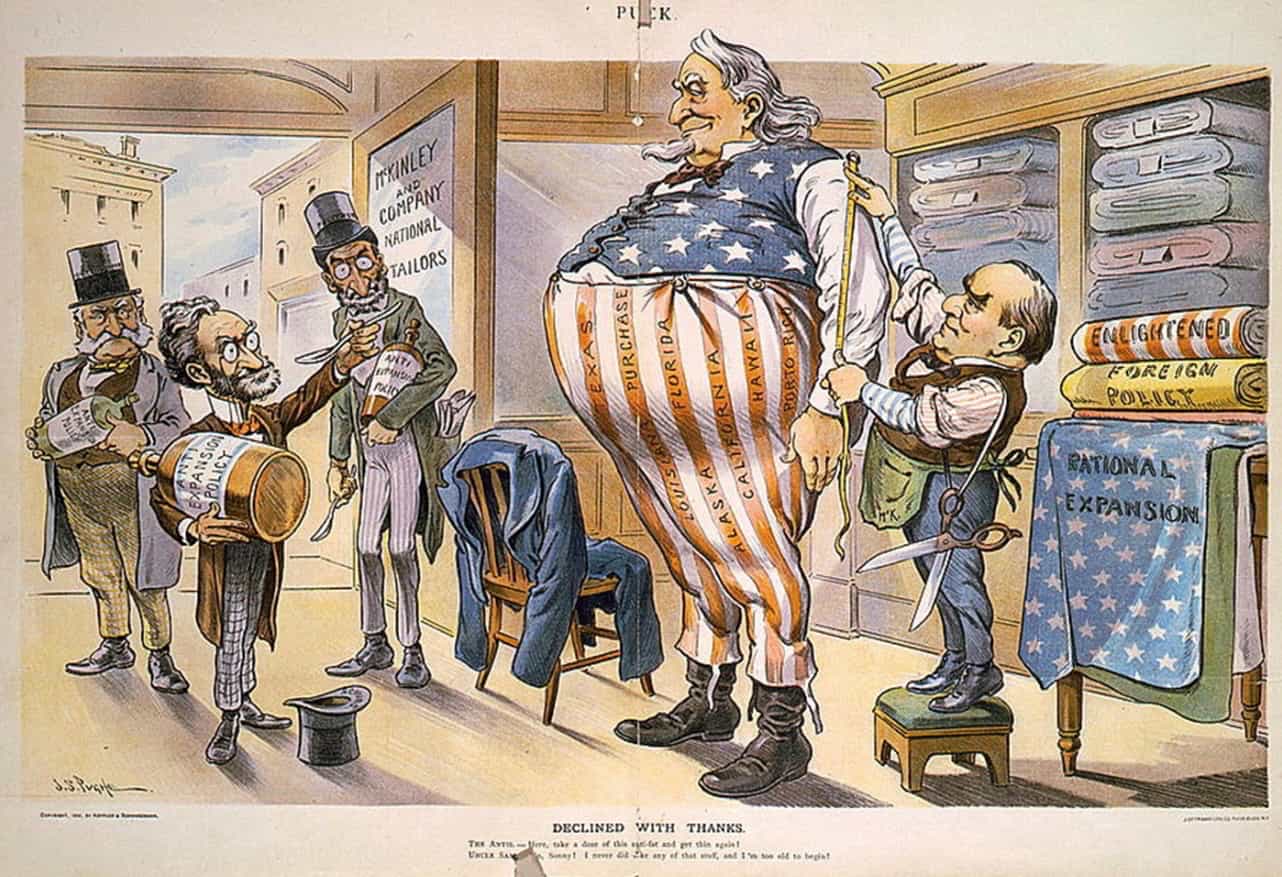
The pattern begins early. The United States was barely a decade old before it was sending naval forces to the Mediterranean to fight the Barbary States. By 1833 it was landing troops in Argentina to "protect American interests." By the 1850s it was intervening in Peru, Nicaragua, and Uruguay. By the 1890s it had seized the Philippines, Cuba, and Puerto Rico from Spain in a single war.
From the late 1800s through the 1930s, the U.S. military intervened repeatedly in the Caribbean and Central America to protect American business interests — particularly those of the United Fruit Company. These so-called "Banana Wars" saw Marines occupy Haiti for 19 years, the Dominican Republic for 8 years, Nicaragua for 21 years on and off, and Cuba multiple times.
These are not the wars that get taught in most classrooms. They do not have famous names. The country in them is not always the one with the superpower military.
The justifications shifted over the decades — protecting trade, fighting communism, fighting terrorism, spreading democracy, enforcing international law — but the geography of the operations remained remarkably consistent. Smaller countries. Weaker militaries. Strategic resources or locations. The language changes. The direction of the planes does not.
The Naming Problem
Language shapes how we remember things. And the language of war naming is very deliberate.
The Vietnam War. The country being bombed is in the name. The country dropping 7.7 million tons of bombs on it — more than all the Allied bombing in World War II combined — is not. The Iraq War. The country that had its infrastructure destroyed and its civilian population killed in numbers that are still contested is in the name. The country that launched a pre-emptive invasion based on intelligence it knew was unreliable is not. The Afghanistan War. Twenty years. The longest war in American history. Named for the country where it was fought, not the country that chose to fight it.
This is not semantics. When a war carries the name of the attacked country, the implicit frame is that the war belongs to that place. It happened there. It was about them. The force that arrived uninvited, that decided when it started, that determined when it ended — that force remains grammatically invisible.
Call a conflict "the US War on Vietnam" and you are describing an American decision. Call it "the Vietnam War" and you are describing a geography. Those are not the same thing.
"Common objectives of U.S. foreign interventions have historically revolved around economic opportunity, protection of U.S. citizens and diplomats, territorial expansion, counterterrorism, fomenting regime change and nation-building, promoting democracy and enforcing international law." — Wikipedia, Foreign Interventions by the United States
What Most People Don't Know About This
Most Americans know about Vietnam. Many know about Iraq. The post-9/11 wars are well documented. What is far less well known is the sheer breadth of smaller, quieter, and deliberately unreported interventions that fill the gaps between the famous ones.
The United States fought naval and air battles against Iran in 1987-1988, including shooting down a civilian airliner killing everyone on board. It invaded Panama in 1989 to overthrow its government. It invaded Somalia in 1992. It occupied Haiti in 1994. It bombed Libya in 1986 and again later. It directed the failed Bay of Pigs invasion of Cuba in 1961. The CIA helped install or support pro-US dictatorships in Iran, Chile, Guatemala, Indonesia, and many other countries during the Cold War.
Most of these are not in the standard curriculum. Several required Freedom of Information requests or declassified documents to confirm. Some are still disputed at the official level.
The U.S. government has acknowledged that its covert operations — particularly those conducted by Special Operations forces under secretive authorities — often evade public documentation. Post-9/11 interventions are almost certainly undercounted by researchers
What most people also don't know: the post-Cold War era, often presented as a period of relative American restraint after the fall of the Soviet Union, actually saw an acceleration of military engagement. More than 25% of all U.S. military interventions since 1776 have taken place in the post-Cold War period alone.The threat that had justified the military apparatus for 45 years disappeared — and the military apparatus kept expanding.
The justification updated. The direction stayed the same.
Why This Still Matters Today
This is not a partisan point. It is a historical record.
The United States has conducted more military operations in foreign countries than any nation in recorded history. That fact is not seriously disputed by historians. What is disputed — constantly, loudly, and with great political energy — is what that record means, who bears responsibility for it, and whether the outcomes justified the costs.
Those are legitimate debates. But they cannot happen honestly if the baseline facts aren't on the table. And for most of the American public, they are not. The gaps in civic education around U.S. military history are not accidental. A population that does not know about the 19-year occupation of Haiti, the CIA-directed coup in Chile, the civilian airliner shot down over Iran, or the 21 years of on-and-off Marine occupation in Nicaragua cannot make informed judgments about foreign policy in the present tense.
The naming of wars is part of that architecture. When the Vietnam War is "the Vietnam War" rather than "the US war in Vietnam," the US is the subject of a history lesson rather than the subject of a reckoning. The grammatical choice is also a political one.
Other countries deal with this too — British imperialism, French colonialism, Soviet interventions — but the scale and recency of U.S. military activity makes it the most consequential current example. The post-9/11 wars in Afghanistan and Iraq alone resulted in an estimated 900,000 deaths and cost over $8 trillion. The people who paid that price with their lives mostly lived in countries whose names ended up in the war titles. The country whose leaders decided to invade them did not.
None of this is ancient history. Eight U.S. military operations are ongoing right now.
They all have names. None of them are called the American War.
The Point
Nearly 500 military interventions in 250 years. Roughly one every seven months. More than a quarter of them after the Cold War ended and the threat that justified building the machine in the first place had disappeared. The wars get named after the countries that were attacked. The country that launched them stays grammatically absent from its own record. You cannot have an honest conversation about American foreign policy without acknowledging that record in full — not selectively, not defensively, not wrapped in the language of exception and necessity, but plainly. The numbers are there. The history is documented. The only thing missing is the name on the label.
Sources
- Wikipedia — Foreign Interventions by the United States — en.wikipedia.org
- DaveManuel.com — Every Country the United States Has Invaded, Bombed, or Staged a Coup In — davemanuel.com (Feb 2026, citing Tufts University Military Intervention Project)
- IBON Foundation — Global victims of US military aggression — ibon.org (2024)
- Wikipedia — Lists of wars involving the United States — en.wikipedia.org
- Zoltán Grossman / Evergreen State College — US Military Interventions Since 1890 — sites.evergreen.edu
- Lapham's Quarterly — American Wars & Foreign Interventions — laphamsquarterly.org
- Wikipedia — Timeline of United States Military Operations — en.wikipedia.org