The pay was good. The work was considered skilled. Management called them artists.
The job was so desirable that young women in New Jersey, Illinois, and Connecticut actively recruited their sisters, cousins, and friends for openings. Dial painting ranked them in the top 5% of female workers nationally. It paid more than three times the average factory wage. It felt like luck.
Some of them painted their teeth with the luminous paint before going out in the evenings, for the radiant smiles it gave them. Some applied it to their nails. They wore their best dresses to work so the fabric would glow brilliantly when they went dancing after their shifts. They were called Ghost Girls — not as a warning, but as a nickname they found charming.
The element making them glow was radium. It was boring holes through their bones from the inside. And the company that employed them had known for years.
How It Worked — and What It Did
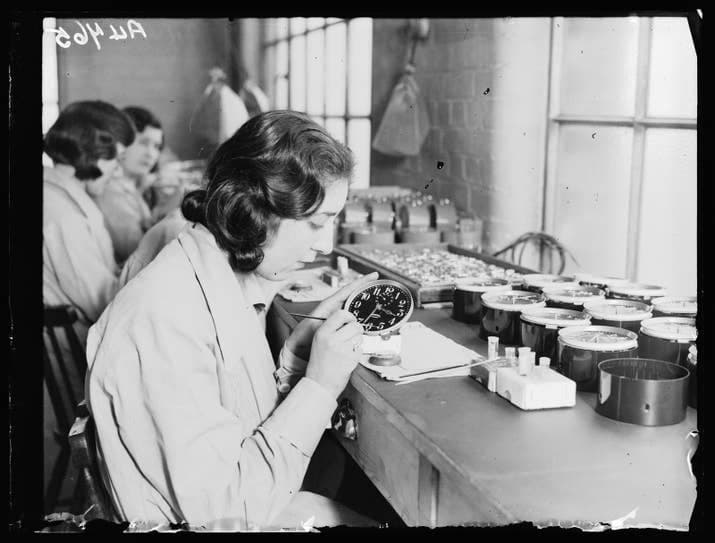
Beginning around 1917, the United States Radium Corporation in Orange, New Jersey began hiring young women to paint glowing numerals onto watch dials, clock faces, and military instruments. The work required extreme precision — fine camel-hair brushes applied to tiny, delicate numbers. The brushes lost their shape after only a few strokes.
The solution management offered was simple: lip, dip, paint. Put the brush between your lips to shape the point. Dip it in the radium paint. Paint the number. Repeat — hundreds of times a day.
When workers asked about safety, they were assured by their managers that radium was harmless. Some were told it would improve their complexions. The radium industry was, at the time, marketing the substance as a health supplement — radium face creams, radium tonics, radium bread. The public had not yet grasped what radium actually was. The women had no reason to doubt what they were told.
The paint they mixed and ingested daily was made from powdered radium, zinc sulfide, gum arabic, and water. Researchers later estimated the women ingested anywhere from a few hundred to a few thousand microcuries — an exposure level up to 20,000 times what would eventually be established as the maximum safe limit for the human body.
Inside the body, radium behaves like calcium. It deposits in bone. And then it stays there, radiating, for decades — for as long as the bone itself lasts.
When you have heard that you are going to die — that there is no hope — and every newspaper you pick up prints what really amounts to your obituary — there is nothing else.
— Raymond Berry, attorney for the Radium Girls, explaining why they sued despite everything
What Happened to Them
The first symptoms appeared around 1920. Stiff joints. Severe toothaches. Mouth sores that would not heal. Dentists across the region began noticing a pattern: young women from the dial factories whose teeth were loose, whose gums were rotting, and whose jawbones crumbled when touched.
Mollie Maggia was among the first to fall seriously ill. When her dentist pressed gently against her jawbone, it broke against his fingers. He removed it — not by surgery, but by lifting it out with his hands. Only days later her entire lower jaw was removed the same way. The disease moved into her throat. On September 12, 1922, it ate through her jugular vein. She was 24 years old.
Her death certificate listed syphilis as the cause. It was a lie her company would later use against her in court.
By 1924, 50 women from the New Jersey factory alone were ill. Dozens had died. Others were developing anemia, bone fractures, collapsed spines, disintegrating hips. Some needed full-body braces just to stand. Some couldn't lift their arms to take an oath in court. Their bones, saturated with radioactive deposits, were literally being eaten from the inside out while they were still alive.
The company response was consistent and deliberate. They denied any connection between the women's work and their symptoms. They hired doctors to examine sick workers and declare them healthy. They suppressed a commissioned report from the Harvard School of Public Health that identified radium poisoning as the cause of the women's illnesses. They told the public the women had syphilis. They argued the statute of limitations had expired, that nothing could be done, that there was nothing to do.
Grace Fryer and the Fight That Changed Everything
Grace Fryer started work at the United States Radium Corporation on April 10, 1917 — four days after the US entered World War I. She was 18 years old. She had two brothers fighting overseas and wanted to do her part.
By the mid-1920s, she understood what was happening to her body. The radium had crushed her vertebrae and she had to wear a steel back brace to stand. She decided to sue.
It took her two years to find a lawyer willing to take the case. When Raymond Berry finally agreed, four other women joined her — Edna Hussman, Katherine Schaub, and sisters Quinta McDonald and Albina Larice, all from the same factory. By the time their first court appearance came in January 1928, two of them were bedridden. None of them could raise their arms to take an oath. A physicist named Elizabeth Hughes measured radioactivity in their breath and testified that all five had ingested so much radium their exhaled air was toxic.
The company, facing a trial it now knew it might lose, agreed to settle out of court in June 1928. Each woman received $10,000 — roughly $175,000 today — plus $600 annually for life and full medical expenses. The settlement also established, for the first time in US legal history, that corporations could be held liable for occupational disease.
Most of the five women were dead within years of the settlement.
The radium had crushed Grace Fryer's vertebrae so she had to wear a steel back brace. But she had the strongest backbone of perhaps all the girls. — Kate Moore, author of The Radium Girls
What Most People Don't Know About This
The New Jersey settlement was not the end. It was the opening shot.
In Ottawa, Illinois, the Radium Dial Company was running a separate operation and had assured its workers that its paint was safe — different from the New Jersey product. When the Illinois women began getting sick and dying with the same symptoms, the company pointed to the New Jersey case and claimed their product was different. By the time the Illinois women realized the truth, the statute of limitations had already expired for most of them.
Catherine Donohue — who became one of the most important figures in the entire story — led fifteen Illinois women in a new lawsuit in 1937. By 1938, she had developed a grapefruit-sized tumor on her hip. She was losing teeth. She picked pieces of her own jawbone out of her mouth with her fingers, using a patterned handkerchief to absorb the pus that seeped constantly from her jaw. She was too ill to attend court.
The court came to her instead. The hearing was held in her sitting room, with Catherine giving evidence from her bed.
The Illinois Industrial Commission ruled in the women's favor. Radium Dial appealed. And appealed again. And again — all the way to the United States Supreme Court. The Court declined to hear the case, upholding the lower court ruling. Catherine Donohue died on July 27, 1938, the day after Radium Dial's attorneys filed what would become their final appeal. She did not live to see the Supreme Court's decision. She had fought to the last breath.
What most people also don't know: when Mollie Maggia — whose death certificate falsely attributed her death to syphilis — was exhumed in 1927 to test for radium, researchers found 48.4 micrograms of radium in her bones. That was 500 times what would later be set as the safe limit for the human body. The radium was still there, still radioactive, still detectable — five years after she died.
Researchers at MIT later determined that the radium in dial painters' bodies has a half-life of 1,600 years. Many of the Radium Girls are still glowing in their graves today.
What Their Suffering Built
The legal battles of the Radium Girls — fought by dying women who knew from the beginning that they had no hope of personal recovery — produced a cascade of regulatory change that still governs workplace safety today.
The Illinois Occupational Diseases Act was signed into law in 1936, directly following the first Illinois cases — requiring employer coverage of industrial poisoning for the first time. The 1928 New Jersey settlement established the legal principle that corporations could be held liable for occupational disease. The scientific research prompted by the dial painters' suffering produced the first national standards for safe radium exposure, published in 1941. And in 1970, the Occupational Safety and Health Administration was created — a direct institutional descendant of everything the Radium Girls had fought for.
Before OSHA, 14,000 people died on the job in America every year. Today, the number is just over 4,500. That reduction represents hundreds of thousands of lives saved over the decades since these women took the stand — and testified from their deathbeds — against the companies that had poisoned them.
Every safety regulation. Every occupational health standard. Every legal precedent holding a corporation accountable for what it knowingly does to the bodies of its workers. All of it has roots in these women — in their diaries, their letters, their court testimonies, their refusal to be told that what was happening to them was their own fault.
They used their last breaths to speak out against injustice. They did it knowing there was no hope for them. They did it for the people who would come after.
The Point
Grace Fryer. Mollie Maggia. Catherine Donohue. Edna Hussman. Katherine Schaub. Quinta McDonald. Albina Larice. These are not footnotes. They are the reason that the person reading this article has certain protections if they go to work tomorrow and their employer knowingly puts their health at risk. The Radium Girls were told they were safe when they were being poisoned. They were told their illness was syphilis. They were told the statute of limitations had expired. They were told no lawyer would take their case, that no court would hear them, that no one cared. They sued anyway. They testified from their deathbeds anyway. They won anyway. We all benefit from their courage — every single day — and most of us have never heard their names.
Sources
- Wikipedia — Radium Girls — en.wikipedia.org
- Britannica — Radium Girls: The Women Who Fought for Their Lives in a Killer Workplace — britannica.com
- HISTORY — How the Radium Girls Forced Workplace Safety Reforms — history.com
- Kate Moore (BuzzFeed/AFA-CWA) — The Forgotten Story of the Radium Girls, Whose Deaths Saved Thousands of Workers' Lives — buzzfeed.com / afacwa.org (2017)
- NIST — New Jersey's Radium Girls and the NIST-Trained Scientist Who Came to Their Aid — nist.gov
- ORAU — Radium Girls: The Health Scandal of Radium Dial Painters in the 1920s and 1930s — orau.org
- Library of Congress — Radium Girls: Living Dead Women — blogs.loc.gov
- Lively History — The Radium Girls: How Glow-in-the-Dark Watch Painters Changed Worker Safety Forever — livelyhistory.com
- Fred Hutch — Q&A with the author of 'The Radium Girls' — fredhutch.org (2017)