Affiliate Disclosure: This article contains affiliate links. If you make a purchase through these links, we may earn a small commission at no extra cost to you.
He Could Have. He Didn't. Why Hercules Is Still the Most Quietly Respectful Hero Disney Ever Made.
In 1997, Disney slipped something rare into a summer blockbuster about a demigod. Not strength. Not glory. Just a young man who closed his eyes, pulled a sleeve back up, and gently stepped away. Twenty-seven years later, that detail still matters.
There is a moment in the 1997 Disney film Hercules that most people missed the first time they saw it.
Meg — sharp-tongued, world-weary, and working reluctantly for Hades — stretches her ankle directly in front of Hercules' face. Her dress rides up around her calf. It is a deliberate move. She is trying to distract him. She is trying to manipulate him. She knows exactly what she is doing.
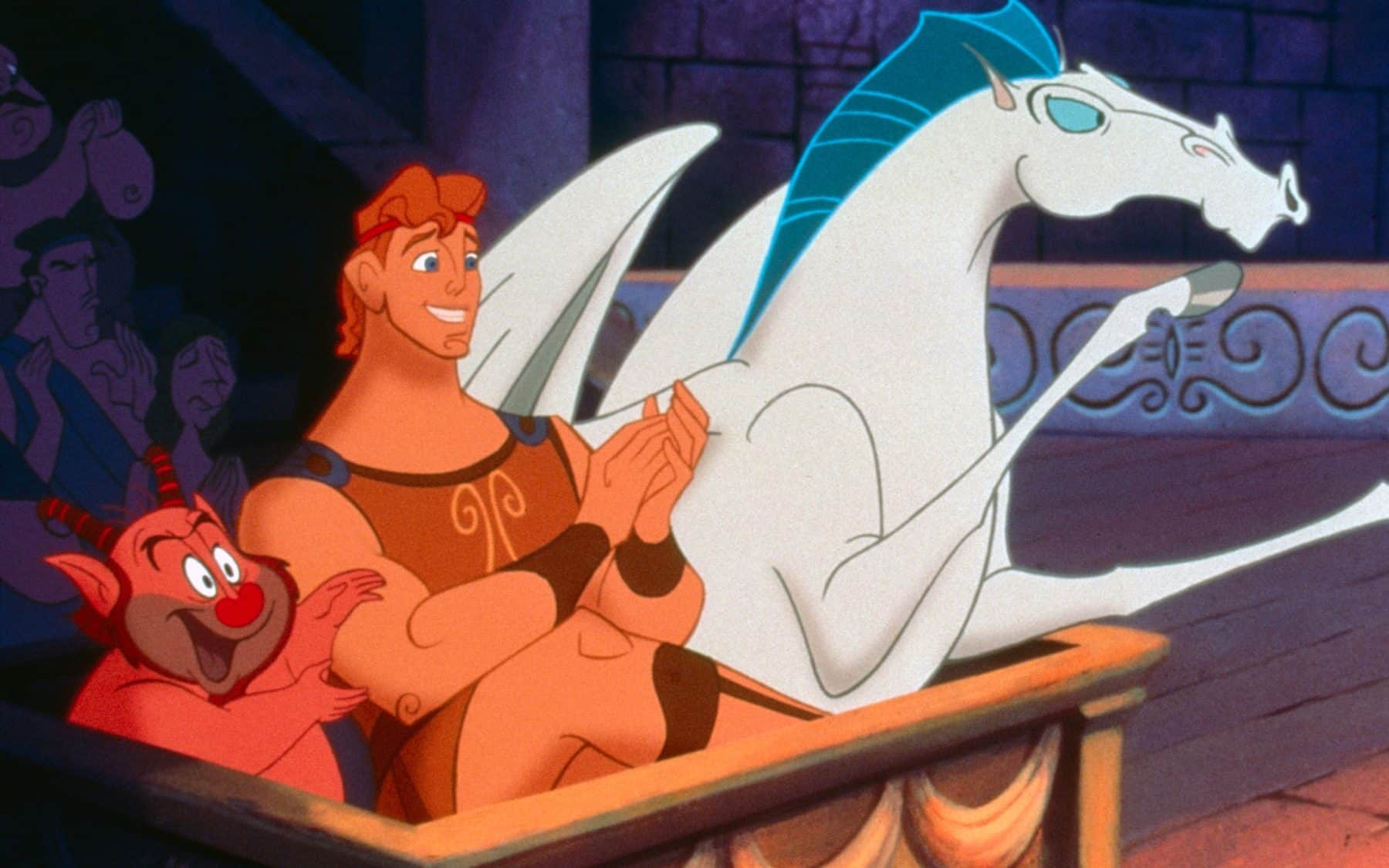
Hercules closes his eyes.
Later, she throws herself across his chest — again, deliberately. He does not lean in. He does not take advantage of her proximity. He reaches over, gently repositions her sleeve back onto her shoulder, and carefully pushes her away.
No lecture. No self-congratulation. No grand speech about virtue. Just a quiet, instinctive act of respect from a young man who had every excuse to behave otherwise — and chose not to.
It is one of the most understated character moments in the Disney animated canon. And it deserves to be talked about far more than it is.
The Summer of the Demigod
Hercules was released by Walt Disney Feature Animation on June 27, 1997, directed by Ron Clements and John Musker — the same pair behind The Little Mermaid and Aladdin. It arrived at the height of the Disney Renaissance, sandwiched between The Hunchback of Notre Dame and Mulan, and it was in many ways the most deliberately playful film the studio had made in years.
The film took considerable liberties with Greek mythology — Hera becomes a loving mother rather than the goddess who tormented Hercules in the original myths, the Muses narrate via gospel choir, and the entire story is filtered through the lens of American celebrity culture and ancient hero worship simultaneously. Phil, the satyr trainer voiced by Danny DeVito, essentially runs a sports academy on a remote island. Pain and Panic are comic-relief henchmen. Hades is a fast-talking Hollywood agent trapped in the underworld.
It was loud, funny, anachronistic, and enormously entertaining. It was also doing something quietly serious underneath all of that.
Clements and Musker were interested in what heroism actually means — not the strength version, not the fame version, not the merchandise version. The entire film is a meditation on the gap between being celebrated and being good. Hercules becomes famous. He gets the action figures and the sandal endorsements and the crowds chanting his name. And the film asks, with genuine seriousness, whether any of that is the point.
The answer it gives, in the end, is that a true hero is not the person who wins the most battles. It is the person who makes the right choice when no one is watching and nothing is at stake — except the dignity of another person.
A true hero isn't measured by the size of his strength, but by the strength of his heart.
— Zeus, Hercules (1997), Walt Disney Feature Animation
Who Meg Actually Is
To understand why those two moments matter so much, you have to understand who Megara is.
Meg is not a damsel. She is not naive. She is not waiting to be rescued. She is, when we first meet her, a cynical young woman who sold her soul to Hades to save a former lover — a man who then left her for someone else. She carries that betrayal like armour. She is funny and cutting and deliberately guarded, and she has decided that the safest policy where men are concerned is to stay one step ahead of them at all times.
When Hades orders her to get close to Hercules, she is not seducing him out of malice. She is doing a job. She is using the tools she has. She has learned, through painful experience, that charm and deflection and a well-timed stretch of the ankle are reliable instruments — because men, in her experience, respond to them predictably.
Hercules does not respond predictably.
He closes his eyes. He straightens her sleeve. He steps back. And in doing so, he does something that Meg has not experienced before: he treats her as a person whose dignity matters, not a body whose attention is a prize to be won.
That is the thing that begins to crack open her armour. Not his strength. Not his fame. Not a grand gesture or a heroic rescue. The thing that reaches Meg is the quiet and repeated experience of being respected. And the film is careful and honest enough to show that it takes time. She does not immediately fall for him. She is confused by him. She does not know what to do with a young man who behaves this way.
What Those Two Scenes Are Actually Saying
The ankle scene and the sleeve scene are separated by enough narrative distance that it would be easy to read them as isolated character beats. They are not. They are a pattern. They are the film building a consistent portrait of who Hercules is when the situation is ambiguous and the easy option is available.
He is not unaware of Meg's attractiveness. The film does not present him as oblivious. He is a young man — physically strong, emotionally earnest, and very obviously drawn to her. The closing of the eyes is not ignorance. It is a choice. The repositioning of the sleeve is not accidental. It is a deliberate act of care for someone who, at that point in the story, he has no particular reason to be careful with.
He does not do it to impress anyone. There is no audience for these moments. They are not public heroism. They are private character — the kind that shows who you actually are when nothing is at stake except how you treat another person.
Clements and Musker built these moments into a film aimed primarily at children, and specifically at young boys who were growing up with a need for models of what a hero actually looks like in ordinary life. Not every situation requires lifting a boulder. Most situations require something harder: deciding how to treat someone when you have power and they are vulnerable, even when vulnerability is being deployed strategically.
What Most People Don't Notice About This
The detail that tends to get missed in both scenes is the absence of reaction from Hercules afterward.
He does not make a point of it. He does not say "I noticed what you were doing and I want you to know I chose not to engage with it." He does not offer a moral commentary. He does not perform his restraint for Meg's benefit or anyone else's. He simply redirects — eyes closed, sleeve straightened, a gentle step back — and moves on. The moment passes. The conversation continues.
This is actually the most sophisticated part of the writing. Making a public show of restraint is its own form of self-interest — it turns someone else's vulnerability into a stage for your own virtue. Hercules does neither. His respect is not a performance. It is just how he moves through the world.
The animators at Walt Disney Feature Animation — working under the supervision of directors of character animation Andreas Deja and Eric Goldberg — built these beats into Hercules' physical movement rather than his dialogue. The closed eyes, the careful hand repositioning the sleeve, the gentle push back: these are body language choices, not script choices. They live in gesture and pantomime rather than words. Which means they work on children who are not yet sophisticated enough to follow complex dialogue — and they work on adults who are sophisticated enough to understand exactly what they are watching.
He does not make a point of his restraint. He does not perform his respect for an audience. He simply closes his eyes, straightens her sleeve, and moves on. That absence of self-congratulation is precisely what makes the moments land — and what separates genuine character from the performance of it.
Why It Still Matters
The Disney Renaissance — roughly 1989 to 1999 — produced a run of animated films that have proven extraordinarily durable as cultural objects. The Little Mermaid. Beauty and the Beast. Aladdin. The Lion King. Pocahontas. Mulan. These films are still being watched by children who were not yet born when they were made, and still being discussed by parents who grew up with them.
Part of that durability comes from the quality of the animation and music. Part of it comes from the stories. But a significant part comes from the values that were embedded — sometimes very quietly — into the characters themselves.
Hercules has always sat slightly outside the inner circle of Disney Renaissance classics in terms of cultural conversation. It is beloved, but it does not carry quite the same weight of cultural reference as The Lion King or Beauty and the Beast. Which is perhaps why those two scenes have never fully received the recognition they deserve.
Because what Clements and Musker built into those moments — and what the animators translated into gesture and movement — is a remarkably precise portrait of what respect actually looks like in practice. Not as a grand declaration. Not as a policy. Not as a lesson delivered by a mentor figure with a speech. Just as a series of small, unremarked choices made by a young man who has decided, without fanfare, that another person's dignity matters more than his own impulses.
That is worth showing to children. It is worth talking about with them. And it is worth noticing — even now, twenty-seven years later — that a summer blockbuster about a demigod with a gospel choir soundtrack took the time to put it in.
For Disney Art Lovers
The Art of Disney: The Renaissance and Beyond — 100 Collectible Postcards
100 collectible postcards spanning the Disney Renaissance era from 1989 to 2014 — the golden age that gave us Hercules, The Lion King, Mulan, and more. Beautiful concept art and iconic scenes from the films that defined a generation. A perfect gift for anyone who grew up with these stories.
Check Price on AmazonThe Point
Hercules closes his eyes. He straightens her sleeve. He steps back. He does not make a speech about it. He does not perform his virtue for an audience. He simply does the right thing, quietly, in a moment when no one would have noticed if he had done otherwise. That is what Disney smuggled into a summer blockbuster in 1997 — not a lesson, but a demonstration. Not a lecture, but a model. And twenty-seven years later, parents are still pausing the film to point at those two moments and say: that. That is what respect actually looks like.
Sources
- Wikipedia — Hercules (1997 film) — en.wikipedia.org
- Wikipedia — Disney Renaissance — en.wikipedia.org
- Walt Disney Feature Animation — Hercules, directed by Ron Clements and John Musker, released June 27, 1997
- Andreas Deja and Eric Goldberg — Directors of Character Animation, Walt Disney Feature Animation (1997)

Maya Thornton is a cultural historian and long-form writer for The Verified Post, specialising in the untold stories behind the films, inventions, and cultural moments that shaped modern life.